Two former employees of a bank based in the Democratic Republic of Congo could face a death sentence after blowing the whistle on the financial institution’s alleged secret networks engaged in money laundering and bypassing international sanctions.
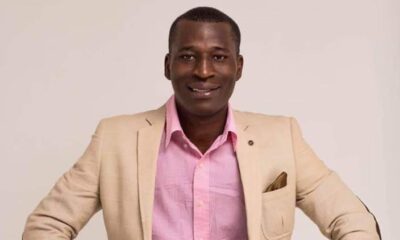
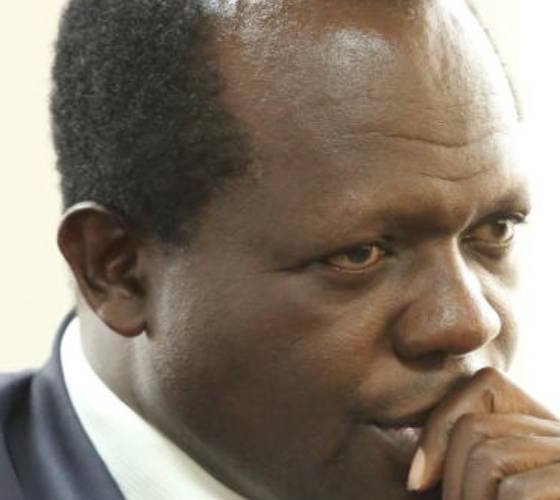
Two former bankers at Afriland risked their lives to expose wrongdoings. (Photo: PPLAAF)
Navy Malela and Gradi Koko came out on Friday to publicly denounce Cameroon-based Afriland First Bank. The two worked for years in the audit department of the bank’s Congolese subsidiary and first revealed their findings internally an then leaked information to NGOs and media outlets.
The Platform to Protect Whistleblowers in Africa (PPLAAF), an NGO that provides legal assistance and secure communication channels to whistleblowers, warned that Afriland’s lawyers said the former workers had been sentenced to death by a court in Kinshasa last September. Both Malela and Koko are exiled in Europe.
Neither PPLAAF nor journalists have been able to trace the judgement the lawyers referred to in a press conference held in Kinshasa on Thursday. However, the organization said that if the sentence is real, then it would represent a violation to Malela and Koko’s fundamental rights.
The bank’s lawyers also accused the whistleblowers of re-launching a defamatory press campaign alongside PPLAAF and US-based NGO Global Witness, which published a report based on the employers’ revelations in July last year.
“It would be incredible if whistleblowers are being sentenced to death without having the opportunity to defend themselves, while those who enable the Congolese people’s money to disappear are not being prosecuted,” Navy Malela said in a statement.
Last year, both whistleblowers revealed that Israeli mining billionaire Dan Gertler allegedly crafted a money laundering web to circumvent U.S. sanctions and acquire mining assets in the DRC.
According to Afriland’s former employees, the bank allowed Gertler’s associates to convert millions of dollars in cash into euros and later deposit the money into accounts of individuals or shell companies connected to the Israeli mogul. One of these companies reportedly received loans of tens of millions of euros from the DRC-based subsidiary.
The revelations also showed that high-ranking Congolese politicians and political institutions reportedly had accounts at Afriland, and some of them made transactions of up to several million dollars in cash.
The statement distributed by PPLAAF reports that millions of dollars were withdrawn from the Congolese Senate account in 2018 and 2019 during the country’s electoral process.
“We call on the Congolese authorities to launch investigations into these acts and on President Tshisekedi to promote mechanisms to protect whistleblowers, as he recently announced,” PPLAAF spokesperson Gabriel Bourdon-Fattal said.
Foreign Corrupt Practices Act scrutiny can arise in a variety of ways. Although not common, occasionally (see here for a prior example) a short seller (generally speaking an investor hoping to profit if a company’s shares fall) alleges that a company is engaged in corruption.
Recently, Hindenburg Research issued this lengthy report suggesting that Ormat Technologies (a Nevada-based geothermal power company with shares traded on the New York Stock Exchange that owns and operates power plants in Kenya, Guadalupe, Guatemala, Honduras and the United States)”has engaged in what we believe to be widespread and systematic acts of international corruption.”
In pertinent part, the report states:
Immediately prior to their work at Ormat, several senior Ormat executives and directors worked at Shikun & Binui, a leading Israeli construction company. Shikun & Binui was recently charged by Israeli prosecutors with bribing officials in what are now two of Ormat’s key markets, Kenya and Guatemala.
Ormat’s General Counsel & Chief Compliance Officer, along with an Ormat director, are under pre-indictment in Israel. This is a formal stage of prosecution just prior to indictment. Ormat has apparently chosen not to disclose that the two are currently in the midst of a criminal prosecution. Both still serve in senior oversight roles at Ormat.
Ormat CEO Doron Blachar’s immediate prior work experience was serving as CFO at Shikun & Binui. The CEO during Blachar’s entire tenure at Shikun & Binui was arrested in 2018 over the above-referenced bribery allegations. It is unclear whether Blachar faces eventual risk of indictment as well.
International electricity projects contributed to 70% of Ormat’s 2020 net income—the vast majority of which is comprised of Kenya, Guatemala, and Honduras. We have uncovered evidence tying Ormat to corruption with senior government officials in this lucrative international business.
For example, multiple former Ormat employees and business partners have revealed how Ormat routes sales of energy assets in Guatemala through an undisclosed related party entity. Guatemalan corporate records corroborate these claims.
The entity shares an address with several Ormat subsidiaries and was set up by a former Ormat senior employee-turned “independent” consultant who answers directly to senior Ormat leadership, according to the former employees.
Official corporate records show that the same Guatemalan entity funneled energy rights to two senior government officials who were responsible for approving Ormat’s original deal in the country; the former head of the Mines & Energy Ministry and the former head of the state utility company.
We believe this is direct evidence tying Ormat to corruption with senior Guatemalan government officials.
Another Guatemalan Mines and Energy Minister, who was in office when Ormat was later awarded major improvements to its contract, was fired and charged with corruption by the United Nations-created anti-corruption commission. He is currently on the run with an outstanding international arrest warrant.
Ormat’s operations in Kenya contribute “disproportionately” to the company’s bottom line, generating an estimated ~41% of the company’s FY 2020 net income. Its customer is the Kenya state power company.
A politically-connected businessman admitted to us that he “opened the doors” for Ormat in Kenya and got the go-ahead for the project after an in-person meeting with the Kenya Power boss (who was later charged with corruption) and former President Daniel Arap Moi, widely regarded as one of Kenya’s most corrupt leaders.
We present documents showing that Ormat paid contractors in Kenya tied to corrupt government officials, including one run by the son of the former President Daniel Arap Moi along with others run by his documented front-men.
The head of the Kenyan state-backed utility who oversaw the original contract with Ormat, as well as the energy minister at the time, were later found to have demanded millions of dollars in bribes to allow international power companies to do business in Kenya.
Two former CEOs of Ormat’s Kenyan customer (the state-backed utility) were subsequently arrested in 2018 and more than a dozen top managers were arrested or accused of crimes relating to corruption.
The same state utility customer, responsible for driving Ormat’s “disproportionate” financial success in the country, is reportedly “broke” and “technically insolvent”, posing another threat to Ormat’s most lucrative market.
In Honduras, Ormat charges the state energy company roughly the same rate as end customers pay, virtually guaranteeing a loss for the state. These rates make no economic sense.
The power agreement assumed by Ormat in Honduras was signed within days of other uneconomical agreements that were signed by the then head of the state utility, who is now under investigation for corruption relating to those agreements.
We found that an opaque Panamanian entity with no public presence, formed the day after the Honduran coup, registered to unnamed nominee directors, was inserted into the deal. We have submitted a FOIA request to a U.S. agency and are awaiting imminent release of records relating to the entity.
Ormat’s Honduran plant operates in Copan, known as drug cartel territory. A Honduran congressman told us “You can’t operate in Copan without paying the cartels, the gangs or corrupt politicians – and sometimes all three.”
We found that Ormat’s contractor in Honduras was raided by authorities on suspicion of being a front company for drug cartels. Its owners are in jail awaiting trial.”
In response to Hindenburg’s report, Ormat issued this statement:
“Hindenburg is a self-proclaimed short seller who we believe stands, along with its clients, to realize significant gains in the event that Ormat’s stock price declines.
Hindenburg’s claims are inaccurate and filled with innuendo in an attempt to mislead investors about Ormat.
We have been providing clean renewable energy in Kenya, Honduras and Guatemala for many years, supporting local communities. Our facilities are financed by numerous leading multinational banks, which conduct extensive due diligence on the Company and its operations prior to entering into lending agreements. We are committed to conducting all of our business according to the highest ethical standards, and we have clear policies in place to ensure our people and our partners act accordingly and consistent with all applicable laws and regulations.
The Company is aware of claims being investigated in Israel regarding Ravit Barniv, an Ormat Board member, and Hezi Kattan, the Company’s General Counsel and Chief Compliance Officer. The claims involve Ms. Barniv’s and Mr. Kattan’s work at another company, prior to joining Ormat. Those claims remain subject to a governmental hearing that may take time to conclude and Ormat is monitoring the process closely.
On February 24, 2021, the Company’s Board of Directors determined that, at this time, it would be prudent to transfer the responsibility for the Company’s compliance function to other members of the Ormat management team until these issues are resolved. In addition, Ms. Barniv told the Board of Directors that she believes that investor attention should be focused on Ormat’s strong performance and future prospects. Accordingly, she has decided not to stand for reelection at the upcoming Annual Meeting expected in May.
Ormat is a global leader in geothermal energy. As the only vertically integrated company in our industry, Ormat is uniquely positioned to serve customers from plant design to supply and development of geothermal, recovered energy, and energy management and storage solutions.
Ormat’s Board of Directors and leadership team are confident in the Company’s strategy. Our strong performance shows that we are on the right path for long-term success and to continue the Company’s growth trajectory. We are focused on capitalizing on our momentum – even in light of the COVID-19 pandemic – and will continue to serve and act in accordance with our values, high ethical standards and in our shareholders’ best interests.”
Upon release of the Hindenburg report, shares of Ormat dropped and as predictable as the sun rising in the east and dogs barking, plaintiffs’ firms representing shareholders began to mobilize.
On March 1, 2021, before the market opened, Hindenburg Research published a report entitled “Ormat: Dirty Dealings in ‘Clean’ Energy.” According to the report, the Company “has engaged in what we believe to be widespread and systematic acts of intentional corruption,” adding that it “expect[s] the blowback to these revelations to be severe, threatening Ormat’s contracts in its most lucrative markets.” The report alleges that Hindenburg “uncovered evidence tying Ormat to corruption with senior government officials,” and “direct evidence tying Ormat to corruption with senior Guatemalan government officials” further noting “Ormat paid contractors in Kenya tied to corrupt government officials.”
On this news, Ormat’s stock price fell $1.00, or 1.1%, to close at $84.67 per share on March 1, 2021, thereby injuring investors.
The same day, after the market closed, Ormat responded to the report and acknowledged that “[t]he Company is aware of claims being investigated in Israel regarding Ravit Barniv, an Ormat Board member, and Hezi Kattan, the Company’s General Counsel and Chief Compliance Officer.” Though the “claims involve Ms. Barniv’s and Mr. Kattan’s work at another company, prior to joining Ormat,” the Company announced that it would “transfer the responsibility for the Company’s compliance function to other members of the Ormat management team until these issues are resolved.”
On this news, Ormat’s stock price fell $1.68, or nearly 2%, to close at $82.99 per share on March 2, 2021, thereby injuring investors further.
Immediately, The Law Offices of Frank R. Cruz announced an investigation of Ormat Technologies, Inc. (“Ormat” or the “Company”) on behalf of investors concerning the Company’s possible violations of federal securities laws.
The country is set to launch a national immunization campaign following the arrival of the much-awaited coronavirus vaccines.
The fight carrying the 1.02 million doses under the Vaccines Global Access (COVAX) program landed at the Jomo Kenyatta International Airport (JKIA) shortly before mid-night. The consignment was received by top government officials led by Health Cabinet Secretary Mutahi Kagwe, Transport CS James Macharia and CS Margaret Kobia.
The vaccines arrived at the JKIA Tuesday night aboard a Qatar Airways flight QR1341.
While addressing the media, Health Cabinet Secretary Mutahi Kagwe termed the arrival of the vaccines as “exciting moment for our nation” saying that the country had been fighting the virus with rubber bullets.
“This is an exciting moment for our nation. We are excited about the particular event which is receiving the vaccines country. We have been fighting the virus with rubber bullets,” he said excitedly.
“The war has changed. This is a game changer on the war on Covid-19 disease in the country,” he said.
Kagwe noted that the vaccination will be a voluntary process adding that the WHO has advised countries to have a third of their populations vaccinated.
CS Kagwe said that the Health Ministry will roll out of the vaccines which will begin with the regional hospitals and level 2 hospitals.
The Ministry of Health expects to vaccinate over 15 million Kenyans from the virus.
Top on the list of those who have been lined up the receive the jab during the roll out of the inoculation program are front-line workers, who will include the teaching and non-teaching fraternity, the uniformed forces and the immigration officers.
According to the Health CS, the 1.02 million doses will be the first batch of the 4.1 million expected in Kenya, with the country ultimately planning to import 24 million doses.
The Ministry of Health has already initiated discussions with the National Treasury that could see funds availed to procure freezers that will store the vaccine at -70°C.
Sources also indicate that the ministry intends to extend request for additional funds for vaccine storage facilities that can achieve -20 degrees Celsius and store up to 20 million vials.
What you need to know about AstraZeneca Vaccine
Last month, the World Health Organization (WHO) Strategic Advisory Group of Experts on Immunization (SAGE) issued interim recommendations for use of the Oxford/AstraZeneca COVID-19 vaccine (AZD1222).
Those aged above 18 years can be administered the vaccine including those aged 65 and above.
While the vaccine supplies are limited, it is recommended that priority be given to health workers at high risk of exposure and older people.
The vaccination is also recommended for persons with comorbidities (presence of two or more diseases in a patient) that have been identified as increasing the risk of severe COVID-19, including obesity, cardiovascular disease, respiratory disease and diabetes.
Vaccination can be offered to people who have had COVID-19 in the past.
Vaccination can be offered to breastfeeding women if they are part of a group prioritized for vaccination. WHO does not recommend discontinuation of breastfeeding after vaccination.
While pregnancy puts women at higher risk of severe COVID-19, very little data are available to assess vaccine safety in pregnancy.
Health CS Kagwe receiving the first batch of COVID-19 vaccines at JKIA.
Who is the vaccine not recommended for?
People with a history of severe allergic reaction to any component of the vaccine should not take it.
The vaccine is not recommended for persons younger than 18 years of age pending the results of further studies.
Higher Education Loans Board (HELB) and Safaricom (NSE: SCOM) has today partnered with to roll out a smart mobile payment solution for students of tertiary institutions to access and utilise their loans and bursaries.
The solution will aid HELB to promote responsible spending with the funds locked for specific allocations, such as tuition or library fees only accessible to the specific Paybill account of the recipient’s University or TVET institution. The students upkeep allowance can now also be transferred into the student’s M-PESA wallet for everyday use.
“Technology today is not only revolutionizing every aspect of our lives but also creating opportunities to enhance efficiency and accountability. We are pleased to support the Higher Education Loans Board to deploy a solution that suits the digital lifestyle of students in tertiary institutions,” said Sitoyo Lopokoiyit, Chief Financial Services Officer, Safaricom.
Students can access the system through HELB USSD and the mobile app once completed from where they will view their loan allocations, current balances, statements and make payments.
HELB disburses over KSh. 15 billion to over 200,000beneficiaries annually. Part of the loan is usually channeled directly to the learning institution to settle part of the tuition and accommodation fees while the rest is sent to the student for upkeep.
The solution will create efficiencies for all stakeholders by reducing queues during registration as students can now pay through their mobile phones. There will be effective management and monitoring of all loans throughout the loan lifecycle.
“The rollout of this smart solution marks a major milestone in our digitization journey. It not only enhances efficiency in our operations, but also enables us to step up the experience of beneficiaries, who are digital natives. The solution will allow the student to access and make transactions within the solution’s ecosystem,” said Charles Ringera, HELB’s Chief Executive Officer.
The platform grants HELB visibility of funds from various sources, which it can aggregate, reconcile real-time and report to its financiers. Continuing students can receive notifications and utilize a financial planning tool on the portal; while those who have graduated can track their repayments and generate statements.
The government has spruced up efforts to safeguard the Savings and Credit Co-operative (SACCO) movement in the country by establishing the Sacco societies’ fraud investigation unit aimed at boosting investor confidence in the subsector.
Agriculture, Livestock, Fisheries and Cooperatives Cabinet Secretary (CS) Peter Munya said that following the presidential directive for the establishment of the Sacco societies’ fraud investigation unit within the Sacco Societies Regulatory Authority (SASRA), the unit has been established and is now fully operational.
Speaking at a Nairobi hotel on Wednesday during a stakeholders forum on the Cooperatives Sector 2020 Regulations, Munya explained that the unit comprises specialised officers seconded from the Directorate of Criminal Investigations (DCI) and is functionally supported by SASRA’s technical staff.
“So far I have been informed that the fraud unit has finalised an investigation, caused an arrest and prosecuted a fraudulent embezzlement including recovery of over Sh1.3 million from the suspect and there are many other investigations and actions being taken,” highlighted the CS.
He added that the unit has done a fantastic job including preventing fraud and closing in on Saccos which are pyramid schemes that are presented to unsuspecting members of the public who would want to invest their money.
“We are in the process of strengthening this unit so that it has the capacity to investigate and have a bigger reach and support Sasra in implementing its mandate of making sure that depositors’ money is safe,” said Munya.
He encouraged members of the public to desist from joining and transacting with unregistered and unregulated entities particularly when it involves their savings and they should undertake due diligence on any entity purporting to be a Sacco.
“Kenya Sacco sub-sector is ranked first in Africa in terms of assets, members and deposit mobilization and therefore prudent measures are necessary to safeguard the member’s interest,” he said.
Munya added that the non-deposit taking Saccos targeted under the new regulations are those with over Shs.100 million in members savings estimated to be 300 from the 3, 626 reported as at December 31, 2019 and they account for 70 percent of the Shs.188 billion in assets and Shs.140 billion in deposits.
“Saccos are an integral part of the deposit taking and lending market in Kenya providing financial services to over six million households across various sectors of the economy and it is for this reason my ministry had been driving policy reforms to enhance the governance and financial soundness and sustainability of the Sacco industry in Kenya,” said Munya.
He added that the reforms are consistent with the policy development articulated in the Cooperative development policy approved by the Cabinet in 2019.
The CS explained that the regulations have given priority to the setting up of the Central Liquidity Facility (CLF) and shared technology platform, operationalisation of the deposit guarantee fund for Saccos, establishment of the Sacco fraud investigations unit and prudential supervision of the Non-deposit taking Saccos.
“The CLF will facilitate cooperation among Saccos through pooling of liquidity and connected services to enhance the financial soundness and competitiveness of the Saccos as deposit taking institutions,” explained the CS adding that there are over 50 Saccos which are working with the regulator on this initiative and have already drafted bylaws guiding the CLF and shared service business among them.
He explained that the aim is to ensure that there is good governance in the cooperatives movement as it is one of the greatest challenges bedeviling the sector.
“My interaction with members of cooperatives shows that we have a very big gap where they keep blaming the government while it is actually the weak governance structures of the cooperatives that have an issue where the officials misappropriate member’s funds,” said Munya.
The CS also sounded a warning to housing cooperatives saying that this is where there is a lot of room for misuse of peoples’ savings because most of them start as Saccos and when they grow they open other organisations they call housing companies so that they move away from regulations.
“Kenyans love to buy land and unsuspecting members of the public have been making investment decisions based on advertisements they hear over the radio, and when they lose their money they have had nowhere to turn. We want to look into these housing cooperatives and streamline them because we have seen people losing their money invested in imaginary projects,” said Munya.
Insurance group Britam Holdings #ticker:BRIT is set to retrench up to 130 employees, mostly in its Kenyan operations in a process that could cost it up to Sh700 million.
This is the second wave of layoffs at the company, which spent Sh664 million to let go of 110 employees in 2018.
The new retrenchment kicked off on February 26 and will run until the end of May, featuring a voluntary early retirement (VER) programme and the elimination of some roles, including 10 top executive positions.
Britam says the move has been necessitated by the company’s financial and share price underperformance relative to its peers, adding that its current staff costs remain bloated.
“Over the past few years Britam has been plagued with inconsistent results performance that has heavily impacted on its perception amongst the investing community, thereby keeping its share price depressed,” the Nairobi Securities Exchange-listed firm said in a statement.
“There is a need to address both the inconsistent market approach and high operating costs to ensure a more credible results performance in future.”
The insurer added that the remuneration of employees accounts for half of its operating costs.
The company says it could cut 10 to 15 per cent of its total workforce which stood at 923 in December 2019, according to the latest available disclosures.
This places the estimated job cuts at 138. Most of the layoffs will be in the Kenyan operation – its biggest and which employed 624 people or 67.6 per cent of the total staff count at the end of 2019.
Britam says employees whose roles have been affected by the restructuring are eligible to apply for the VER (early retirement).
The exit package includes compensation for accrued leave days, the balance of medical cover for 2021 and notice pay as per individual contracts.
The company also said it would make ex-gratia payments above the statutory minimum of 15 days for each year of service, subject to board approval.
Those who would not have applied and their roles impacted by the restructuring will lose out on some of the benefits and will be given a one-month redundancy notice.
The company spent a total of Sh3.9 billion on staff costs in the year ended December 2019, eating 10.7 per cent of the total income of Sh36.4 billion in the period.
The loss was largely caused by paper losses on its listed equities investments, including stakes in Equity Group and HF Group as the Covid-19 pandemic intensified the bear run on the Nairobi bourse.
The new retrenchment is being implemented under the leadership of the new chief executive Tavaziva Madzinga who was appointed on February 1, replacing Benson Wairegi who had been with the company for four decades.
Mr Madzinga, a Zimbabwean national who previously served as the chief executive of Old Mutual’s Kenyan business, has been tasked with boosting returns for Britam’s shareholders.
Britam has grown shareholder wealth by nearly two per cent, including dividends since its initial public offering in September 2011 when it went public at an offer price of Sh9 per share.
The Kenya Bureau of Standards (Kebs) has suspended 27 brands of consumer tissue whose products such as toilet paper and handkerchiefs it said are substandard.
Kebs managing director Bernard Njiraini said the firms had not complied with Kebs standards including those that prescribe the quality of products.
“They have not complied with various parameters including quality,” said Mr Njiraini in response to Business Daily queries.
Kebs subsequently asked retailers to withdraw the 27 brands from their stores with immediate effect.
“Following market surveillance on toilet paper brands in circulation around the country Kebs detected non-compliances with the requirements of the Standards Act Cap 496, Laws of Kenya,” said Kebs director of market surveillance Peter Kaigwara in a letter to the Retail Traders Association of Kenya (Retrak) chief executive Wambui Mbarire.
“We request your good office to notify your members to withdraw these brands from your outlets across the country until further notice.”
Some major brands among those banned include Cosy by Kim Fay Limited, Poshy by Jubilee Tissue Industries, Bloom by Tissue Kenya Limited, Tosha by Interconsumer Products, Peacock by Twiga Stationers and Printers, and Tulip by Phoenix Paper Ltd.
Others are Imara by Purex Holdings, Sofken by Ameriken Limited, Law Prima Kenya and Uno by UAE, Sunrise by Mikeline Ltd and Meek and Lucao both by Benco investment.
Retrak CEO Wambui Mbarire said retailers had already complied with the Kebs order.
“Yes (we have complied),” she said in response to Business Daily queries.
Other brands affected by the order include Best by Zaam industries, Rapras by Rapra Limited, Tiny by Tim Trade, Mwangaza by Amonah Ltd and Jambo by Zaam.
Also included in the list includes Violet by Phoenix, Purex, Lona and Taji by Nasco Paper, Stelly by Newstelly Ltd, and Nice one by UR Home International.
Mr Njiraini said among breached standards by the firms include health and safety aspect where Kebs warned some of the products could cause spread of diseases, PH- Low and high where Kebs warned some products could cause burns and bruises to the body tissues.
Some tissues breached the moisture content standard with high moisture content that could encourage proliferation of microorganisms.
At the same time some products breached standards for dimensions, grammage, number of sheets per roll, perforation and tensile strength.
Days after reports emerged that the construction of East African Crude Oil Pipeline (EACOP) project was set to commence in the second week of March, a new development has surfaced.
More than 260 organisations have urged banks not to finance the $3.5 billion project, saying the project could lead to the loss of community land and livelihoods, environmental destruction and surging carbon emissions.
Ryan Brightwell, a researcher and editor at the finance and sustainability NGO BankTrack said that they have informed banks on the consequences of funding the mega crude oil pipeline project.
In an open letter, organisations from 49 countries, including 122 African-based organisations, detail the immense threats that the 1,445-kilometer-long East African Crude Oil Pipeline (EACOP) would pose to local communities, water supplies, and biodiversity in Uganda, Tanzania, Democratic Republic of Congo and Kenya.
They also warn that the pipeline – proposed by French oil company Total and the China National Offshore Oil Corporation – will fuel climate change by transporting oil that will generate over 34 million tons of carbon emissions each year.
The letter to the three banks acting as financial advisors for the project – Standard Bank, Sumitomo Mitsui Banking Corporation, and Industrial and Commercial Bank of China – and 22 banks that have recently provided finance to Total and CNOOC, comes as speculation mounts that a Final Investment Decision (FID), which would commit Total to mobilize capital for the project, is imminent.
Nearly a third of the pipeline will run through the basin of Africa’s largest lake, Lake Victoria – which more than 40 million people depend on for water and food production. It will also cross more than 200 rivers, run through thousands of farms and cut through vital wildlife reserves.
The pipeline is expected to cost around $3.5 billion. Of this, about $2.5 billion will be borrowed from banks and other financiers. It is not yet clear which banks intend to participate, although the three banks acting as financial advisors are likely to join and act as lead arrangers.
The UK’s Export Credit Agency, UK Export Finance has also confirmed that it has been approached for a project loan, although the agency is consulting on timing around a recent announcement to end finance for fossil fuel projects overseas.
Signatories to the open letter included Friends of the Earth International, 350.org, the Catholic Agency for Overseas Development, Reclaim Finance, Sierra Club, Global Witness, the IUCN National Committee of the Netherlands, BankTrack, Africa Institute for Energy Governance (AFIEGO) and Inclusive Development International (IDI).
Several organisations that played prominent roles in fighting North American pipelines including the Dakota Access Pipeline (DAPL) and Keystone XL also signed the letter, including Indigenous Environmental Network and Divest Invest Protect. African environmental and human rights law NGO Natural Justice, a signatory, described efforts to stop EACOP as Africa “facing its own Standing Rock moment”.
The 263 organisations are demanding that Total provides full and fair compensation to communities already affected by the project, and are calling on banks to publicly rule out providing any funding to the construction of the pipeline and work with governments and other financiers to promote a sustainable energy future for East Africa based on clean alternatives instead of oil.
And the letter has already started bearing fruits. Standard Bank Group Ltd. has hired an independent adviser to help assess its involvement in the project, according toBloomberg.
“A full environmental and social due diligence report” will be issued after the advisers visit the project area, Standard Bank, which acknowledged receipt of the letter, said in an emailed response to questions.
An investigative report published by The Guardian reveals that British American Tobacco (BAT) is using influencers to promote its products online. The report exposes BAT’s efforts to market its next generation products in Kenya, citing the East African country as one of its “most exciting trial markets’.
Compelling evidence affirms BAT and other tobacco multinationals’ historical denial of targeting the younger generation.
These reports by The Guardian and The Bureau, further prove that not only does BAT lie about targeting young people, it does so deliberately, with the intention of boosting its sales even if it means getting young people hooked to tobacco, which is harmful to human health.
BAT’s exciting opportunity in Kenya as noted in the report by The Guardian focuses on the sale of its oral nicotine pouch, Lyft, via online retailer Jumia, where it was categorized as a party product. On another website, customers were directed to products they might also like, such as Dunhill and Sportsman cigarettes.
Concerned about the report by The Bureau, BAT-hired public relation firm Engage BCWattempted to bribe a reporter for inside information on its content. Even though BAT has disengaged the agency since the incident, this situation is yet another reminder that the tobacco industry will stop at nothing to achieve its known objective of making profits, even at the detriment of public health.
Cris Achola, BAT Kenya Managing Director.
Marketing tobacco products online through influencers is a flagrant violation of Article 13 of the WHO Framework Convention of Tobacco Control (FCTC) which requires parties to undertake a comprehensive ban of all tobacco advertising, promotion and sponsorship.
The African Tobacco Control Alliance (ATCA) condemns this action by British American Tobacco, as well as the bribery attempt by its former public relation agency.
“We congratulate the Kenyan government for its continuous efforts to guarantee the wellbeing of its population and call for more actions to fully implement the WHO Framework Convention on Tobacco Control (FCTC).” The body says in part.
ATCA has also called for a massive mobilization of civil society to denounce these tobacco industry tactics. They urge the tobacco control community to remain steadfast in its tobacco industry monitoring and response efforts.
A director of a insurance company was arraigned before a Nairobi court to face charges of stealing Sh 4 millions by agent.
Cecilia Bridget Rague who is also the CEO of Underwriting Africa Insurance Brokers appeared before Milimani Chief Magistrate Martha Mutuku but did not plead to the charges.
The magistrate differed the plea to a further date to enable firm through the Investigating officer in the case to arrest co-directors of Rague who are still at large.
According to a charge sheet filed in court Rague and Underwriting Africa Insurance Brokers are accused that on December 6,2019 at NCBA Westlands branch in Nairobi jointly with others not before court being the agents of Sanlan General Insurance limited they stole Sh. 4,659, 934 million the property of Sanlan General Insurance limited which had been trusted to them by remittance as reinsurance premiums to continental reinsurance Ltd.
They are also accused that on the same dates at NCBA Westlands branch in Nairobi jointly with others not before court being agents of Sanlan General Insurance Ltd stole Sh 2, 011,760 Million property of the said company which had been entrusted to them for remittance s reinsurance premiums to Ghana reinsurance Ltd.
The duo are further accused of stealing Sh 2,427,160 property of the Sanlan General Insurance Ltd which had been entrusted to them for remittance as reinsurance premiums to CICA reinsurance.
Rague and company other representative will appear before Milimani Chief Magistrate to plead to the five charges of stealing by agent next month
by Aisha Kehoe Down (OCCRP), Seydou Traore (CENOZO), Gaston Sawadogo (L’Evenement), and Tom Stocks (OCCRP).
Billions of cigarettes, most made by BAT, are smuggled north through Mali every year on their way to the gray markets of the Sahel and Northern Africa.
Stashed inside pickup trucks and guarded by armed militias and jihadists, every year billions of illicit cigarettes wind their way through the lawless deserts of northern Mali bound for the Sahel and North Africa.
The profits from their long journey fuel north Mali’s many armed conflicts, lining the pockets of offshoots of al-Qaida and the so-called Islamic State (IS) group, as well as local militias, and corrupt state and military officials. This violence is now spilling out across West Africa, displacing more than two million people in Burkina Faso, Chad, Mali, and Niger.
Cigarettes made by one of the world’s largest tobacco companies, British American Tobacco (BAT) and distributed with the help of another major, Imperial Brands, through a company partially owned by the Malian state, dominate this dirty and dangerous trade.
Now an investigation by OCCRP can show this is no accident.
Secrets contained in leaked documents, backed up by trade data and dozens of interviews with insurgents, former BAT employees, experts, and officials, show BAT started to oversupply Mali with clean-labelled cigarettes soon after the north fell to militants, knowing that its product would be fodder for traffickers.
For years the company partnered with Mali’s state-backed tobacco company, a subsidiary of Imperial Brands, to distribute cigarettes in regions controlled by rebel militias and throughout the country. Sources say these cigarettes, trucked north with the help of the military and police, then fall into the hands of jihadists and militias. An internal document suggests BAT used informants in West Africa to keep abreast of the workings of the illicit trade.
Credit: Edin Pasovic/OCCRP
The dirty business goes well beyond the desert. OCCRP’s reporting found the Malian government not only helps to distribute BAT’s cigarettes, but also apparently turns a blind eye to gross accounting irregularities at its partner Imperial and even possible trade fraud.
And it continues today. Public trade data and expert analysis show BAT and Imperial continue to oversupply the country with billions more cigarettes than it needs. Meanwhile, BAT’s annual revenue in 2019 alone exceeded the total GDP of Mali and Burkina Faso.
The Malian case is the latest to show the world’s leading tobacco companies are not always abiding by the terms laid out in a series of historic agreements between 2004 and 2010 with the European Union (EU), in which they agreed to prevent their cigarettes from falling into the hands of criminals by only supplying legitimate demand. The agreements were concluded in the wake of legal disputes between three companies and the EU over cigarette smuggling.
“This is their playground,” Hana Ross, a University of Cape Town economist who researches tobacco, said of the industry.
“They know they can get away with stuff. It’s much easier to bribe. It’s much easier to cheat the system,’’ she said. “Governments here are generally weak. This is where they do things that they don’t dare to do in Europe anymore.”
A spokesperson said BAT was opposed to the illegal trade in tobacco, which the company called a “serious, highly organized crime.”
“At BAT, we have established anti-illicit trade teams operating at global and local levels. We also have robust policies and procedures in place to fight this issue and fully support regulators, governments and international organizations in seeking to eliminate all forms of illicit trade.”
Imperial said it is committed to ensuring high standards of corporate governance and “totally opposed to smuggling which benefits no-one but the criminals involved.”
The Malian government did not respond to requests for comment for this story.
Credit: AP Photo/Rebecca Blackwell Malian soldiers traveling in convoy across the desert arrive at the entrance to Kidal in northern Mali.
The Tobacco People
In the deserts of northern Mali, cigarette smugglers are called “kel tabac,” the tobacco people.
Illicit cigarettes from the capital, Bamako, and ports in Guinea, Benin, and Togo are loaded into convoys with armed guards and driven north along thousands of kilometers of winding roads and desert tracks to Libya and Algeria, and as far east as Sudan.
Smuggling has long been a part of life in the vast and largely empty Sahel region, where armed insurgents claim a patchwork of ever-shifting territories. Jihadist movements linked to al-Qaida and IS, Tuareg separatist forces, and local ethnic militias take turns controlling roads and checkpoints along the way.
Moving illegal tobacco is a difficult and dangerous job, with trips taking between three and 10 days. Many truckers are killed by military or armed groups along the way. But it is well-paid: In a country where most people live on less than $1.90 per day, drivers can expect to earn between 6,000 to 10,000 euros for moving a load of contraband cigarettes.
It is also a lucrative trade for the drug lords and corrupt local officials in Mali’s restive northern regions.
Hama Ag Sid Ahmed, spokesman for the National Movement for the Liberation of Azawad (MNLA), an armed Tuareg independence movement that has controlled much of northern Mali on and off, said state officials and organized crime work together to profit from smuggling.
“Certain military officers, members of the intelligence services, heads of military zones in the northern regions are approached by drug lords,” he said.
“Large sums of money are paid for a contract related to a service rendered or to be rendered.”
A former tobacco industry insider said various militant groups, from the Tuareg separatists who have been fighting the Malian state for decades to the more recent offshoots of IS jihadists, also take a cut along the way.
“Product is escorted north by the Malian army or the gendarmerie [police], to protect it from so-called bandits,” said the former official, who would only speak on condition of anonymity due to safety concerns. “It would be given to the Tuareg for the trip onwards near Timbuktu, and then the Tuareg looked after paying IS in the Sahel.”
With the continuing violence and lawlessness, Malian customs have abandoned much of the north. Samba Ousmane Touré, an ex-employee of BAT’s distributor in Mali who is now a member of the country’s tobacco control committee, said armed groups have become the gatekeepers of the smuggling routes towards Algeria, Libya, and Niger.
“Armed groups play the role of customs,” he told OCCRP. “Yes, [BAT] knows.”
?Mr. Marlboro
One of the most high-profile jihadists in northern Mali, an al-Qaida operative known as Mr. Marlboro, is thought to have financed his jihad by smuggling cigarettes.
The one-eyed Mokhtar Belmokhtar allegedly orchestrated terror attacks, including one in Algeria in January 2013 that killed more than 35 people. He led the so-called Those Who Sign in Blood Battalion. In June 2013, U.S. authorities offered a reward of up to $5 million for information leading to Belmokhtar’s location.
His battalion had ties to key Malian armed groups, reportedly providing crucial military assistance to the terrorist group MUJAO against the MNLA during the battles of Gao and Timbuktu. A senior U.S. official said in July 2013 that Mr. Marlboro “has shown commitment to kidnapping and murdering Western diplomats and other civilians.” One such hostage was the former U.N. Niger envoy Robert Fowler.
Sid Ahmed, the spokesperson for the MNLA, said many terrorists like Belmokhtar started out trafficking cigarettes before moving onto harder substances, and then to violent jihad.
“The Arab drug barons created armed militias to protect their drugs and which later developed into the terrorist organizations that are present today in the Sahel region,” he said.
Research from The Global Initiative Against Transnational Organized Crime argues the long established smuggling networks in Mali and the Sahel evolved “first to move illicit cigarettes, later hashish and then, most profitably, cocaine.”
A 2017 KPMG report agrees, noting that the region’s cocaine trade overlays routes originally used to smuggle cigarettes, and that illicit trade “can also intersect with the operations of terrorist groups.”Illicit trade is “an important component of the local political economies” of Mali and other countries in the Maghreb, said the report, which was sponsored by Philip Morris, though it claims the trade is fueled by illicit cigarettes from free-trade zones in the United Arab Emirates.
Raoul Setrouk, who is pursuing a court case against BAT competitor Philip Morrisin the state of New York for intellectual property theft, said that illicit tobacco in the region has consequences that go far beyond health and tax issues.
“I hope we don’t have to wait for a new Mr. ‘Marlboro’ like terrorist Mokhtar Belmokhtar to raise our consciousness,” he told OCCRP.
Multiple sources, from soldiers and U.N. employees to businessmen, and armed militia members, told OCCRP that brands made by BAT and Philip Morris dominate the illicit trade.
Most common are Dunhills, produced in BAT’s factories in South Africa, and Philip Morris’ flagship brand Marlboros, which are handed to smugglers linked to armed groups by PMI’s politically connected representative in Burkina Faso, along with American Legends.
“Those which transit through are mainly three brands: Dunhill, American Legend and Marlboro,’’ said Hama from the MNLA. “It is the same thing also in northern Niger and not far also in the south of Algeria.”
Mohamed Ag Alhousseini, an independent researcher in the region, said much the same: “Even in Algeria, the trafficking is encouraged by the need of Marlboro and Dunhills, because they have other brands in the country.”
It’s hard to determine exactly how many illicit cigarettes are smuggled through Mali.
Trade data, information from customs officials, leaked BAT documents, and industry experts indicate there may be up to 4.7 billion surplus cigarettes in Mali every year — the equivalent of around 470 shipping containers of extra cigarettes. Some of them are produced in the country, but more are imported, almost all of them from South Africa.
It’s also tricky to determine how much profit BAT makes because the company doesn’t separate out country figures in its annual reports. A company presentation from around 2007 estimates BAT’s market value in 18 “operational markets” in West Africa at 201 million British pounds (about US$394 million), and its market share in Mali at 61 percent. Another document, from 2012, gives gross turnover for Mali of 52.06 million British pounds ($84.6 million).
A BAT source, by contrast, estimated the company had a gross turnover of over $160 million in Mali in 2019 alone.
Imperial said SONATAM’s sales are “commensurate with the legitimate demand of the Malian population” and the company operates a stringent sales monitoring system.
“All cigarettes imported by SONATAM into Mali are done so legally under synallagmatic contracts with other commercial operators,” the company said in a statement.
?Calculating the Oversupply
Understanding Mali’s illicit cigarette trade is a messy business — and that includes the data behind it. Because the illicit market is so opaque, many of the calculations rely on educated guesswork.
Euromonitor International, a strategic market research company, estimated the country’s retail volume at 3 billion cigarettes in 2016, rising to nearly 3.2 billion in 2020.
Leaked documents obtained by the University of Bath and shared with OCCRP show that in 2007, BAT estimated the country had demand for 1.9 billion cigarettes. In 2011, the company upped the estimate to 2.4 billion. Both these figures are lower than independent projections for the same years.
After northern Mali became a war zone, however, BAT’s calculations changed, with documents from 2013, 2014, 2015, and 2017 estimating the market as significantly larger than Euromonitor’s figures, at between 3 to 3.8 billion sticks.
The reason behind these high figures is unclear, as the same documents contain estimates of Mali’s smoking prevalence that are below the WHO’s. Experts have varying estimates for smoking rates. In 2011 BAT pegged it at 9.5 percent. The World Health Organization, by contrast, says 12 percent smoked in 2017, a rate that has remained steady over the past decade.
Yet data shows that every year since 2016, the first year after Mali’s 2012 rebellion for which trade figures are available there may have been up to almost 8 billion cigarettes in Mali.
Exact figures are hard to determine. A Malian customs official estimated an annual total of 4.6 billion cigarettes based on adding imports (2.6 billion in 2018 and in 2019 each year) with local production (around 2 billion in 2018 and in 2019 each year).
U.N. Comtrade data, however, shows between an estimated 3.4 billion to 5.9 billion cigarettes were exported to Mali per year from 2016 to 2019, nearly all of them from BAT’s regional hub, South Africa. Adding in local production, that could mean as many as 7.9 billion cigarettes are available in Mali each year.
Officials in Mali and South Africa confirmed the accuracy of the Comtrade numbers, which closely match regular reports on the value of tobacco imports released by the Malian government.
Credit: AP Photo/Baba Ahmed Malian troops join with former rebels before a joint patrol in Gao, Mali, after deadly attacks by Islamic extremists.
Hallmarks of an Illicit Trade
In Gao, a city in northern Mali that has long been under the control of armed groups, a warehouse that distributes BAT’s cigarettes does a brisk trade.
Ahmoudou Ag Attiane, a local automotive dealer, told OCCRP that 20-ton tractor-trailers stocked with cigarettes commonly arrive at the warehouse. Many of the cartons are then trucked 10 hours north to Kidal, which is controlled by al-Qaida in the Islamic Maghreb (AQIM).
“The law is the [AQIM group] that has the most power — the terrorists, the jihadists — and they banned smoking and also alcohol. So you see, someone can’t show off too much by opening up a place where everyone knows this is where cigarettes are stored, this is where cigarettes are sold.
“All these big traders have relations with the big boss of Kidal,” he said, “which means that they are protected.”
Sid Ahmed, the MNLA spokesperson, added to this point, saying: “The traffickers make a large order with a merchant in Gao or Timbuktu. The traders transport [product] from Bamako to Gao and or Timbuktu. From Gao it goes to Algeria [and] Libya and from Timbuktu it goes to Mauritania and Algeria.”
The company that runs the warehouse, SONATAM — the state tobacco company whose shareholders include Imperial and the Libyan Arab African Investment Company — has been BAT’s distributor in Mali for years. Many of the cigarettes that pass through its warehouse in Gao are Dunhills from BAT’s plant in Heidelberg, near Johannesburg, which have accounted for up to 37 percent of South Africa’s total cigarette exports in recent years.
Unlike locally produced brands, the South African Dunhills come in packaging covered with health warnings in a major European language, French, known in the industry as a “clean label,” meaning they can be sold on the gray market.
David Reynolds, who built Japan Tobacco International’s program on countering the illicit tobacco trade, said BAT in South Africa is “notorious” for oversupplying the region.
“The rule is always the same: Oversupply plus lack of local controls leads to gray trade. That’s been a big part of BAT’s — and other cigarettes companies’ — business model for years,” he said.
“If you combine a major, high-end international brand, plus oversupply in a marginal market, such as Mali, with a clean label, you have all the hallmarks of intentional diversion into the parallel [illicit] trade.”
Documents obtained by OCCRP shed further light on how BAT’s Dunhills fall into the hands of armed groups in northern Mali.
A document from 2013 show SONATAM distributes between 25 percent to 75 percent of the three brands of BAT’s cigarettes sold in Mali. Three of its warehouses and distribution points are in rebel-controlled areas, including Gao, as well as Timbuktu and Mopti in the north of the country.
This map from a BAT presentation shows the company’s distribution points in Mali underneath the text: “As we know, in a dark market, the war is won on the battlefield with no pity for our competitors and a massive and well executed trade marketing and distribution to be seen and reachable everywhere.”
One BAT presentation from 2013 calls northern Mali a “war zone,” but notes that BAT has nonetheless identified future stockists and networks in Gao, Timbuktu, and Kidal. Another from 2017 highlights the “extremist insurgency” in eight of Mali’s regions, noting that three of them “remain completely dangerous to operate within owing to terrorist activities.”
However, an internal strategy memo from 2015 shows BAT planned to increase its business in these regions. The plan, called “Desert Storm” in an apparent reference to the U.S.-led military operation during the Gulf War, discusses how to reach “full potential” for their brands in Mali by incentivizing SONATAM to meet sales targets in areas including insurgency-run regions.
“As we know, in a dark market, the war is won on the battlefield with no pity for our competitors,” said the memo.
A 2007 presentation echoes the language of Europe’s colonial-era Scramble for Africa to describe the contest for the “crown jewels” of Mali and Ghana, casting West Africa as a battleground and speaking of “fighting ITG [Imperial Tobacco Group] to the death” and a “PMI [Philip Morris International] attack.”
“Mali was such an important market that BAT undertook a two-pronged strategy,” said Andy Rowell, a University of Bath researcher working with anti-tobacco watchdog STOP.
“The company set out to secure a ‘license to operate’ by schmoozing government officials. At the same time, the company sought to ‘delay and disrupt’ the operations of the opposition.”
Other BAT documents lay out its strategy to increase its market share against lower-cost cigarettes in Bamako and “UPC” — jargon for “Up Country” — including detailed analysis of the competition. They also show the company’s fine-grained ability to map and track contraband in West Africa: One presentation from around 2006 lists BAT’s “informants” in Mali and Niger.
Telita Snyckers, a lawyer who previously held senior positions at the South African Revenue Service and author of the book Dirty Tobacco: Spies, Lies and Mega-Profits, called the operation “corporate espionage stuff.”
The slides of the 2007 presentation discuss BAT’s strategy for West Africa, including Mali, stressing the need to “Grow VFM in Freedom Markets and Mali.” Snyckers said that VFM, or “Value For Money,” is a euphemism for smuggling and illicit channels.
In another presentation from 2009, a group of legal and security officials from BAT was told that “Mali, as the principal market which has the highest volume of illicit trade, is where we have the most to gain by increasing contestable market space.”
A BAT spokesperson declined to comment on the documents without seeing them before the publication of this article, but added, “we are not aware of the phrases ‘dark market’ or ‘value for money brands’ relating to illicit trade.”
Credit: OCCRP A map shown in a BAT presentation from around 2007. One slide explains: “The bulk of the contraband goes to Libya via Agadez (Niger) from the ports of Cotonou and Lomé.” Another notes a trail of contraband from Guinea to Mali.
Extraordinary Mistakes or Barefaced Lies
The rampant tobacco smuggling in Mali isn’t only down to the cigarette companies. OCCRP’s reporting indicates there is little state oversight of the industry.
For one thing, the government has overlooked blatant inaccuracies in figures from BAT’s distribution partner, Imperial, which for two consecutive years stated in its public accounts that SONATAM paid 5.5 million euros in taxes more every year than its total turnover.
West African financial analyst Oumar Ndiaye called the numbers “impossible.” Some former tobacco executives in Mali dismissed the SONATAM turnover figures as deliberate lies to fiscal authorities.
Imperial attributed them to an error in currency conversion, with West African CFA francs mistakenly not converted into euros. The company declined to provide documentation, however, and referred reporters to the Malian government, which did not respond to several requests for comment.
Alex Cobham, the chief executive officer of the Tax Justice Network and an expert on tax avoidance by multinationals, said Imperial’s explanation “doesn’t stand up,” and that repeating the same numbers over multiple years is “implausible.”
“Whoever wrote these numbers down thought nobody would ever look at them,” he said. “They’re either making extraordinary mistakes, year after year, or they’re telling you barefaced lies, or both.”
He also faulted the company’s auditor, PricewaterhouseCoopers, for apparently accepting the shoddy accounting.
“The idea that one of the world’s leading accounting firms, that prides itself on the auditing of multinationals to ensure they’re behaving as they should do, would not have picked up any of this in their rigorous annual audit process is difficult to square with any claim that corporate tax is being paid or audited on an appropriate basis,” he said.
It’s unclear who put together the “impossible” numbers.
?Imperial’s History in West Africa
Imperial inherited much of West Africa’s tobacco business from Bolloré Group, a giant in France’s former colonies which operates a number of ports across Africa and logistics companies worldwide.
The tobacco purchase bought Imperial a stack of elite connections. The directors of SITAB, an Imperial subsidiary in Ivory Coast, included a relative of former President Felix Houphouet-Boigny. Lassine Diawara, the chairman of the board of directors of MABUCIG, a Burkina’ cigarette manufacturer. His online biography says he is a Knight of the National Order of Merit in France. He has traveled with Blaise Compaoré, the ex-president of Burkina Faso. SONATAM was run for a number of years by Cissé Mariam Kaïdama Sidibé, who became prime minister of Mali for a short period in 2011.
Ross Delston, a U.S.-based lawyer and anti-money laundering compliance expert who has worked in West Africa, said the Malian government could well have an incentive to overlook years of obvious errors.
“Any governmental authority that has a monopoly over a given commodity also has a high degree of risk for corruption,’’ he said after discussing SONATAM figures with OCCRP. “It’s just too easy to skim off a bit, or more than a bit, for the people at the top.”
Touré, the ex-employee of BAT’s agent in Mali, agreed, saying that the state shared in the responsibility for the bad accounts, adding, “I think that [in] corrupt states like ours, the tobacco industry has a lot of power over their leaders.”
Mali’s government declined to comment.
U.N. trade figures also indicate years of discrepancies equaling millions of dollars in the price of the country’s cigarette imports.
Mali imported more than 3 million kilograms of cigarettes from South Africa annually in both 2016 and 2017, representing around 95 percent of the country’s cigarette imports. An ex-BAT official said that the only cigarettes Mali imports from South Africa are BAT’s Dunhill cigarettes, a point confirmed in an earlier BAT document.
If the former employee is correct, BAT reported to the government of South Africa it sold the cigarettes for under $7 per kilogram, while SONATAM reported it bought the cigarettes for $15 per kilogram in 2016 and 2017, the years for which U.N. trade data is available for Mali. The discrepancy amounts to between $29.1 million and $32.8 million per year, and appears to have continued afterward, according to Malian government data available for 2018.
It’s unclear exactly what is behind the difference.
A Malian customs official dismissed the numbers as a likely lag in reporting shipments.
Two former tobacco industry insiders told OCCRP that trade mis-invoicing, a method for moving money across borders that involves deliberate falsification of the volume or price of goods, is common practice in the company’s dealings with Mali.
“Mis-invoicing, under- and over-invoicing, and invoicing direct to the U.K. instead of in the delivered country were all used at one time or another,” one of them said.
Cobham, of the Tax Justice Network, said SONATAM’s overpayment is “very much consistent with the longstanding history of commodity trade price manipulation for profit-shifting purposes.”
That’s apparently not unusual for BAT. In 2019, Cobham’s organization authored a report that found BAT used various methods to shift profits out of poorer countries, at a scale that could deprive eight countries in Asia, Africa, and South America of nearly US$700 million in tax revenue until 2030.
“The bottom line is BAT is manipulating the price of the same commodity and the transaction in a way that can’t be justified by any possible transport costs, and any auditor worth their salt should have picked that up,” he said.
SONATAM did not respond to requests for comment.
Imperial did not respond to several OCCRP requests for clarification, saying only that the company “is committed to high standards of corporate governance” and “totally opposed to smuggling which benefits no one but the criminals involved.”
A BAT spokesperson said the prices of its tobacco “are in line with what external, independent parties would charge,” which is documented in the company’s tax strategy.
“BAT entities … comply with all applicable tax legislation and regulations in the countries where we operate,” he said.
PricewaterhouseCoopers and its French partner Xavier Belet, who audits the SONATAM accounts, ignored several requests for comment by OCCRP.
Credit: MINUSMA/Sylvain Liechti handout via REUTERS A solider lights a cigarette in Kidal, Mali.
Friends on the Ground
From warehouses in Gao, Timbuktu, and Mopti, Dunhills flow north largely unchecked by Malian regulators.
“With the insecurity, the customs abandoned an important part of the north because of the narco-traffickers,” said Aboubacar Sidiki Kone, a Malian customs official.
Even if customs did man Mali’s lonely desert posts in the north, it’s unclear what they would do. An internal document obtained by OCCRP shows Malian customs and police were sponsored by BAT.
In a 2013 presentation, BAT lays out an “action plan” for a series of scheduled raids to be carried out by Malian customs and police in collaboration with company agents, tallying seizures of illicit cigarettes made by its competitors. A mission order and a protocol agreement in the presentation show BAT was supposed to pay for these raids.
A former BAT employee described staffers in Mali feeding intelligence on contraband to customs agents, helping them to seize the brands of other manufacturers.
Sory Coulibaly, a former sales executive for a BAT distributor in Mali, added that BAT has sweetened the deal, equipping customs agents and police with motorcycles and small patrol boats. Touré added that BAT has given customs several new cars every year.
The cooperation between Mali’s customs and BAT was formalized further in 2019, when local media reported Malian customs’ announcement of a memorandum of understanding (MoU) with the tobacco company.
Deals with customs agencies are a longtime tobacco industry strategy, detailed in a paper published by the BMJ’s journal Tobacco Control the same year. Eric Crobie, Stella Bialous, and Stanton A. Glantz found that there are more than 100 such MoUs around the world, that they violate the World Health Organization’s international tobacco control treaties, and are ineffective at reducing smuggling.
Memoranda of Understanding (MOUs) were seen by transnational tobacco companies as “useful to provide access to decision makers and promote the image of [tobacco companies] as government partners,” the authors wrote.
In Mali’s case, the details of neither its deal with BAT nor an MoU it signed with SONATAM are easy to find. Abdel Kader Sangho, director of the customs’ training center, ignored several inquiries from reporters.
Touré, the Malian tobacco control expert, said the country’s tobacco laws are weak and there is little enforcement of them on the ground. “Our anti-smoking texts are not strong and most of our leaders are corrupt,” Touré said. “The texts exist, but it remains to apply them in the field.”
Today, SONATAM’s statistics claim Mali’s contraband levels are at an all-time low, while BAT continues to flood the country with cigarettes far exceeding demand.
Anecdotal evidence suggests the flows of smuggled tobacco may even be increasing. Touré said he has observed that the amount of Dunhills moving to the north, have recently been on the rise.
“I’m sure these cigarettes are destined for other countries, Niger, Algeria and others,” he said.
Meanwhile BAT and the Malian government are planning to make more cigarettes in the country. In 2017 they partnered up to build a new $18.2 million factory, according to local media reports. It is expected to open this year with the capacity to produce 3 billion Dunhills per annum.
Amnesty International interviewed 41 survivors and witnesses to mass killings in November
Troops carried out extrajudicial executions, indiscriminate shelling and widespread looting
Satellite imagery analysis shows evidence consistent with new burial sites
Eritrean troops fighting in Ethiopia’s Tigray state systematically killed hundreds of unarmed civilians in the northern city of Axum on 28-29 November 2020, opening fire in the streets and conducting house-to-house raids in a massacre that may amount to a crime against humanity, Amnesty International said today in a new report.
Amnesty International spoke to 41 survivors and witnesses – including in-person interviews with recently arrived refugees in eastern Sudan and phone interviews with people in Axum – as well as 20 others with knowledge of the events. They consistently described extrajudicial executions, indiscriminate shelling and widespread looting after Ethiopian and Eritrean troops led an offensive to take control of the city amid the conflict with the Tigray People’s Liberation Front (TPLF) in mid-November.
Satellite imagery analysis by the organization’s Crisis Evidence Lab corroborates reports of indiscriminate shelling and mass looting, as well as identifies signs of new mass burials near two of the city’s churches.
“The evidence is compelling and points to a chilling conclusion. Ethiopian and Eritrean troops carried out multiple war crimes in their offensive to take control of Axum. Above and beyond that, Eritrean troops went on a rampage and systematically killed hundreds of civilians in cold blood, which appears to constitute crimes against humanity,” said Deprose Muchena, Amnesty International’s Director for East and Southern Africa.
This atrocity ranks among the worst documented so far in this conflict. Besides the soaring death toll, Axum’s residents were plunged into days of collective trauma amid violence, mourning and mass burials.
“This atrocity ranks among the worst documented so far in this conflict. Besides the soaring death toll, Axum’s residents were plunged into days of collective trauma amid violence, mourning and mass burials.”
The mass killings came just before the annual celebration at Axum Tsion Mariam, a major Ethiopian Orthodox Christian festival on 30 November, compounding the trauma by casting a pall over an annual event that typically draws many pilgrims and tourists to the sacred city.
On 19 November 2020, Ethiopian and Eritrean military forces took control of Axum in a large-scale offensive, killing and displacing civilians with indiscriminate shelling and shooting.
In the nine days that followed, the Eritrean military engaged in widespread looting of civilian property and extrajudicial executions.
Witnesses could easily identify the Eritrean forces. They drove vehicles with Eritrean license plates, wore distinctive camouflage and footwear used by the Eritrean army and spoke Arabic or a dialect of Tigrinya not spoken in Ethiopia. Some bore the ritual facial scars of the Ben Amir, an ethnic group absent from Ethiopia. Finally, some of the soldiers made no secret of their identity; they openly told residents they were Eritrean.
‘All we could see were dead bodies and people crying’
According to witnesses, the Eritrean troops unleashed the worst of the violence on 28-29 November. The onslaught came directly after a small band of pro-TPLF militiamen attacked the soldiers’ base on Mai Koho mountain on the morning of 28 November. The militiamen were armed with rifles and supported by residents brandishing improvised weapons, including sticks, knives and stones.
Sustained gunfire can be heard ringing out across the city in a video recorded early that day from several locations at the bottom of the mountain.
A 22-year-old man who wanted to bring food to the militia told Amnesty International: “The Eritrean soldiers were trained but the young residents didn’t even know how to shoot… a lot of the [local] fighters started running away and dropped their weapons. The Eritrean soldiers came into the city and started killing randomly.”
Survivors and witnesses said Eritrean forces deliberately and wantonly shot at civilians from about 4pm onwards on 28 November.
According to residents, the victims carried no weapons and many were running away from the soldiers when they were shot. One man who hid in an unfinished building said he saw a group of six Eritrean soldiers kill a neighbour with a vehicle-mounted heavy machine-gun on the street near the Mana Hotel: “He was standing. I think he was confused. They were probably around 10 metres from him. They shot him in the head.”
I saw a lot of people dead on the street. Even my uncle’s family. Six of his family members were killed. So many people were killed.
A 21-year-old male resident said: “I saw a lot of people dead on the street. Even my uncle’s family. Six of his family members were killed. So many people were killed.”
The killings left Axum’s streets and cobblestone plazas strewn with bodies. One man who had run out of the city returned at night after the shooting stopped. “All we could see on the streets were dead bodies and people crying,” he said.
On 29 November, Eritrean soldiers shot at anyone who tried to move the bodies of those killed.
The soldiers also continued to carry out house-to-house raids, hunting down and killing adult men, as well as some teenage boys and a smaller number of women. One man said he watched through his window and saw six men killed in the street outside his house on 29 November. He said the soldiers lined them up and shot from behind, using a light-machine gun to kill several at a time with a single bullet.
Interviewees named scores of people they knew who were killed, and Amnesty International has collected the names of more than 240 of the victims. The organization has been unable to independently verify the overall death toll, but consistent witness testimonies and corroborating evidence make it plausible that hundreds of residents were killed.
Burying the dead
Most of the burials took place on 30 November, but the process of collecting and burying the bodies lasted several days.
Many residents said they volunteered to move the bodies on carts, in batches of five to 10 at a time; one said he transported 45 bodies. Residents estimate that several hundred people were buried in the aftermath of the massacre, and they attended funerals at several churches where scores were buried. Hundreds were buried at the largest funeral, held at the complex that includes the Arba’etu Ensessa church and the Axum Tsion St Mariam Church.
Amnesty International’s Crisis Evidence Lab geolocated a video showing people carrying a dead man on a stretcher in Da’Ero Ela Plaza (14.129918, 38.717113), towards Arba’etu Ensessa church. High-resolution satellite imagery from 13 December shows disturbed earth consistent with recent graves around the Arba’etu Ensessa and the Abune Aregawi churches.
Intimidation and looting
In the days following the burials, the Eritrean army rounded up hundreds of residents in different parts of the city. They beat some of the men, threatening them with a new round of revenge killings if they resisted.
Axum residents witnessed a surge in the Eritrean army’s looting during this period, targeting stores, public buildings including a hospital, and private homes. Luxury goods and vehicles were widely looted, as well as medication, furniture, household items, food, and drink.
International humanitarian law (the laws of war) prohibits deliberate targeting of civilians, indiscriminate attacks, and pillage (looting). Violations of these rules constitute war crimes. Unlawful killings that form part of a widespread or systematic attack against a civilian population are crimes against humanity.
“As a matter of urgency, there must be a UN-led investigation into the grave violations in Axum. Those suspected of responsibility for war crimes or crimes against humanity must be prosecuted in fair trials and victims and their families must receive full reparation,” said Deprose Muchena.“We repeat our call on the Ethiopian government to grant full and unimpeded access across Tigray for humanitarian, human rights, and media organizations.”
As internet penetration and smartphone usage increases across Africa, digital spaces have become increasingly important in organising opposition movements. In response, several governments have at times shut down the internet or blocked social media apps. More recently, however, some regimes have turned to digital surveillance technology for more subtle ways to crush resistance.
In a recent report titled Running in Circles, the University of Toronto’s Citizen Lab – which investigates digital espionage against civil society – details how 25 governments around the world are using tools developed by the Israeli telecoms company Circles. Its technology is sold to nation-states only. It intercepts data from 3G networks, allowing the infiltrator to read messages, emails, and listen in on phone calls as they occur. Using only a telephone number, a Circles platform can also identify the location of a phone anywhere in the world within seconds without a warrant.
Circles is affiliated with the notorious NSO Group, whose Pegasus spyware has been widely used to spyon human rights defenders and journalists. Unlike that technology, however, Circles’ tools does not require targets to click on a malicious link. It works by exploiting flaws in Signalling System No.7 (SS7), the set of protocols that allows networks to exchange calls and text messages between each other. SS7 is predominantly used in 2G and 3G systems, which in 2019 became the leading mobile technology in sub-Saharan Africa, accounting for over 45% of all connections.
With the faster and possibly more secure 4G networks years away from becoming the standard for mobile connectivity in Africa, Circles technology is ideal for power-hungry African leaders looking to spy on critics. Indeed, of the 25 countries identified as likely to be using Circles’ tools, seven are on the continent.
Nigeria
Citizen Lab detected two Circles systems being used in Nigeria. It identified one likely client as being the Nigerian Defence Intelligence Agency (DIA), while a 2016 investigation by the Premium Times found that the governors of Delta and Bayelsa states used Circles to spy on opponents.
Nigeria has a long history of surveillance technologies being used against civil society and government critics. Femi Adeyeye, a Lagos-based political activist who has been detained several times, cites several cases – such as those of Omoyele Sowore, Abubakar Idris Dadiyataand Stephen Kefas – in which Nigerians have been swiftly traced, arrested and detained after criticising the government. The Committee to Protect Journalists (CPJ) has also reported numerous cases of the Nigerian authorities targeting journalists’ phones.
“We are already in the worst stage of dictatorship,” says Adeyeye. “Freedom of expression, media, and political association have been further weakened by this spying technology.”
He suggests that political analysts now self-censor, particularly since witnessing the government’s infiltration of the #EndSARS movement against police brutality in late-2020. “They have seen how people have been traced, their passports seized, bank accounts frozen and they have been forced to go into exile,” he says.
Zimbabwe
Three Circles platforms were detected in Zimbabwe. The use of one dates back to 2013, while another was activated in March 2018. The Zimbabwean government has long targeted its critics and opponents. Last year, investigative journalist Hopewell Chin’ono and opposition politician Jacob Ngarivhume were detained ahead of anti-government protests. Circles technology may be facilitating this repression.
Equatorial Guinea
In Equatorial Guinea, Circles technologies have been operating since 2013. For 40 years, President Teodoro Obiang has kept power partly by suppressing opponents by using torture, extra-judicial executions, arbitrary arrests, and the persecution of political activists and human rights defenders. Obiang has violently crushed protests and ignored demands for electoral reforms and term limits. Surveillance methods could be an important part of his toolbox.
Morocco
Morocco’s Ministry of the Interior has been a Circles Client since 2018. Rabat has a history of leveraging digital technology to unlawfully target human rights activists.
Botswana
Despite being hailed as one of Africa’s most democratic countries, Botswana’s Directorate of Intelligence and Security Services (DISS) is linked to two Circles surveillance systems dating back to 2015. The DISS is known for targeting journalists investigating political corruption.
According to Moeti Mohwasa, spokesperson for the opposition Umbrella for Democratic Change (UDC), Israeli companies have been selling spying software to the Botswana government for years. He alleges that this equipment has been used to eavesdrop on opposition politicians and union leaders.
Kenya
Citizen Lab detected a Circles system being used in Kenya. This did not surprise Suhayl Omar, who researches policing, surveillance, and militarism in Nairobi.
“In Kenya, freedom of expression and media freedoms are under constant threat. The [Uhuru] Kenyatta regime has waged a war against constitutionalism and any form of opposition in Kenya,” he says. “The Kenyan government relies heavily on surveillance of its citizens to crack down on any form of opposition.”
Zambia
Zambia appears to be another Circles client. Its government also has a record of using surveillance against its critics. In 2019, authorities arrested a group of bloggers who ran an opposition news site, allegedly with the aid of a cyber-surveillance unit in Zambia’s telecommunications regulator used to pinpoint the bloggers’ locations. It is not known if a Circles system was used but the technology has these capabilities.
Should the Israeli government be held responsible?
The ultimate responsibility for using these surveillance technologies lies with the government agencies that pay huge sums for them. However, some campaigners argue that the Israeli government shoulders some responsibility too for allowing questionable tech firms such as Circles to operate and by providing them with export licenses.
Israeli minister Zeev Elkin has refuted this suggestion, insisting that “everyone understands that this is not about the state of Israel”. But many disagree.
“The Israeli regime has actively enabled the authoritarianism of Uhuru Kenyatta,” says Omar. Mohwasa makes the same argument regarding the government in Botswana which he suggests is increasingly eroding civil rights. “Israel is aiding these dangerous trends,” he adds.
In January 2020, Amnesty International filed a lawsuit in Israel calling for the Defence Ministry to ban the export of invasive spying software. In July, a court denied the request.
According to some analysts, the sale of spying equipment is in fact an important part of Israel’s diplomatic charm offensive in Africa. Tel Aviv has been forging closer partnerships with governments on the continent in recent years in the hope of diminishingAfrican solidarity with Palestine and gaining supportive votes in the UN. Helping rulers stay in power – even at the cost of widespread popular freedoms – is one way to make friends.
Assets recovery Agency (ARA) has won big after the High Court Anti-Corruption ordered the forfeiture of Sh97.6 million belonging to the mother of a suspect facing charges over the alleged theft of Sh791 million from National Youth Service (NYS).
Justice Mumbi Ngugi ruled that the money in four accounts belonging to Charity Wangui Gethi and Samuel Mdanyi Wachenje alias Sam Mwadime were proceeds of crime having been siphoned from NYS between 2014 and 2015.
Gethi is mother to Ben Gethi who is facing charges over the loss of Sh791 million from the state agency.
“Accordingly, i find and hold that the application by Assets Recovery Agency (ARA)is merited and a declaration is hereby issued that the funds Sh 97,682,424 held in the names of Wangui and Wachenje at Faulu kenya limited, Standard chartered bank Ruaraka branch, Family Bank and Old Mutual money Market fund Nairobi are proceeds of crime and liable for forfeiture to the government,” ordered Mumbi.
The judge further said that Sh97.68 million which the court had earlier ordered be deposited into account number 1000320079 at the Kenya Commercial Bank (KCB) in the name of the agency will now be forfeited to the government and later transferred to Assets Recovery Agency.
Justice Mumbi forfeited the funds after the two suspects failed to show a legitimate source of the funds deposited in the several bank accounts from NYS accounts in the 2014-2015 period.
“Wachenje has not bothered to proffer an explanation for the source of the funds. Wangui has proffered an explanation that does not satisfy the court that the agency’s contentions are wrong,”ruled Mumbi.
Although Gethi mother defended the funds saying she earned it genuinely from her business entities, the court said ARA had proved that the funds moved from NYS prime suspect Josephine Kabura Irungu, to Gethi’s business associates then to some law firms then eventually to her accounts.
“It would also be quite a strange coincidence that on the same dates and in the same branch of the same bank, that funds were moving from Josephine Kabura Irungu’s business entities, then the same quantity of funds were being deposited in the accounts of John Kago and thereafter the her advocates and then into her accounts,” the Judge said.
She said ARA had established on a balance or probabilities that the funds in the four accounts were proceeds of crime, having been part of the funds fraudulently transferred from NYS.
“Having so found, then the only recourse to the court is to find that as proceeds of crime, they are liable to forfeiture to the state,” the Judge said and dismissed her defence that because she has not been convicted in relation to NYS funds, then the funds were from genuine business.
The money was in four accounts, including 79.6 million in Ms Gethi’s account at Faulu and in her name, Sh10 million at Family Bank in the name of Mr Mwadime, a further Sh7.8 million at Standard Chartered bank in and another Sh204,000 at Old Mutual both in Gethi’s name.
According to the court papers, the agency says that from the amounts paid to the accounts of Kabura a total of Sh 381 million was transferred by the busineslady to one John Kago Ndungu and Goodluck Treaty Eleven Enterprises at Family bank, Cargen branch on diverse dates between January 20 and June 2015.
It is said that Kabura later transferred Sh 273 million to Kago on diverse dates between April 10 and June 9,2015 and another 108 million in the name Goodluck Treaty Eleven Enterprises, a business entity owned by Kago.
The agency further presented bank statements showing that out of Sh 273 million Kago received in his bank accounts, he transferred through RTGS a sum of Sh 103 million and another 10 million to K-Rep Bank in the name of Ogola and company advocates between March and June 2015.
The court heard that the firm of Ogola and company advocates upon receiving a total of Sh 113 million from Kago, transferred Sh 79,676,505 to Charity Wangui bank account held at Faulu Kenya Limited.
Muthoni also tabled in court a statement made by lawyer Patrick Ogola on May 28,2015 showing that his law firm out of the Sh 113 million they received from Kago, they transferred another Sh 20 million to Wangui.
According to further evidence availed in court by the agency show that on April 8,2015 out of the Sh 273 million held at Family bank in the name of Kago, he transfered another Sh 78 million to M.M Gitonga and Associates bank accounts held at Prime bank
New York prosecutors investigating former president Donald Trump’s finances have received his tax returns following a marathon legal battle, a spokesman said Thursday.
“Our office obtained the records on Monday,” Danny Frost, a spokesman for Manhattan District Attorney Cyrus Vance, told AFP.
Vance’s office obtained the returns after the Supreme Court on Monday rejected a last-ditch bid by Trump’s lawyers to block the release of the records.
The prosecutor is investigating hush payments made to two women who allege they had affairs with Trump and possible fraud.
Vance, a Democrat, fought for over a year to obtain the eight years of returns.
He issued a subpoena to Trump’s accountants Mazars USA in August 2019 ordering the company to furnish documents stretching back to 2011.
Vance’s probe was initially focused on payments made before the 2016 presidential election to two women who claim they had affairs with Trump, including porn star Stormy Daniels.
But the state-level investigation is also now examining possible allegations of tax evasion, and insurance and bank fraud.
Trump, who left the White House last month, called the investigation “a continuation of the greatest political witch hunt in the history of our country.”
US presidents are not required by law to release details of their personal finances but every US leader since Richard Nixon has done so. Trump repeatedly said he would release them pending an audit but ultimately broke with the tradition.
Vance’s investigators have interviewed Trump’s former personal lawyer Michael Cohen, who received a three-year prison term after admitting making hush payments to the two women. The ex-lawyer had testified to Congress that Trump and his company artificially inflated and devalued the worth of their assets to both obtain bank loans and reduce their taxes.
If Trump were charged and convicted he could face a possible jail term. Unlike federal offenses, state crimes are not subject to presidential pardons.
Investigators also recently interviewed employees of Deutsche Bank, which has long backed the former president and the Trump Organization, US media reported. They spoke to staff at Trump’s insurance broker Aon, too.
Vance’s investigation is taking place behind closed doors in front of a Grand Jury.
It is unclear if and when it will lead to a prosecution, which would be the first of a former US president.
In July, the Supreme Court rejected Trump’s argument that as a sitting president he was immune from prosecution.
Trump’s lawyers then challenged the scope of the requested documents, saying it was too broad.
President Uhuru Kenyatta now urges Kenyans to put aside their political differences for the sake of the country’s development.
Speaking after a meeting with leaders who have been championing the cause of the Building Bridges Initiative, the head of state and his political party colleagues made a case for the country to build a greater political consensus for the enduring benefit of the nation.
In an apparent reference to the ongoing debate around the Building Bridges Initiative, the head of state noted that leaders and Kenyans from all walks of life must close ranks, mend their differences and focus on building a better Kenya.
The leaders who included ODM leader Raila Odinga, Wiper’s Kalonzo Musyoka, Musalia Mudavadi (ANC), Charity Ngilu (NARC), Moses Wetangula of Ford Kenya and KANU’s Gideon Moi, disclosed plans to hold a joint consultative meeting on the 9th March 2021, involving Members of Parliament and Counties leadership.
“BBI represents a once-in-a-generation break from the past; to resolve many longstanding national challenges that hold us back from realizing a united and prosperous Kenya for all.” They said in a statement read on their behalf by the KANU leader.
Now that the BBI Bill has been passed by the majority of counties the President says the country must endeavor to pull in the same direction.
“As our County Representatives have shown, now is the moment for all Kenyans to put aside partisan divides and come together to build a better Kenya; for ourselves, our children, and for generations of Kenyans yet to be born.
Speaking after a meeting with political party leaders in statehouse on Thursday, President Kenyatta, alongside the political leaders who have expressed their support for the BBI Initiative expressed “immense gratitude to all our County Assemblies for their monumental support for this Popular Initiative.”
“Their bold action sets the foundation upon which Kenya shall advance inter-generational equity, realize gender parity, guarantee equal opportunities for all, and give each Kenyan a bigger slice of our shared prosperity.” The leaders said in a joint statement.
They all noted that the passage of the BBI Bill in the counties is a demonstration of the faith Kenyans have in the process.
“THUS FAR, 42 County Assemblies have considered the Bill. Their affirming voice has thundered across the Republic, in resonance with the desire of all Kenyans to further strengthen our governance by breaking the cycle of divisive elections, fostering equitable distribution of resources by enhancing the share of revenues to County Governments, and creating a more robust and responsive framework to secure opportunities for all Kenyans including our micro, small and medium enterprises.” They said
Moving forward, they vowed to ensure the voice of every Kenyan is heard disclosing plans to carry out civic education to sensitize the entire Kenyan nation on the opportunities that lie for the country as part of the BBI process.
Crown Paints, the Nairobi Securities Exchange-listed firm has run into trouble with the Kenyan authorities according to a report by Competition Authority of Kenya (CAK) that has faulted four paints manufacturing companies of unethical marketing including price fixing in what has been described as cartel like tendencies.
According to the report tabled by CAK in parliament, Crown Paints which is the only listed paint maker in Kenya — Basco Products Limited, Kansai Plascon and Galaxy Paints were found guilty of price fixing and determining discounts for consumers.
Crown Paints flagship Dura Coat brand includes paint products for interior and exterior finishes and its collusion with the three fuel fears that consumers have been buying paints at inflated prices.
The CAK says that the four breached Section 31 of the Competitions Act on restrictive trade practices that bar companies from colluding to determine product prices, setting minimum prices and determining when and whom to offer discounts — acts that hurt consumers and competitors.
“The investigations with respect to the three other paint manufacturing and distributors were concluded in July 2019,” the CAK says in its latest annual report tabled before Parliament.
“The authority making preliminary findings that the parties were involved in anti-competitive agreements on price fixing, discount structure and transport charges.”
Besides exposing consumers, price-fixing locks out rival firms that do not agree to the collusive setting of prices.
Crown Paints is listed on the Nairobi bourse and is a major player in the local paints market with subsidiaries in Uganda and Tanzania.
The three contested the CAK’s ruling and appealed the decision at a tribunal in efforts to escape paying millions of shillings in fines.
Section 36 (c) of the Competition Act empowers the CAK to impose a financial penalty of up to 10 percent of the preceding year’s gross annual turnover in Kenya.
Basco Products Limited did not challenge the CAK’s ruling and paid a fine of Sh20.799 million.
The company then agreed to desist from similar breaches in the future.
PREMISES RAID
The competition agency started investigating the four companies in July 2018 after receiving allegations of the cartel-like practices between the paint makers and undisclosed distributors.
The competition watchdog raided the premises of the paint makers and carted away computers in the investigations that were followed by written and oral submissions from the four companies.
Detectives are investigating a scandal involving healthcare workers at four leading hospitals in Nairobi who are suspected to be colluding with criminals to siphon money from accounts of terminally ill tycoons.
According to the Director of Criminal Investigations (DCI), George Kinoti, the fraudsters collude with unscrupulous health workers to obtain financial details of ailing rich people before hacking into their bank accounts and withdrawing millions of shillings without the knowledge of the victims’ family.
The detectives, according to Kinoti, are currently investigating three cases, including one involving former Presbyterian Church of Africa (PCEA) Secretary General the late Rev Peter Kania Kariuki and businessman and director of Penta farm Amos Ngata Muiruri, who died late last year.
Rev Peter Kania Kariuki, died of Covid-19 related complications on July 26, 2020, and Nairobi businessman Amos Ngata Muiruri, died after a botched surgery almost four months later on November 22, 2020. Both men died at the Nairobi Hospital. Detectives are also looking into the death of John Kinuthia Makumi who incidentally died in Nairobi Hospital in 2019.
The third case involves a prominent Kiambu tycoon who died several months ago while the fourth case involves a prominent personality from the Rift Valley from whose account the fraudsters siphoned Sh7 million.
“We stumbled upon one case, which has opened a Pandora’s box. Our preliminary findings reveal the deep involvement of some employees of hospitals that are highly regarded,” Kinoti said.
Callous business Kinoti disclosed that though their focus at the moment is on the four hospitals, they discovered that “the callous underworld business has been thriving for a long time”.
He disclosed that detectives had made a major breakthrough in investigating the scam through which millions of shillings belonging to both the dead and the living have been lost through Sim card-swap fraud.
Detectives now believe the wealthy in Kenya have become a major target of fraudsters who collude with crooked employees in well-equipped hospitals that offer quality medical care.
The crooked medical staff, in collusion with the criminals, target personal details of the critically ill tycoons admitted in the hospitals which they use to withdraw huge sums of money from the patients’ accounts upon their demise.
Three of the hospitals are private while the fourth is a public facility. Apart from the healthcare workers, the racket also involves some bank employees and people working for communication service providers.
Using the Sim card swap facility, the cybercriminals use the victim’s telephone number to gain access to their sensitive personal data and bank details including accounts, using the Mobile Banking Apps available on Android and other smartphones.
IT experts explain Sim card swapping as a complicated system which enables cybercriminals to “steal” an individual’s telephone line and using the person’s details obtained without their knowledge. In collusion with crooked employees of a communication service provider, the fraudsters proceed to reactivate the stolen line.
Once they take control of the swapped SIM card, the crooks insert it in their phone, access the financial accounts and transfer the money to other scammed telephone numbers.
Detectives say once the crooks have withdrawn the cash, they switch off the stolen phones, frustrating efforts by sleuths to track them down.
The scam first came into the fore two weeks ago when family members of the late PCEA cleric and Muiruri discovered huge sums of money being withdrawn from accounts of the deceased persons. Kariuki died of Covid-19 complications on July 26, 2020, while Muiruri passed away after a botched surgery on November 22, 2020.
One of Muiruri’s sons discovered that his late father’s telephone line, which he used for mobile bank transactions when he was alive, had suddenly gone dead a week after his burial in Ndunyu Njeru, Nyandarua county.
The line was swiftly activated on another phone. The family was puzzled to discover that more than Sh2.8 million had been stolen through various banking apps operated by different banks.
DCI explains that hardly a week after Ngata was buried at his farm in Ndunyu Njeru, Nyandarua County, on December 2, 2020, one of his sons discovered that the father’s telephone which he used for mobile bank transactions when he was alive had suddenly gone dead. The line was swiftly activated on another unknown phone.
Following a successful reversal of the line by mobile service provider Safaricom to the family, it was discovered that more than KES 2.8 million had been stolen through the NCBA App operated by the NCBA Bank Kenya, the Eazzy Banking App operated by Equity Bank and the M-coop cash app run by the Co-operative Bank. The money was transferred to a different phone number.
According to the DCI, after investigations of this act, it was revealed that the telephone number which was used to clean up Ngata’s bank accounts was the registered line of Rev Kania before he died. The scammers had also stolen Sh500,000 from Rev Kania’s bank account without the knowledge of his widow and his children. Unknown to Rev Kania’s family, the telephone line he used before he died had been used to steal money from the late Ngata and many other Kenyans
Subsequent joint investigations by the Operations Branch, Crime Research and Intelligence Bureau (CRIB) and Special Service Unit (SSU) have since opened a can of worms. Detectives uncovered graves that mark the dark world of the modern, lethal and high-tech phone scammers.
It’s through Ngata’s phone that detectives made a breakthrough in the major SIM-swap fraud through which the dead and the living have lost millions of shillings.
“The syndicate mostly targets wealthy individuals – especially those who have died, and their families placed their death announcements in newspapers. They also target telephone lines of the elderly and those who have travelled abroad.” Said DCI
Besides, the crimes investigative unit records that the telephone lines of those that fall in that category have minimal chances of raising suspicion. They normally strike soon after the person dies and before the family establishes the exact wealth in the deceased’s bank accounts.
In a successful SIM swap scam, the cybercriminals hijack the victim’s cell phone number and use it to gain access to his/her sensitive personal data and bank accounts through the Mobile Banking Apps available on Android and other smartphones.
Once they take control of the swapped SIM card, the crooks insert it in their phones to access the financial accounts and transfer all the funds to other scammed telephone numbers. Once the cash is withdrawn, they switch off the stolen cards frustrating efforts by detectives to track them down.
While investigations are ongoing, detectives have established that dozens of other Kenyans have since been defrauded by the multi-faced gang.
With majority of county assemblies having approved the BBI bill, the next phase is the parliament and eventually the referendum which is scheduled for June.
Tanga Tanga which is affiliated to DP William Ruto has in the past years been openly in opposition to the constitution amendment and campaigned against it even though the efforts didn’t bare fruits in the county assemblies.
Machakos Governor Dr. Alfred Mutua now claims that he has unearthed the secret plan by the DP camp to secretly fund outfits that will campaign against the BBI while taking a laid back position.
“They (TangaTanga) are fence-sitting, I believe they will not come out to oppose the BBI, they will do what they have been doing in by-elections, which is to get another team out there, maybe ‘Linda Katiba’, and fund it.” Said Mutua on Citizen TV.
In the same panel, Soy MP Caleb Kositany had said, “This thing (BBI) is not in our (TangaTanga) line of priorities. All those who are supporting BBI are dishonest people who don’t care about the plight of Kenyans and the state of the economy.”
Martha Karua who’s a member of the Linda Katiba group has slammed Mutua saying his claims are mere propaganda. The group consisted of Activists Boniface Mwangi, Jerotich Seii, Prof Kivutha Kibwana who has since decamped and joined the referendum team and economist David Ndii as the faces of the movement.
In the same interview, Rarieda MP Otiende Amolo hinted at the possibilities of his party leader Raila Odinga being in the presidential ballot. “He has said for now he’s focusing on the BBI…but there are those of us who are clear that the right person to take over, who has won severally and has not gotten the opportunity to lead this country, is Raila Amollo Odinga.” He said when asked whether Raila will be contesting for the presidential seat.
The government has launched the Youth Enterprise Development Fund Strategic Plan 2020-2024 to empower the youth economically.
ICT, Innovation and Youth Affairs CS Joe Mucheru said through the plan, the fund envisions to realize an economically empowered youth to run sustainable enterprises.
“This will be achieved by increasing economic opportunities where the youth will participate in creating jobs through innovative, affordable financing enterprise development and strategic partnerships,” he added.
Mucheru said the ministry of ICT will continue to develop strategies and interventions geared towards empowering the youth, as they are key to the country’s development agenda.
The CS was speaking at the Moi International Sport Centre Kasarani Wednesday, where President Uhuru Kenyatta unveiled the 750 winners of Youth Entrepreneurship Competition Award, dubbed ‘MbeleNaBiz’.
‘MbeleNaBiz’ Business Plan Competition under the Kenya Youth Employment and Opportunities Project (KYEOP) is a programme aimed at empowering the youth through entrepreneurial and financial literacy skills building.
Mucheru said the programme which targets the youth with form four level of education and above, aged between18 and 35 seeks to foster entrepreneurial spirit and capacity among young Kenyans by supporting the development of strong business models.
“The KYEOP policy is unique as it gives an expanded nation of youth profile in Kenya by recognizing the categories of youth and is cognizant of their uniqueness diversity, expectations, challenges and opportunities of each,” he added.
He also announced that the KYEOP project that was implemented in 2016 and ends in December this year has four components including improving the youth employability, support and job creation, strengthening news policy development, project management and improving market formation, where the Ministry of Labour provides labour market information system.
In the component of improving youth employability the youth are equipped with life skills, core business skills and job specific skills, while in job creation it will be administered through the provision of small grants and business development services.
The CS said the key factors that were considered during the design and implementation of the ‘MbeleNabiz’ Business Plan Competition was the impact of the business and if it demonstrated the potential to provide employment for other youths aged between 18 to 35 years.
“We were also looking if the business has gloss potential and the youth had to demonstrate a promise of becoming commercially viable and if they are the owners of the businesses and if they can harness creativity,” he added.
Mucheru said the Jubilee administration continues to empower the youth in a systematic and transformative manner, taking pride that President Uhuru Kenyatta is the global youth champion.
“The President is celebrated by the United Nations General Assembly and his goodwill focuses on the need, opportunities and support for the young people,” he said.
Speaking at the same event, the World Bank County Director for Kenya Mr. Hansen Keith said the employment of youth contributes significantly to the country’s economy and assured of World Banks support in increasing employment and earnings opportunities for targeted youth through KYEOP project.
“The World Bank will support Kenyan Youth through a 150 million US Dollar multi- sectoral project,” he said.
The Director said Kenya is setting the standards in youth entrepreneurship employment and the World Bank is proud that KYEOP initiative is leading the way for others to follow.
Keith who congratulated the winners of the awards, said before the Covid-19 hit the country, Kenyans had seen a lot of progress in employment and expressed confidence that the economy will improve from the pandemic shock, which has severely hit businesses in the informal and formal sectors.