
Investigations
The Karen Predator: Agnes Kagure Has Spent A decade Trying To Steal A Dead Briton’s Land, And Now Betting On A Technicality Loophole
How Agnes Kagure Has Spent a Decade Trying to Steal a Dead Briton’s Forest Estate, Weaponised the State Against His Executor, and Is Now Betting a Procedural Technicality Will Deliver What Forged Documents Could Not


There is a peculiar industry that has flourished in Kenya’s prime real estate belts, particularly in Karen, Runda, Lavington, and the corridor bordering the Ngong Forest. It preys on a specific category of property owner: the foreign national, the elderly absentee landlord, the dying man with no local family, the deceased with a complicated estate. The predators identify the land, manufacture documents establishing a prior purchase or gift, move in physically while litigation crawls, and then exploit every procedural crack in the legal system to outlast the estate’s legitimate representatives. They are patient, well-connected, and practiced at using the police, the lands registry, and the courts simultaneously as weapons and shields.
Agnes Kariuki Kagure, who prefers the polished shorthand ‘Agnes Kagure’ for her political branding, has become the most prominent face of this playbook in Nairobi’s legal and land circles. Across more than a decade, her name has appeared at the centre of multiple land disputes, each bearing the same hallmarks: a deceased or elderly owner, documents of suspicious provenance, allegations of forgery, police involvement on her side of the fence, and a determination to keep litigation alive long after courts have ruled against her. The most audacious of these battles concerns a six-acre estate in Karen along Ushirika Road, bordering the Ngong Forest, that once belonged to Roger Bryan Robson, a childless British national who made Kenya his permanent home until his death on August 8, 2012. More than thirteen years after Robson died, Kagure is still fighting for land that a High Court has told her she never bought, that Robson’s own family has sworn was never sold, and that a judge declared was clearly intended for wildlife conservation and charity.
The latest chapter, reported in late May 2026, involves a courtroom manoeuvre that encapsulates everything about how this playbook works. Kagure’s lawyer, Conrad Maloba, extracted an admission from Robson’s estate executor, Guy Spencer Elms, that neither the will nor the associated title deeds had been fully certified by the relevant authorities as Kenyan succession law demands. In the theatre of cross-examination, the trap was elegantly laid. But what Maloba is carefully not highlighting, and what no headline has yet fully exposed, is the breathtaking audacity of that argument: a woman whose own documents have been denounced as forgeries by witnesses, judges, and forensic examiners across multiple proceedings is now trying to benefit from procedural shortfalls in the legitimate executor’s paperwork. The mouse is arguing that the cat has untidy whiskers.
A woman whose documents have been denounced as forgeries by witnesses, judges and forensic examiners is now trying to benefit from procedural shortfalls in the legitimate executor’s paperwork.
ROGER BRYAN ROBSON: THE MAN AND THE ESTATE
Roger Bryan Robson was no eccentric hermit stumbled upon by a predator. He was a British businessman of means who had lived in Kenya long enough to own substantial property, accumulate legal affairs managed by a qualified Kenyan advocate, and make considered decisions about his estate while in full possession of his faculties. On March 24, 1997, he walked into the office of his trusted lawyer, Guy Spencer Elms, and executed a will. The document was witnessed by two persons and drafted by an advocate, satisfying every formal requirement Kenyan law imposes on testamentary instruments.
He was explicit in his directions: his six-acre Karen plot, identified as LR No. 2327/10 and LR No. 2327/117, and a block of Upper Hill apartments were to be sold upon his death, with proceeds distributed among his nephew, the Kenya Wildlife Service, the Kenya Forest Service, and an educational charity. He appointed Elms and a second executor, Sean Battye, to carry this out. Battye eventually left Kenya and renounced his executorship, leaving Elms solely responsible. Robson’s health declined in his final years. Witnesses who appeared before Justice Maureen Odero during the extended succession hearing described a man who by 2011 was frail, with hand tremors that made his signature appear unsteady and jerky. Lawyer David Michuki, who represented Robson in separate rate disputes with the Nairobi City Council as recently as 2011, told the court that the signatures Kagure produced on her purported sale documents did not resemble Robson’s genuine signature. He was blunt: the photo on her conveyance document was not even of the deceased.
On August 5, 2012, Robson was taken to Nairobi West Hospital by a man named Jackson Mulinge. He died three days later, childless, his estate intact. His brother, Michael Fairfax Robson, appearing by video link from the United Kingdom during the protracted proceedings, told the court unequivocally that between January 2011 and the day his brother died, Roger remained in possession of all his land and entered into no agreement to sell any of it to anyone. A handwritten letter Robson sent his brother in March 2011, the very period Kagure claims a sale was executed, contained no mention of any transaction with a Nairobi businesswoman.
THE CLAIM THAT CAME FROM NOWHERE
Kagure’s account of how she came to own Roger Robson’s Karen land has never been supported by a single piece of independently verifiable evidence. She maintains she purchased parcels in Karen from Robson in November 2011 for Sh100 million, making her the legitimate owner of land that, under her account, Robson simply forgot to mention in his will, to his brother, to his lawyer, or to anyone else in any documented form. She produced documents purporting to show a sale agreement. The estate said the signatures on those documents were not Robson’s.
In one of the most telling exchanges during the trial before Justice Odero, Kagure’s conveyance documents were placed before David Michuki. He had represented Robson himself in his final years and knew his signature intimately. Michuki said the signature on Kagure’s documents did not look like Robson’s. The photograph affixed to the document, he added, was not of the man he knew. A police forensic examiner, Chief Inspector Susan Wanjiru, told the court that signatures on the will appeared to come from different individuals. The defence’s own expert, forensic document examiner Jacob Oduor, told the High Court in 2022 that he had examined Robson’s known signatures and found no evidence of forgery on the genuine will.
What the evidence could not accommodate was Kagure’s total inability to produce a payment trail. Sh100 million paid in 2011 to a British businessman in Kenya would have generated a bank transaction, a money transfer record, a stamp duty receipt, a valuation report, something. Courts heard no such evidence. Robson’s estate never received or acknowledged any such payment. The Karen property remained encumbered by a bank charge during Robson’s lifetime, a fact Elms pointed out, which by itself would have made any outright cash transfer of title legally impossible without the bank’s express release.
Courts heard no payment trail. No bank record. No stamp duty receipt. No valuation. Just documents bearing what witnesses say are not Robson’s signatures.
THE PHYSICAL INVASION AND THE POLICE’S ROLE
While litigation was being prepared, Kagure was not content to wait for courts. Elms appeared before Justice Mary Gitumbi in 2015 and told the court what had happened at the Karen property. Kagure, he said, had hired men who arrived at Ushirika Road accompanied by police officers. They ejected the estate’s caretaker. Then construction of a perimeter wall began around the six-acre estate. Justice Gitumbi issued an injunction barring Kagure and her agents from laying claim to, encroaching upon, trespassing on, or otherwise dealing with the property. The wall went up anyway.
When Elms subsequently visited the property, he found it fenced and manned by individuals who prevented him, the court-recognised personal representative of the estate, from entering land he was legally charged with protecting. A subsequent ruling by Justice Lucy Njuguna went even further, making an observation that should have triggered institutional response but largely did not. The judge found that police were actively aiding fraudsters in attempts to dispossess Elms of the land. Police escorting people conducting what a court would eventually find to be a fraudulent property seizure. Officers of the law enabling exactly what the law prohibits. That explosive finding passed with minimal public accountability. Kagure faced no criminal charges for the physical invasion. No police officer faced discipline for facilitating it.
A SYNDICATE AND ITS METHOD
What happened at Ushirika Road in Karen follows a recognisable operational template that investigators, land lawyers, and property registrars privately describe as an organised acquisition playbook. It works in phases.
Phase one is target selection. Vulnerable estates are identified through a network of informants that includes hospital workers, estate agents, court clerks, and registry insiders who can flag properties with probate delays, foreign ownership, or absent heirs. Properties bordering forests or national parks attract premium interest because supply is permanently constrained.
Phase two is document manufacture. This is where rogue advocates, complicit notaries, and registry insiders become essential. A backdated sale agreement is drafted, typically predating the owner’s death by a year or two to avoid obvious impossibility. The deceased’s signature is replicated using samples obtained from genuine documents held at the lands registry or in court files. A power of attorney, also backdated, may be manufactured to add a veneer of authority. Stamp duty receipts can be counterfeited or, in more sophisticated operations, genuine stamps obtained through bribed officials. Witnesses to the purported transaction are recruited, sometimes people who share surnames with the deceased’s associates.
Phase three is registration. The title is transferred at the lands registry using the manufactured documents. Where complicit registry officials are involved, the transfer is processed without scrutiny. Once a questionable title is on the register, it carries the presumption of legality that the Land Registration Act confers on registered titles, placing the burden of disproving it on whoever challenges it.
Phase four is physical occupation. The grabber moves in, typically using hired muscle with a veneer of legal authority from the questionable title. Police connections matter enormously here. A police-assisted occupation is significantly harder to dislodge than a purely private trespass, because any counter-force immediately becomes a public order problem rather than a civil trespass matter.
Phase five is legal attrition. The legitimate estate files suit. The grabber files a counter-suit, typically alleging that the estate’s documents are themselves forgeries. Criminal complaints are filed against the legitimate executor. The DCI investigates. Forensic reports are disputed. The DPP files charges. The High Court’s Family and Succession Division, the Environment and Land Court, and the magistrates’ courts all become active simultaneously. Each thread of litigation takes years. Court backlogs in Kenya’s property divisions routinely stretch to a decade or more.
Phase six is the technicality harvest. After years of failed frontal assaults, syndicate lawyers mine the estate’s procedural history for formal defects. Did the will get certified by every required authority? Was the grant of probate stamped by the correct office? Were title deeds transmitted through every step of the succession process without a single procedural lapse? In a complex probate spanning a decade, across multiple court divisions, with a cast of executors who come and go, the probability of finding at least one procedural gap approaches certainty. That gap, however minor relative to the substance of the case, becomes the escape hatch.
In a complex probate spanning a decade, the probability of finding at least one procedural gap approaches certainty. That gap becomes the escape hatch.
THE CERTIFICATION TRAP: WHAT MALOBA IS NOT SAYING
At the hearing reported on May 27, 2026, Maloba drew from Elms an admission that neither Robson’s will nor the associated title deeds had been fully certified by the relevant authorities as Kenyan succession law demands. Under the Law of Succession Act and the Land Registration Act, a will must be probated through the High Court with a formal grant, and titles passing through an estate require a chain of transmission documents, death certificates, and official endorsements before they are fully regularised in the lands register. If those steps were not completed to the letter, Maloba’s argument runs, the estate’s documents are fatally defective, potentially invalidating Elms’s standing entirely.
The argument is technically creative. Courts do take succession formalities seriously, and incomplete probate documentation can create genuine complications. What Maloba is carefully not highlighting, however, is that the same technical scrutiny applied to Kagure’s own documents would obliterate her claim entirely. She has produced no probated purchase agreement. She has produced no independently verified payment record. She has produced documents that forensic experts and two of Robson’s own advocates told courts do not bear his genuine signature. Justice Hillary Chemitei, in a 33-page judgment delivered in June 2025, found no shred of evidence that Robson was coerced, that the will was properly executed and witnessed, and that Kagure’s claim had no factual foundation.
That judgment was supposed to end it. The Environment and Land Court was directed to handle the residual title questions. But the criminal proceedings against Elms, which Kagure’s original complaint set in motion in 2017, remain alive, and the certification argument is now being pressed in what appears to be a parallel track designed to either force a settlement or create enough procedural chaos to make the estate’s position untenable.
THE PERSECUTION OF GUY SPENCER ELMS
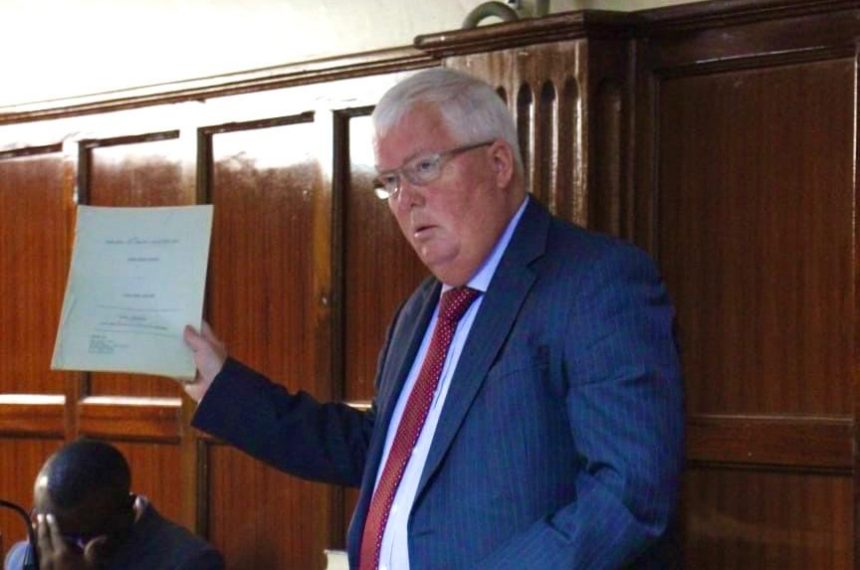
Senior Lawyer Guy Spencer Elm giving his witness testimony on 27 May, 2026.
Guy Spencer Elms has spent nearly a decade as a criminal defendant for doing his job. In 2017, then-Director of Public Prosecutions Keriako Tobiko directed his arrest on charges that he had forged Robson’s will and power of attorney, fraudulently obtaining letters of administration over the estate. The stated basis was forensic findings that purported signatures on the will were not genuine.
The charge sheet is worth reciting in full because of how badly it has aged. Count one alleged that on or before March 24, 1997, Elms made a false document, namely Robson’s will, purporting it to be genuine. Count two alleged that on February 10, 2015, he presented that forged will to DCI Corporal Samuel Kamau at DCI headquarters. Count three alleged he forged a power of attorney dated January 24, 2010. Count four alleged he uttered that forged power of attorney to Kamau on the same date. Count five alleged that on October 30, 2013, at the High Court, he filed the forged will to obtain probate over land valued at Sh100 million. Elms denied all counts and was released on Sh400,000 cash bail.
What followed was a procession of findings that systematically demolished the prosecution’s theory. By 2019, DCI investigators themselves found insufficient evidence to sustain the case and the criminal probe effectively collapsed. In November 2022, forensic document examiner Jacob Oduor appeared before the High Court and testified that after examining Robson’s known signatures across multiple documents, he found no evidence of forgery on the will. In June 2025, Justice Chemitei’s comprehensive judgment upheld the will in every particular, stating it was lawfully executed, properly witnessed, and showed no sign of coercion or mental incapacity.
Logically, these findings should have triggered the DPP to drop the criminal charges. The DPP agreed. An application was filed in the Milimani magistrate’s court to withdraw the charges, informing Magistrate Ben Mark Ekubi that Justice Chemitei’s judgment had definitively validated the very will that was the subject of the prosecution. Ekubi declined not once but twice. The DPP appealed to the High Court. In January 2026, Justice Martin Muya dismissed that appeal, ruling there was no good reason to interfere with Ekubi’s decision. Kagure’s side had successfully argued that the criminal case should continue even though the civil court had fully validated what the criminal case alleged was a forgery.
In August 2025, the absurdity intensified. Elms failed to appear for a court mention, his lawyer citing a sick child. Magistrate Ekubi issued an arrest warrant. The charges against Elms for possessing and submitting a document that a High Court has found to be genuine remain, technically, active. He is living a wanted man’s existence for having been, courts have now found, a faithful executor of a legitimate will.
The charges against Elms for submitting a document a High Court found to be genuine remain, technically, active. He is wanted for having been a faithful executor.
A PORTFOLIO OF PREDATION
The Karen operation is the grandest entry in Kagure’s property dispute portfolio, but it is far from the only one. A picture assembled from court records spanning nearly a decade reveals a pattern that goes well beyond bad luck in property transactions.
The Makadara case is the most operationally brazen. Ruth Wambui Kimani, a widow, told the Environment and Land Court in case 345 of 2018 that her late husband Kimani Mungai had purchased a plot along Jogoo Road in Makadara in 1997 and the family remained in possession until 2015, when Kagure appeared claiming she had bought it for Sh10 million. The transfer bearing Mungai’s signature was registered on October 7, 2015. The problem: Wambui produced a death certificate showing her husband died on October 26, 2010, nearly five years before the transfer. The land had been, on the face of the documents, sold by a corpse.
When the case came to court, something extraordinary happened. A man identifying himself as Francis Kimani Mungai appeared, very much alive, seeking to join the proceedings and confirming he had sold the land to Kagure on July 30, 2015, for Sh10 million. Kagure’s side produced a living man to contradict the death certificate. Whether that man was the genuine Kimani Mungai or someone recruited to perform the role, the widow maintained her husband had died in 2010 and the transfer was impossible. In April 2025, Judge Oguttu Mboya issued a permanent order stopping Kagure from entering, occupying, or claiming the Eastlands plot, ruling that the registration of the property in her favour was premised on illegal and unlawful documents and was therefore void.
Joel Munyoki Munene had a comparable experience. In ELC case 65 of 2017, Munene sued Kagure over a Nairobi Eastlands plot valued at over Sh20 million. He had acquired the property in 2002 and obtained a formal allotment letter from Nairobi City County, but found when he went to formalise his title that Kagure had somehow registered it in her name through what Judge Mboya would later describe as illegal and unlawful documents.
Then there is the matter of the German investor. In late 2022, three months after losing the Nairobi gubernatorial election, Kagure was introduced to Uwe Heinz Odenthal, a German national, through a chain of connections involving his compatriot Jurgen Haese and Haese’s Kenyan wife Rose Kirimi. The vehicle was Trojan Six Oil 2019 Ltd, a petroleum company in which Kagure, Said Mohamed Farah, and Franklin Were Juma are listed as directors. Odenthal says he was presented with annual dividends of 30 percent on his invested capital and handed over one million euros, approximately Sh142 million, after taking out a bank loan in Germany to fund part of it. He received nothing. He filed a report with the DCI saying he had been cheated, stolen from, and defrauded. Kagure dismissed the allegation as politically motivated noise.
THE POLITICAL REINVENTION AND WHY IT SHOULD ALARM NAIROBI
Kagure first entered political consciousness in 2018, when Nairobi Governor Mike Sonko nominated her to replace the departed deputy governor Polycarp Igathe. She was a leading candidate for confirmation. Then the Karen and Makadara cases became public. Sonko, who had made public theatre of his anti-land-grabbing stance, quietly shelved the nomination without ever formally withdrawing it. Kagure’s political ambitions survived intact. She ran for Nairobi governor as an independent candidate in August 2022, finishing fourth behind Johnson Sakaja, Polycarp Igathe, and Harman Grewal. She then pivoted immediately into preparation for 2027, declaring her candidacy through social media in early 2025 with the backing of a section of the Kikuyu Council of Elders.
Her public persona across this period has been carefully curated. She presents as a women’s empowerment advocate, a philanthropist, a mentor to the youth, a businesswoman who built herself from nothing. Her social media is professionally managed. When allegations resurface, she frames them as politically motivated attacks by rivals threatened by her ambitions. ‘Ever since I hinted at my political ambitions, I have been seeing all sorts of attacks and stories that date back as far as 1901,’ she wrote on social media in October 2024, after the German investor story broke. Every documented allegation becomes, in her telling, a fabrication by political enemies.
What that framing cannot explain is why the attacks come from judges, not politicians. Judges Oguttu Mboya, Hillary Chemitei, Mary Gitumbi, Maureen Odero, and Lucy Njuguna have all made findings, issued injunctions, or delivered rulings against Kagure across these various disputes. None of these judicial officers is known to be aligned with any of her political rivals. Justice Njuguna’s finding that police were actively aiding fraudsters in the Karen case was not a political statement. It was a judicial observation on what the evidence before the court showed.
THE CERTIFICATION GAMBIT AND WHAT COMES NEXT
Back in the courtroom in May 2026, Conrad Maloba’s cross-examination of Elms was not a philosophical exercise. It was a calculated move in a long game. By extracting Elms’s acknowledgment that the will and title deeds were not fully certified through every required authority, Maloba has created an argument that, if accepted, could do one of two things. It could void the estate’s standing entirely, theoretically opening the door for Kagure’s contested documents to be treated as the only surviving claim. Or it could create enough uncertainty about the estate’s title that a settlement becomes attractive to Elms and the beneficiaries, particularly the charities and conservation bodies that have been waiting since 2012 for proceeds from Robson’s generosity.
What Maloba cannot explain away, and what the court will be required to weigh when the hearing resumes in October 2026, is the full context. The certification shortfall, if it exists, is a procedural defect in documents that a High Court has already found to be substantively genuine. Justice Chemitei’s June 2025 ruling did not say the will might be genuine. It said there was no shred of evidence of coercion, that the will was properly executed and witnessed, and that it satisfied every legal test of validity. Procedural cures exist for estates with technical registration gaps. Kenya’s courts have ample equitable jurisdiction to regularise probate processes where the underlying instrument is found to be genuine.
The court will also have to reckon with the underlying reality that Kagure’s own documents have never survived forensic scrutiny. No payment trail has ever been produced. Robson’s family swore under oath that no sale occurred. Two of Robson’s own advocates confirmed that the signatures on Kagure’s documents were not consistent with Robson’s genuine signature. The property was under a bank charge at the time of the alleged sale, making a clean title transfer impossible. That is the substance that sits behind Maloba’s procedural argument, and it is deeply unflattering to his client.
The hearing resumes in October 2026. If Kagure’s certification argument fails, she is left without a legal avenue on the Karen property. If it somehow succeeds, an extraordinary injustice will have been done: a man appointed executor of a genuine will, prosecuted for a forgery courts have found never occurred, subjected to a decade of litigation, will have watched the beneficiaries of Robson’s generosity lose because of a stamp not applied to documents every substantive finding has validated.
If Kagure’s technicality argument succeeds, conservation charities and Robson’s nephew will lose because of a missing certification stamp on documents every court has validated as genuine.
THE LOOPHOLE AND THE LAW: WHAT KENYA MUST CONFRONT
The certification argument, even if legally ambitious, exposes a systemic vulnerability extending far beyond this case. Kenya’s succession system is a labyrinth. The Law of Succession Act, the Land Registration Act, the Civil Procedure Act, and the various practice directions governing probate together create a process that, for complex cross-border estates, can generate decades of procedural irregularities through nothing more sinister than administrative delay, bureaucratic turnover, and institutional dysfunction. A title that passes through a genuine estate but is not certified precisely as required at every step is not necessarily a fraudulent title. It is a common title with a fixable procedural gap.
The land grabbing syndicate’s genius is that it understands this systemic reality better than most legitimate executors. Predators do not need to prove they own the property. They only need to create enough doubt about whether the estate’s documents are perfect. In a system where perfection is rare, doubt is cheap. Kagure’s lawyers have invested more than a decade manufacturing doubt. The question for October 2026 is whether any Kenyan court will reward that investment with a six-acre Karen estate that was willed to elephants, forests, schoolchildren, and a British nephew who has been waiting since 2012 to honour his late brother’s wishes.
Agnes Kagure will call whatever follows a politically motivated attack. She will write on social media that her enemies fear her. She will appear at women’s empowerment events and give speeches about resilience. But in the High Court in October 2026, the record will speak for itself. It will speak of a British man who made a clear, witnessed, legally executed will in 1997. Of an executor who has been prosecuted for implementing it. Of a businesswoman who has never produced a single document of purchase that survives forensic scrutiny. Of police officers a judge found were aiding fraudsters. Of a dead man’s signature appearing on transfer documents long after his death in at least one of her other disputed acquisitions. And of a Karen estate, six acres of Nairobi’s most valuable land bordering the Ngong Forest, that has not yet reached the charities and conservationists its owner intended it to benefit.
That is not a politically motivated attack. That is a court record. And it is damning.
Kenya Insights allows guest blogging, if you want to be published on Kenya’s most authoritative and accurate blog, have an expose, news TIPS, story angles, human interest stories, drop us an email on [email protected] or via Telegram













The Kenyan in the Room: How Jeremy Gisemba Became a Principal in South Sudan’s Biggest Tax Heist

The Karen Predator: Agnes Kagure Has Spent A decade Trying To Steal A Dead Briton’s Land, And Now Betting On A Technicality Loophole

Meta Launches Paid Subscriptions For Instagram, Facebook, and WhatsApp

On Uthamaki’s Bogeyman Politics: Time to Call the Demonization of President Ruto What It Is

Mt Kenya UDA MPs Give Hassan Omar 48 Hours to Quit

Kenya In Talks With US, Duale Breaks Silence On Alleged Ebola Quarantine Plan

Trump To Set Up Quarantine Facility In Kenya For Americans Exposed to Ebola

Crawford Capital: The Corrupt, US-Sanctioned, UK-Registered Digital Firm That Milked South Sudan Dry

The Invisible Hand: Al Jazeera Further Exposes How Safaricom Became The Regime’s Most Powerful Spy

ODM Abandons Linda Ground Rallies

How Did a Sh468K KRA Salary Allegedly Turn Into Sh30 Billion? Questions Deepen Over Commissioner George Obel and Ciala Resort Owner’s Wealth

Why Ruto’s Favourite Candidate Adan Mohammed Could Be Locked Out of the KRA Top Job

Green Gold, Rotten Roots: How Kenya’s Biggest Avocado Firms Hijacked a Sh5.8 Billion Harvest Ban

Safaricom’s Sh1.4 Billion Reckoning: How Kenya’s Most Profitable Company Stole a Man’s Idea and Got Caught

The Rot Inside Absa: How Bank Insiders Are Looting Nairobi’s Customers

The $24 Million Heist at the End of the World

Denial Under Duress: The Untold Collapse Threatening David Lagat’s DL Group’s Empire

THE INSURER THAT TOOK YOUR PREMIUM AND FORGOT YOUR NAME: How ICEA Lion Left a Client Begging for Sh7.8 Million Across Four Months

The President’s Helicopter: How Ruto’s Aviation Empire Lands a Historic Airbus Milestone While His Government Writes the Tax Code

DENTIST IN DISGUISE: How Este Medical Kenya’s Co-Founder Allegedly Prescribed Medicines Outside Her Scope, Lied to Police, and Weaponised the Law Against a Foreign Patient
-
 News1 week ago
Why Ruto’s Favourite Candidate Adan Mohammed Could Be Locked Out of the KRA Top Job
-
 Business2 weeks ago
The Rot Inside Absa: How Bank Insiders Are Looting Nairobi’s Customers
-
 News3 days ago
DENTIST IN DISGUISE: How Este Medical Kenya’s Co-Founder Allegedly Prescribed Medicines Outside Her Scope, Lied to Police, and Weaponised the Law Against a Foreign Patient
-

 Business1 week ago
Court Confirms Safaricom Customers Data Was Sold To Betting Companies In Seven-Year Cover-Up
-

 Investigations2 days ago
LifeCare on the Brink: SHA Fraud, Stolen Wages, and the Rotten Empire Jayesh Saini Built
-
 Business1 week ago
Blocked: How Mombasa Tycoon Ashok Doshi Has Stopped Imperial Bank Depositors From Getting Their Money
-
 Americas3 days ago
Inside FAFSA Fraud: How Kenyan Cybercriminals Siphoned Millions from America’s Sh12 Billion Student Loan System
-

 Business1 week ago
Paybill 585555: How Airtel Kenya’s Interoperability Gateway Became A Criminal Pipeline Draining Millions From Unsuspecting M-Pesa Users