THE APPRENTICE OF SCALE
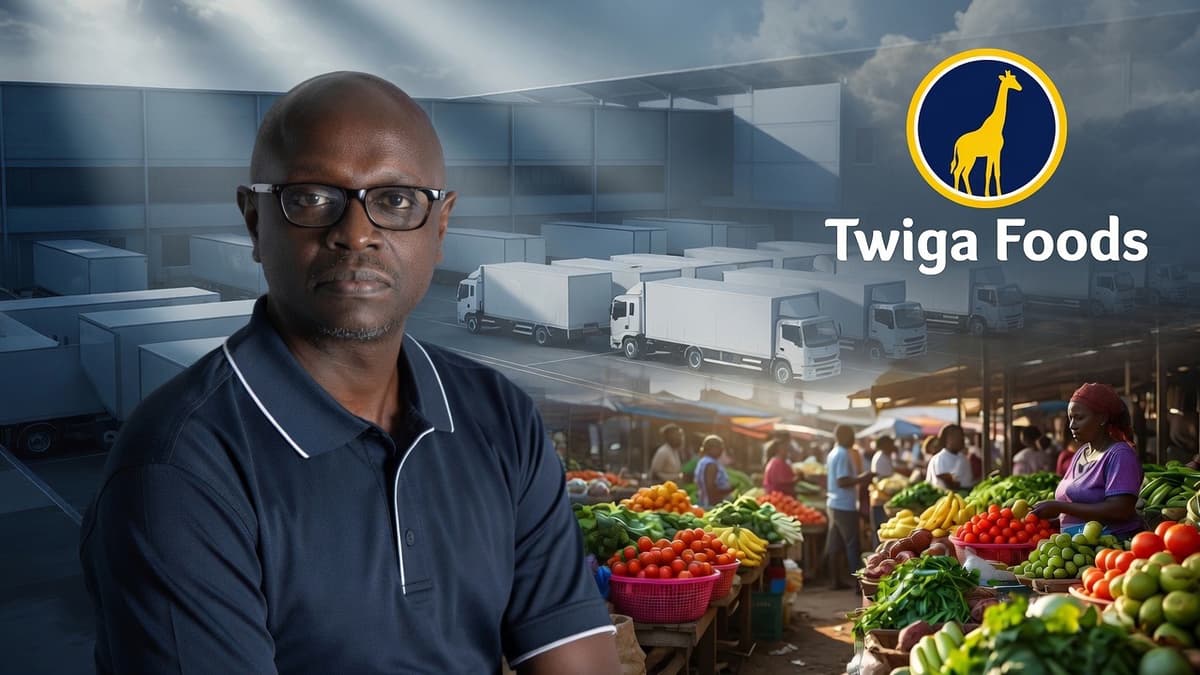
Peter Njonjo did not arrive in Kenya’s food markets as a founder chasing a garage idea. He arrived as a twenty one year veteran of The Coca Cola Company, the last eight of them as President of the multinational’s West Africa business unit, a posting that put him in command of bottling and distribution networks spanning dozens of countries.
That pedigree is the single fact investors and journalists have repeated most often about him, and it is also the fact that explains everything that followed at Twiga Foods.
When Njonjo co-founded Twiga with American entrepreneur Grant Brooke in 2014, he did so as a non-executive director, still drawing his Coca Cola salary, watching from a comfortable distance as Brooke built the early version of the company: a scrappy platform aggregating bananas and tomatoes from smallholder farms for delivery to Nairobi’s kiosks and mama mbogas.
Njonjo’s formal entry as Group CEO came only in April 2019, five years in, at the precise moment Twiga’s board decided the company needed to graduate from experimental distributor to what the board itself called an industrial institution.
Brooke would later describe the handover in terms that Njonjo’s admirers still quote approvingly: his own skill was suited to starting ventures, Njonjo’s to running institutions.
What that euphemism concealed was a more consequential shift. Twiga was ceasing to be a Kenyan social experiment answerable to the farmers and traders it claimed to serve, and becoming a vehicle for importing Coca Cola style command and control logistics onto a market that had organised itself, imperfectly but functionally, for generations without it.
THE PANDEMIC AND THE PRESIDENT
Njonjo’s institutionalist ambitions found their moment in the COVID-19 pandemic, when panicked government planners in Nairobi began treating any digitised supply chain as a matter of national food security. Twiga’s warehouses, its fleet, its app based ordering system, all of it was reframed almost overnight from a private commercial bet into what the Kenyan state began calling essential infrastructure.
The clearest evidence of how far that reframing travelled came in November 2022, when President William Ruto personally presided over the opening of Twiga’s distribution centre at Tatu City in Kiambu County. Ruto did not merely cut a ribbon.
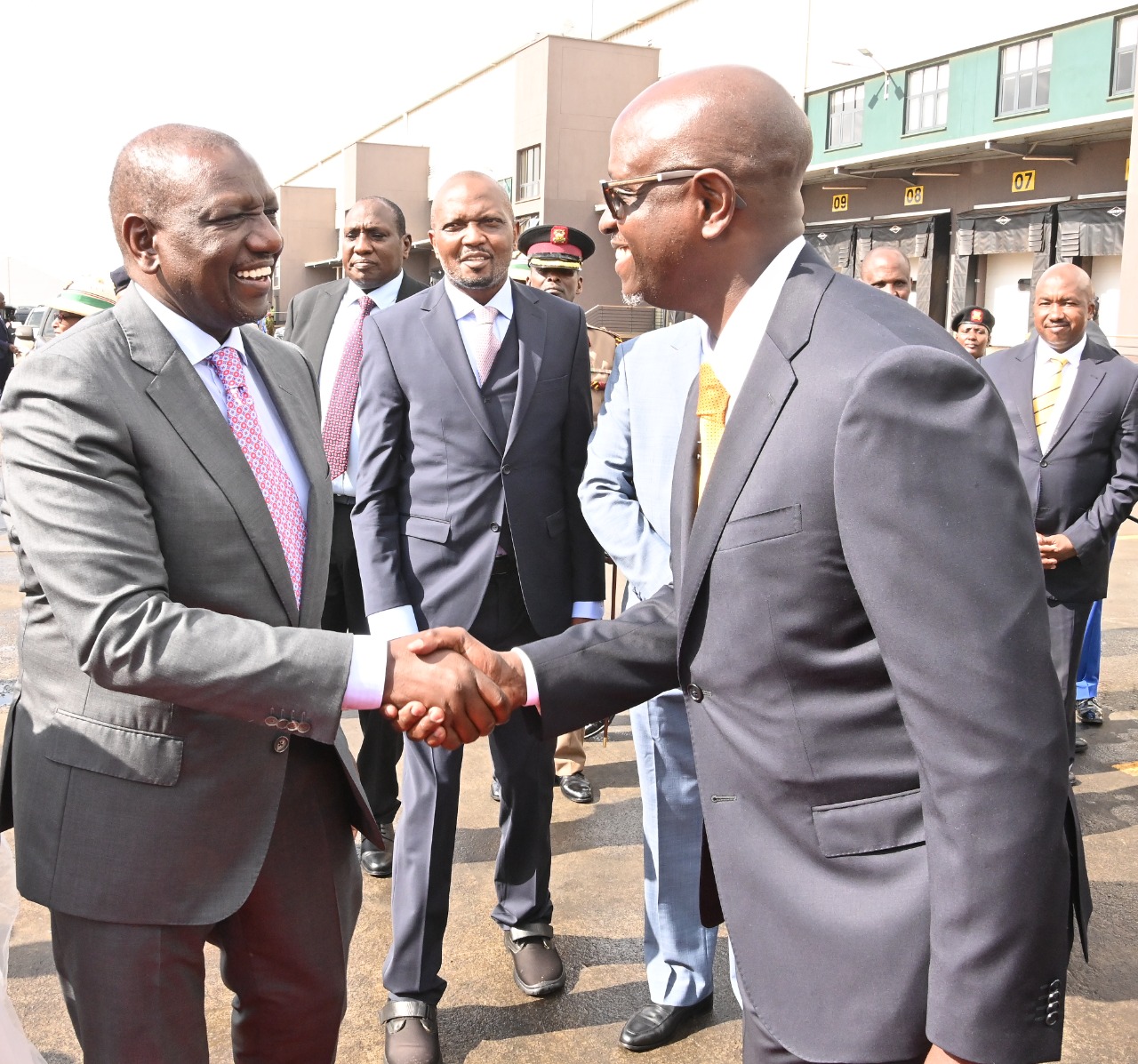
He publicly branded the Twiga model truly bottom up, a direct echo of his own campaign rhetoric, and he did not stop at applause.
He directed the Ministry of Trade and Cooperatives to release Sh300 million from the state backed Hustler Fund for onward lending to Twiga’s suppliers, a taxpayer subsidy routed through a private platform that had, by its own admission, already burned through most of a cumulative $160 million in venture capital.
That single presidential endorsement did more for Twiga’s fundraising optics than any product launch. It converted a struggling logistics company into a politically protected national champion, at exactly the moment its internal numbers were beginning to buckle.
THE FARM THAT VANISHED INTO A PRIVATE COMPANY
It is in the deserts of Kilifi and Tana River counties, not in a Nairobi boardroom, that the clearest portrait of Njonjo’s methods emerges. Early in 2023 the Ruto administration allocated Twiga Foods a concession inside the Galana-Kulalu Food Security Project, a long stalled, multi decade state irrigation scheme on the Galana River.
The pitch, delivered publicly by Njonjo himself, was that Twiga would run a pilot maize farm and eventually scale it to 20,000 acres, guaranteeing the company’s own supply chain against the price volatility and quality inconsistency of smallholder farming.
Njonjo told the public and the Irrigation ministry that the operator behind the project was backed by serious foreign agricultural capital, describing a partner overseeing more than 600,000 acres of farmland in Latin America and precision agriculture technology sourced from the United States.
On the strength of that pitch, Irrigation Principal Secretary Gitonga Mugambi publicly justified handing the concession to Twiga, citing the work the company had already done locally.
By June 2023, company registry filings told a starkly different story.
The development rights to the entire 20,000 acre concession had been transferred, not to any foreign agribusiness consortium, but to Selu Limited, a special purpose vehicle in which Peter Njonjo personally held all 500 ordinary shares.
His own company secretary held none.
There was, Njonjo told Business Daily when confronted with the registry documents, no consideration paid for the transfer, because Selu had allegedly been funding the pilot phase itself. He did not dispute the ownership structure the documents revealed.
A state administration had handed a Twiga Foods concession, justified by claims of foreign agribusiness credibility, into what registry records show was a single Kenyan man’s personal holding company, at the very moment that same man’s public company was cutting a third of its workforce and fighting vendors in court over unpaid bills.
Njonjo would go on to run the farm under Selu even after he left Twiga altogether, appearing alongside President Ruto in later years as the concession expanded and reported record maize yields, a private legacy asset extracted intact from a company whose smallholder farmers, the very people the concession’s food security branding invoked, received none of it.
A state administration had handed a Twiga Foods concession, justified by claims of foreign agribusiness credibility, into what registry records show was a single Kenyan man’s personal holding company.
THE PRODUCER PROMISE, INVERTED
The Galana land transfer did not happen in isolation. It was the logical extension of a pivot that had already alienated the smallholder farmers Twiga was founded to serve. As the company’s fundraising rounds grew larger, from a $10.3 million Series A in 2017 to a $50 million Series C in 2021, the pressure to deliver standardised volume at investor grade scale grew with them. Smallholder plots, fragmented and inconsistent by nature, could not reliably meet that demand.
Njonjo’s answer was Twiga Fresh, launched in May 2022 with a $10 million investment: a 650 hectare industrial farm in Taita Taveta growing onions, tomatoes and watermelons directly, in open competition with the same small farmers the platform had once promised to lift out of broker dependency. A company that marketed itself for years as an empowerment platform for the little guy had, by its own strategic choice, become the guy squeezing him out.
The Galana concession, and its quiet migration into Selu Limited, was simply that same logic taken to its furthest point.
If the informal market could not be aggregated on Twiga’s terms, and if smallholder land could not be industrialised fast enough, the solution was always going to be state land, secured through political proximity and then consolidated into a structure the public company did not control.
WHEN THE CAPITAL STOPPED
Global venture capital’s retreat from African technology bets in 2022 and 2023 exposed exactly how dependent Twiga’s institutionalist architecture had become on constant external financing.
The company that had raised $160 million across a decade suddenly could not meet its own obligations.
A Kenyan court in December 2023 gave Twiga four months to resolve a dispute with cloud services provider Incentro Africa, which alleged it was owed $450,000 including a delayed Google bonus, a claim Twiga contested down to $94,000. Suppliers went unpaid. Salaries were delayed. The company confirmed cuts of between thirty and forty percent of its permanent workforce.
In December 2023, Twiga closed a $35 million convertible bond round led by existing investors Creadev and Juven, explicitly to pay down vendor debt.
Two weeks later the company announced Njonjo would take a six month sabbatical. By January 4, 2024, the sabbatical had revealed itself as an exit.
In a resignation letter addressed to board chairman Hein Pretorius and copied to shareholders, Njonjo wrote that strategic direction and daily operations were now firmly in the hands of Juven and Creadev, and that there was very little value he could add from that point on.
Industry reporting at the time concluded plainly that Njonjo had not chosen to leave so much as been eased out, his departure a precondition investors quietly attached to the very funding round that kept the lights on.
Within days, Twiga’s head of legal and administration and the head of its East Africa business had also departed. The institution Njonjo had spent five years constructing did not survive contact with the capital markets discipline he claimed to have imported from Coca Cola.
THE RESTRUCTURING PROJECT
What Creadev and Juven inherited was not a technology company but a restructuring project. Under the new foreign controlled leadership, the capital intensive model Njonjo had built, the farms, the cold chain, the proprietary logistics fleet, the sprawling tech stack, was systematically dismantled.
Twiga pivoted toward an asset light FMCG distribution model, acquiring traditional distributors including Jumra, Sojpar and Raisons in April 2025 to break directly into fast moving consumer goods, while shedding the very infrastructure that had once defined its identity.
Further job cuts followed through 2025, with hundreds more roles eliminated as supply chain functions were outsourced.
Operations in Nairobi were temporarily suspended altogether during the overhaul.
The company that emerged was leaner and more conventional, and critics noted the irony without much sympathy: it now resembled the broker networks Twiga had spent a decade vowing to destroy, more than the algorithmic empire Njonjo had once described to investors.
Even Njonjo’s post-Twiga diversification bore the same institutionalist fingerprints that had strained the parent company.
Through the fintech vehicle Shara Inc, he and Brooke engineered a 55.8 percent controlling acquisition of Maisha Microfinance Bank in May 2023, approved by the Central Bank of Kenya, seeking to bolt banking infrastructure onto an agri-tech ecosystem that could not yet fund its own supply chain. It added regulatory complexity to an already teetering empire at precisely the moment the 2023 funding crisis was closing in.
The company that emerged was leaner and more conventional, and critics noted the irony without much sympathy: it now resembled the broker networks Twiga had spent a decade vowing to destroy.
THE VERDICT
The official narrative around Peter Njonjo’s exit treats Twiga Foods as a cautionary tale of macroeconomic timing, a promising African tech story undone by a global funding winter no founder could have predicted. The documentary record tells a narrower and less forgiving story.
It shows a Coca Cola executive who joined a small farmer’s platform as a background investor, took command once it needed institutional muscle, leveraged a pandemic and a sympathetic presidency into state credit and a 20,000 acre irrigation concession, misrepresented the ownership of that concession to a government ministry, quietly moved it into a company he personally controlled, presided over the marginalisation of the smallholder farmers his platform was built to serve, and then exited an emptied out company to foreign creditors while retaining, in his own name, the one asset that survived the wreckage intact.
That is not simply the record of an ambitious idea meeting its natural limits. It is the record of a deliberate sequence of strategic choices, each one moving value and control away from the public company and its stated mission and toward a private holding structure answerable to no shareholder but Peter Njonjo himself.
The street level informal economy Njonjo set out to institutionalise proved, in the end, harder to conquer than the Galana riverbed he was quietly permitted to keep.



Comments