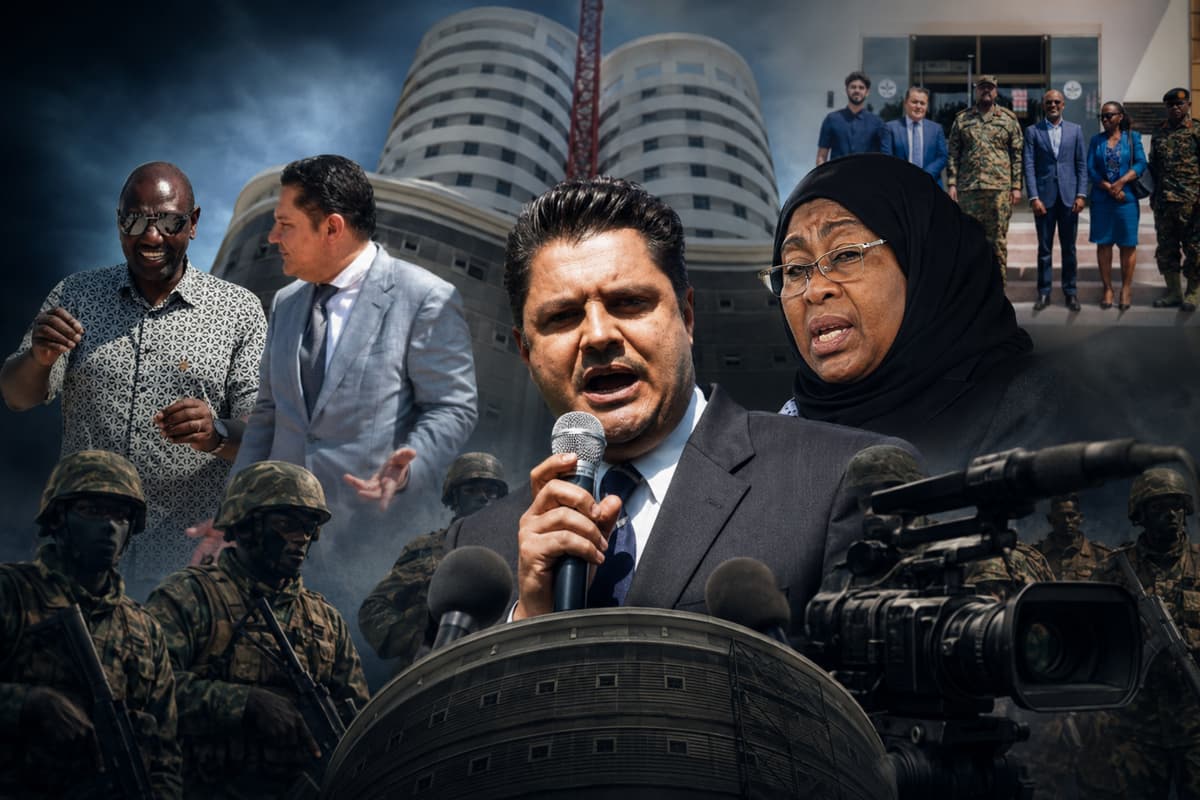
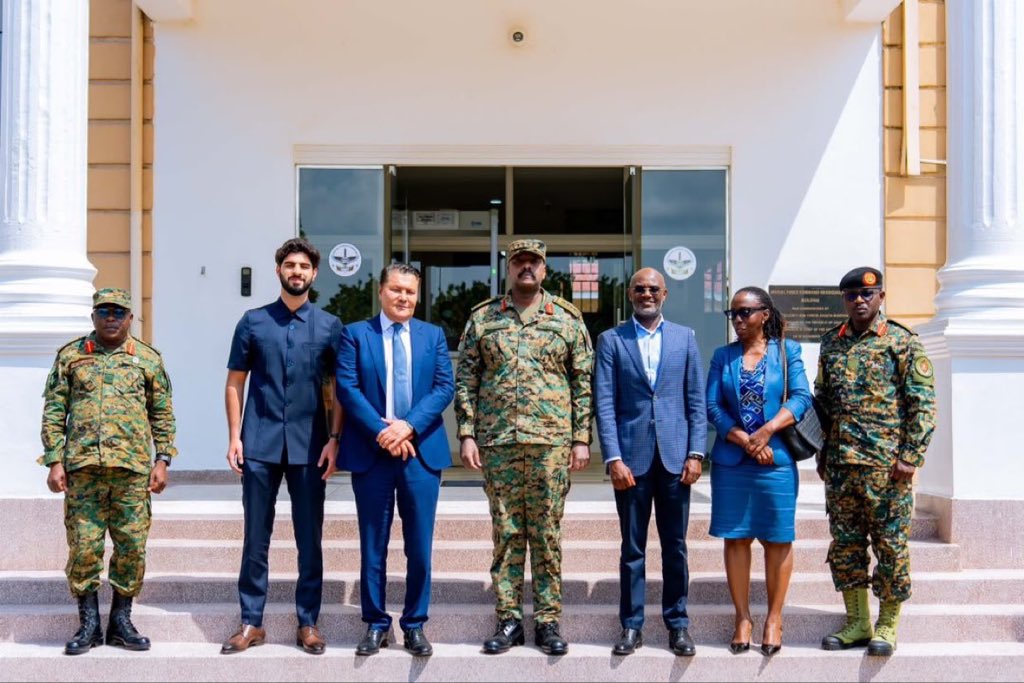
The photograph that should worry every shareholder, every journalist and every citizen who still believes East Africa can produce accountability journalism was taken inside a military installation. Rostam Aziz, the Tanzanian billionaire who four months earlier had bought control of Nation Media Group from the Aga Khan Fund for Economic Development, sat inside the Special Forces Command headquarters in Entebbe on July 1, 2026, across the table from General Muhoozi Kainerugaba, Uganda’s Chief of Defence Forces and the son of President Yoweri Museveni.
With him were his son Saam Aziz and Georgia Mutagaywa, chief of staff at Taarifa Limited, the vehicle through which the Aziz family now controls the largest media house in East and Central Africa. On the other side of the table sat the machinery of a military state: an acting director of defence public information, and a general who three days earlier had shut down six of that media house’s outlets with a 1:07 a.m. post on X.
This was not a negotiation between equals. It was a hostage situation being resolved through diplomacy, and everyone in that room knew it.
THE NIGHT THE SOLDIERS CAME
At 1:07 a.m. on June 27, 2026, Muhoozi Kainerugaba announced on X that Nation Media Group’s flagship Ugandan properties, the Daily Monitor newspaper and NTV Uganda, were being shut down immediately. Armed personnel from the Uganda People’s Defence Forces had already begun sealing NMG’s Namuwongo headquarters in Kampala and its broadcast facility at the Kampala Serena Hotel, cutting power, locking staff inside, and preventing others from entering.
By 5:00 a.m. on June 28, NTV Uganda and Spark TV had gone dark, their screens replaced with a blunt message: video unavailable. KFM and Dembe FM radio stations fell silent soon after. By the time the National Association of Broadcasters and Amnesty International had finished counting, six separate NMG mastheads and frequencies, including The East African, had been forced off air or off the newsstands without a single court order, regulatory notice or written legal instrument.
Muhoozi did not pretend this was regulatory. He said so himself, in writing. He declared that he did not believe in a free press. He announced that all negative stories about Uganda would now require prior clearance from his office.
He claimed he had possessed the personal authority to close any media house in the country since 2017, a power he said his father had given him. None of that authority exists in Uganda’s constitutional or broadcasting law. The Uganda Communications Commission, the body actually empowered to license and sanction broadcasters, was left publicly scrambling to explain a shutdown it had not ordered and could not immediately justify.
This shutdown was not announced by a regulator. It was declared by a general on social media at one in the morning, and treated as a personal, hereditary right.
The pattern is not new.
Uganda’s security establishment shut down NTV Uganda in 2007, barely two months after its launch, over coverage it disliked. In 2013, police sealed the Daily Monitor and Dembe FM for more than a week after the paper published a letter alleging a succession plan for Muhoozi that became known, prophetically, as the Muhoozi Project. What changed in June 2026 is the mask.
There was no pretence of due process this time, only a general’s phone and a column of soldiers, deployed weeks after President Museveni’s inauguration for a seventh consecutive term and in the same stretch of days that Muhoozi had a lawyer representing detained opposition figure Kizza Besigye arrested and charged with treason for attempting to hold him accountable.
Two days after the raid, Uganda’s ICT Minister Chris Baryomunsi confirmed what the generals had already made obvious: the shutdown had been personally instituted by President Museveni himself, dressed up as a security-led inquiry involving the UPDF, the Criminal Investigation Directorate and unnamed security experts. The government would, the minister said, inform the public once the inquiry concluded.
Four days after that, no such conclusion had been offered. What had been offered, in its place, was Rostam Aziz’s flight to Entebbe.
THE FIG LEAF QUESTION NOBODY WANTED TO ASK
Roll the tape back to March 2026. The Aga Khan Fund for Economic Development, custodian of Nation Media Group since 1959 and the institutional force that turned it into East and Central Africa’s most trusted news brand, agreed to sell its entire holding in NPRT Holdings Africa Limited, the vehicle carrying 92,618,177 shares, 54.08 percent of NMG, to Taarifa Ltd. Taarifa is Rostam Aziz’s company.
Aziz is a former CCM parliamentarian in Tanzania, a co-founder of Mwananchi Communications who once built and then sold the very newspapers NMG would go on to acquire, and a businessman with interests spanning mining, telecoms, ports, energy, agriculture, real estate and construction across the region. His acquisition ended sixty-six years of Aga Khan stewardship in one transaction.
The market’s verdict was instant and telling.
NMG’s share price jumped 28.3 percent in the two trading days after the deal was announced, a spike that reflected both relief that a capitalised buyer had finally arrived and a wager that the new owner’s political access would translate into commercial protection.
Aziz, for his part, said all the right things.
He pledged to uphold NMG’s editorial independence. He promised no mandatory or voluntary takeover offer for the remaining shares, and no delisting from any of the four exchanges on which NMG trades, in Nairobi, Kampala, Dar es Salaam and Kigali. On June 26, 2026, barely a day before the Uganda raid, NMG held what was described as the most consequential shareholders’ meeting since its 1973 listing, its first AGM under Aziz’s control, with chief executive Geoffrey Odundo reassuring the room that operations would continue uninterrupted.
Even before the Entebbe photographs, sceptics inside and outside the newsroom were asking the uncomfortable question in public.
A former NMG employee, writing about the sale, asked bluntly whether Rostam Aziz was a fig leaf for other background investors, and warned that Tanzania’s own record on media freedom offered little comfort. Aziz, the critic noted, is close to both President Ruto of Kenya and President Samia of Tanzania, relationships his other businesses depend on for survival. Those words, written in March, read very differently in July.
THE ENTEBBE SUMMIT AND THE PRICE OF REOPENING
What happened inside the Special Forces Command headquarters on July 1 was reported, cautiously, as a negotiation to restore the Daily Monitor and NTV Uganda to the air.
What it actually represented was a controlling shareholder travelling personally to a military command centre to negotiate the terms on which his own company would be permitted to keep functioning inside a member state of the East African Community.
According to accounts of the meeting, the parties reviewed specific instances of coverage the government considered biased and malicious, and the NMG side committed in principle to what was described as more patriotic journalism as a precondition for the outlets being switched back on.
Andrew Mwenda, the journalist turned pro-government Patriotic League of Uganda leader who has functioned as Muhoozi’s informal envoy to international media interests, brokered much of the contact.
Muhoozi, in the meantime, had publicly boasted that the closure was costing NMG millions of dollars a day, and said the losses suited him fine.
There is no universe in which this counts as a free negotiation.
A regulator issuing a fine or a suspension is accountable to law, however imperfectly. A general who has just demonstrated he can switch off a newsroom’s electricity and lock its staff inside the building is not negotiating. He is dictating terms, and the owner of the newsroom is the one taking the meeting.
KENYA’S WARNING LIGHT IS ALREADY FLASHING
Nairobi should not watch this as a Ugandan story. The Daily Nation, Business Daily and NMG’s Kenyan digital platforms have spent years absorbing a familiar set of pressures: advertising pull-outs after uncomfortable coverage of politically connected corporates, legal threats engineered to exhaust newsroom resources rather than win in court, and the quieter, harder-to-document kind of pressure that arrives through boardrooms rather than statutes.
None of that required military intervention. It required only that advertisers, regulators and powerful individuals understand which stories were survivable and which were not.
What the Uganda shutdown has now done is change the ownership calculation that sits above all of that pressure. NMG’s largest shareholder is a man who has just shown, in the most public way possible, that when a regional strongman decides coverage has become inconvenient, his response is to fly to that strongman’s military headquarters and negotiate.
Kenyan editors do not need a memo circulated to understand the new incentive structure.
They need only watch what an assignment desk does the next time an investigation touches a business partner, a political ally, or a country where Taarifa Limited has other interests at stake. Self-censorship rarely announces itself. It arrives quietly, as a story that gets delayed for further review, or dropped for reasons that are never quite spelled out.
THE TANZANIA TRIANGLE
Complete the map and the danger sharpens. Aziz’s political biography inside Tanzania, a former ruling-party parliamentarian with continuing commercial ties across the CCM-aligned business establishment, plus his existing Habari Corporation media holdings, means the same owner now sits atop NMG’s operations in three sovereign jurisdictions with three separate sets of political sensitivities.
A media owner who is simultaneously a politically embedded Tanzanian businessman has every commercial incentive to ensure that NMG’s coverage of Dodoma, and of Aziz’s own wider business interests, never becomes inconvenient either.
The firewall that used to separate ownership from editorial mandate, imperfect even under the Aga Khan’s distant stewardship, has now been structurally compromised in three countries simultaneously, by the same man, for the same reasons.
WHAT INVESTORS ARE ACTUALLY BEING ASKED TO BUY
For minority shareholders on the Nairobi Securities Exchange, and the smaller cross-border holders in Kampala, Dar es Salaam and Kigali, the arithmetic here is brutal.
NMG is a thinly traded stock, ranked only 36th by trading volume on the NSE in recent months, with average daily turnover of roughly 31,000 shares worth under half a million shillings.
That illiquidity means the market has limited ability to price new information quickly, which is precisely why the 28.3 percent post-acquisition rally deserves scrutiny rather than celebration.
Investors were never buying a conventional media stock with predictable cyclical exposure to advertising spend.
They were buying exposure to a brand whose primary competitive asset was perceived independence and cross-border institutional credibility. That asset has just been shown, on camera, in a military compound, to be negotiable.
The reaction beyond the newsroom has already begun to register the political risk. Amnesty International’s East and Southern Africa director publicly condemned what she called an unchecked and unjust campaign of harassment against independent media.
United States Senate Foreign Relations Committee chair Jim Risch called on Washington to review its security relationship with Uganda, describing Muhoozi and the Ugandan military as unfit partners over the crackdown.
Reporters Without Borders already ranks Uganda 143rd out of 180 countries on press freedom, in the category reserved for environments where journalists face near-daily intimidation. None of that international attention reverses the underlying commercial reality: a media asset whose moat was trust and independence has watched that moat drained in full public view, and the market has not yet finished pricing the discount.
The depressed valuation at which Aziz acquired control was the market quietly signalling that NMG’s independence premium was already under threat. Entebbe simply made the discount visible to everyone.
THE TEMPLATE IS NOW AVAILABLE TO EVERY REGIME IN THE REGION
What Muhoozi Kainerugaba has demonstrated does not require nationalisation, expropriation, or even a change of ownership.
It requires only that the sitting owner of a regionally significant media platform understand that his licences, his physical premises, his staff’s safety and his other cross-border commercial interests can be switched off at will.
The owner then negotiates the terms of his own compliance, and calls it reopening talks.
Every government in the region now has a working demonstration of how cheaply editorial independence can be purchased back from a controlling shareholder who has more to lose elsewhere than he has invested in the newsroom itself.
The Aga Khan era at Nation Media Group was never a golden age of fearless journalism, and nobody serious pretends otherwise.
It was, at its best, a period in which institutional distance and reputational patience created room for reporting that would otherwise have been impossible across four East African markets. That distance has now been deliberately, publicly, and commercially collapsed.
What replaces it is a model in which editorial independence is treated as a discretionary cost and political accommodation is rebranded, with a straight face, as commercial pragmatism.
THE VERDICT
This is not merely a Ugandan press freedom story, and it should stop being covered as one. It is a live case study in how political consolidation destroys the intangible value of a regional institution faster than any macroeconomic shock could manage, and it is playing out in real time across four stock exchanges and three sovereign media markets.
The investment thesis that justified Aziz’s entry, that a professionally run, regionally scaled media asset could retain meaningful independence while its controlling shareholder periodically demonstrated loyalty to the region’s most powerful generals, has now been tested. It has failed, on camera, inside a Special Forces command post.
Hundreds of thousands of readers, viewers and listeners across Kenya, Uganda and Tanzania who relied on NMG’s titles as their least imperfect source of independent accountability journalism have lost something that will not be easy to rebuild.
The journalists who spent careers inside that flawed but genuine institution now operate under a standing instruction to anticipate what will and will not survive contact with power.
The investors who thought they were buying a growth story in African media have instead purchased a front-row seat to the live mechanics of media capture, one Entebbe meeting at a time.
The chains are not coming.
They are already fastened. The only open question left is which government in the region moves next, and how much of NMG’s remaining credibility will still exist by the time they do.



Comments