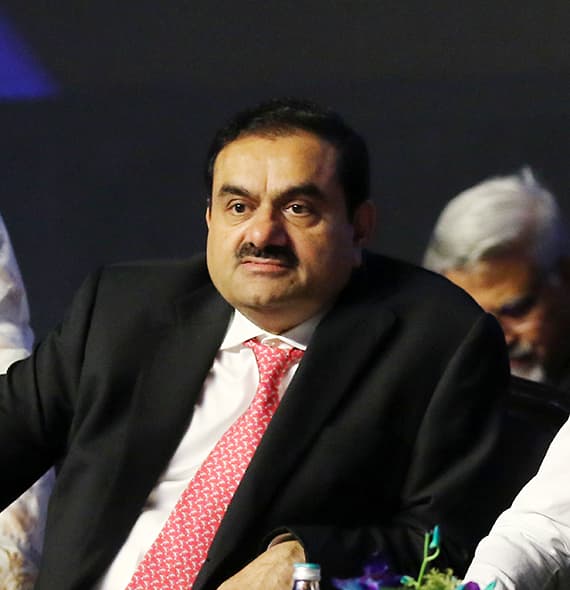
February 17, 2026 | Nairobi, Kenya
They presented themselves as ordinary investors.
A businessman from the United Arab Emirates and a quiet executive from Taiwan, each with their own offshore shell companies, their own numbered bank accounts, their own carefully constructed layers of financial anonymity.
For more than a decade, Nasser Ali Shaban Ahli and Chang Chung-Ling moved billions of dollars through the secretive plumbing of the global financial system, buying and selling shares in the Indian conglomerate Adani Group.
What they did not disclose, and what investigators across three continents are now fighting to prove, is that they were not independent investors at all. They were, according to a growing body of international evidence, front men for the Adani family itself.
The full, staggering scale of that arrangement has now been laid bare for the first time.
Internal banking documents obtained by the Organised Crime and Corruption Reporting Project, in partnership with the Financial Times and the Guardian, reveal that as recently as 2023, Ahli and Chang held approximately three billion dollars in Adani Group stock through a web of Bermuda-based hedge funds, routing the money through a Dubai subsidiary of Swiss banking giant REYL Intesa Sanpaolo.
The figure dwarfs any previously known estimate of their holdings and transforms what was already one of the most explosive corporate scandals in modern Indian history into something altogether more alarming.
“The prosecuting authority must have time to conduct its investigation. It should be noted that the appellant is clearly unable to provide explanations which it should be able to provide in order to dispel the doubts legitimately raised.” – Swiss Federal Criminal Court, August 2024
The revelations arrive at a moment of extraordinary legal peril for the Adani empire.
In November 2024, American federal prosecutors in New York indicted Adani Group founder Gautam Adani and his nephew on charges of orchestrating a scheme to pay over two hundred and fifty million dollars in bribes to Indian government officials, allegedly to secure lucrative solar energy contracts.
The United States Securities and Exchange Commission filed a parallel civil complaint that remains ongoing.
In Switzerland, prosecutors have frozen more than three hundred and ten million dollars in assets linked to Chang, having opened a criminal investigation into allegations of money laundering and document forgery as far back as 2021, a full two years before the world learned of the Hindenburg Research exposé that initially rocked markets and wiped over a hundred and fifty billion dollars from Adani’s stock valuation.
THE MEN BEHIND THE CURTAIN
The story of how Ahli and Chang became entwined with one of the world’s most powerful conglomerates stretches back more than fifteen years and runs through some of the darkest chapters in the Adani Group’s history.
Both men surfaced in not one but two separate Indian government investigations into alleged wrongdoing by the conglomerate, and both cases were eventually dismissed under circumstances that critics say raise profound questions about regulatory independence in India.
The first arose from a 2007 investigation by India’s Directorate of Revenue Intelligence into an allegedly illegal diamond trading scheme.
Investigators from the DRI, the premier financial crime agency under the Ministry of Finance, described Chang as a director of three Adani companies involved in the operation, while Ahli represented a trading firm also implicated in the scheme.
That inquiry also produced a particularly striking detail: Chang shared a residential address in Singapore with Vinod Adani, the notoriously low-profile elder brother of Gautam Adani, the Group’s billionaire founder and chairman.
The second investigation, launched in 2014, alleged that Adani Group companies had been illegally siphoning money out of India by artificially inflating invoices for imported power generation equipment, potentially to the tune of one billion dollars.
Once again, the names of Ahli and Chang appeared.
At separate points in time, both men served as directors of two companies later owned by Vinod Adani that were allegedly used to handle the proceeds of the scheme, one registered in the United Arab Emirates and one in Mauritius. Both cases collapsed without convictions, but the pattern they established would prove difficult to escape.
“The question of whether this arrangement is a violation of the law rests on whether Ahli and Chang should be considered to be acting on behalf of Adani promoters.” – OCCRP Investigation, 2023
Documents later obtained by OCCRP and shared with its media partners showed that from at least 2013 onwards, Ahli and Chang were channeling enormous sums of money into Adani Group shares through a series of offshore structures of extraordinary complexity.
The money passed through at least four companies, flowed into a Bermuda-based vehicle called the Global Opportunities Fund, and was then deployed through two Mauritius-registered investment funds to acquire shares in Adani Enterprises, Adani Ports, Adani Power, and Adani Transmission. At the peak of their investments in June 2016, the two funds controlled by the pair held between eight and fourteen percent of the free-floating shares in each of those four companies.
Under Indian securities law, publicly listed companies must maintain at least twenty-five percent of their shares in genuine public hands to prevent price manipulation. If Ahli and Chang were acting on behalf of the Adani promoter group, their combined holdings would have pushed insider ownership well above the legal ceiling.
THE SWISS BANK CONFESSION
It was the Hindenburg Research report, published in January 2023, that first forced the hidden architecture of this arrangement into the open.
The American short seller accused the Adani Group of engineering what it called the largest con in corporate history through brazen stock manipulation, sending Adani’s share prices into freefall and triggering a loss of over a hundred and fifty billion dollars in market value within days.
The Adani Group issued a four-hundred-and-thirteen page rebuttal, dismissed the report as a calculated attack on India, and maintained that its operations were fully transparent and compliant with all applicable laws.
But behind the scenes, something more consequential was happening. At REYL Intesa Sanpaolo’s Dubai subsidiary, compliance officers were quietly conducting their own investigation.
The Italy-based parent group, Fideuram Intesa Sanpaolo Private Banking, launched an internal review to identify any accounts connected to the Adani Group.
What they found shook them enough to summon Ahli and Chang to an emergency meeting.
In February 2023, with the CEO and a board member of Reyl MEA present, both men signed a written statement acknowledging that the accounts were theirs and confirming that they had invested in Adani stock because of personal and professional relationships with members of the Adani family, whom they trusted as businessmen.
They denied any wrongdoing and promised to diversify their holdings in the short term. The bank responded by freezing any further transactions on the accounts without specific sign-off from its anti-money laundering officers.
The three accounts identified at Reyl MEA were staggering in their scale.
Ahli held two point zero two billion dollars through his British Virgin Islands company, Gulf Asia Trade and Investment Ltd, almost entirely invested in hedge funds described in the bank’s own internal documents as likely invested in Adani Group companies. Chang held one point zero two billion dollars through his BVI company, Lingo Investment Ltd, in funds described as probably invested in the same conglomerate.
Vinod Adani himself held a comparatively modest six point five million dollars through a UAE-registered company, with bank records noting small loan-related transactions between his account and Chang’s.
Those three Bermuda-registered hedge funds, identified in Fideuram’s investigation as Gleneagles Investment Fund, Pangea Fund, and Oyster Bay Fund, were administered by a single firm, Apex Fund Services.
Two of the three, Pangea and Oyster Bay, were managed by Elara Capital Ltd, a firm that also ran two other funds with reported concentrated positions in Adani stock: the Elara India Opportunities Fund and the Vespera Fund.
REGULATORS ON TRIAL
The question of whether India’s own institutions were willing or able to investigate the Adani Group has become as controversial as the underlying allegations.
The country’s securities regulator, the Securities and Exchange Board of India, was already examining the conglomerate when the Hindenburg report was published. After the report’s release, India’s Supreme Court directed SEBI to broaden its inquiry and appointed an independent six-member expert committee to assist the court in evaluating the affair.
That committee delivered a finding that would itself become a subject of fierce debate: it found no evidence of regulatory failure by SEBI, but simultaneously acknowledged that the regulator had drawn a blank on the ultimate owners of certain offshore entities, meaning it could not reach conclusive findings on whether insider ownership had breached legal limits.
In January 2024, the Supreme Court declined to remove the investigation from SEBI, noting the regulator had completed twenty-two of its twenty-four separate lines of inquiry and expressing confidence in its work.
In September 2025, SEBI issued its long-awaited final orders in relation to two specific sets of transactions flagged by Hindenburg, finding those particular allegations not established.
Reuters, citing sources with direct knowledge, reported at the same time that more than a dozen other cases were still pending.
SEBI has never published a comprehensive report on the totality of its investigations, leaving enormous questions unresolved and beyond public scrutiny.
That regulatory silence has grown only louder in the context of an August 2024 revelation that proved particularly damaging.
Hindenburg Research published a second report, this one targeting the SEBI chairperson herself, Madhabi Puri Buch, alleging that she and her husband had previously held investments in some of the very offshore funds at the centre of the Adani inquiry.
Both Buch and her husband denied the allegations emphatically. The report sent Adani’s shares tumbling again, erasing billions in value before a partial recovery. SEBI did not open a public inquiry into the allegations against its own leadership.
A GLOBAL WEB OF SCRUTINY
While India’s domestic legal machinery has moved slowly and inconclusively, other jurisdictions have proven less reluctant to act.
Swiss prosecutors launched their criminal investigation into Chang in December 2021, more than a year before the Hindenburg report was published and before the wider world had begun to understand the alleged architecture of what was happening inside the Adani Group. The Swiss Federal Criminal Court, in an August 2024 ruling, rejected an appeal by Chang’s company to unfreeze the three hundred and eleven million dollars seized from his five Swiss bank accounts. The court’s language was pointed. It noted that Chang’s company had proved unable to provide the explanations and supporting documents that it should have been able to produce to dispel the legitimate doubts raised by prosecutors.
According to the internal banking report obtained by OCCRP, Swiss judicial authorities had sent specific information requests to REYL Intesa Sanpaolo about accounts held by Ahli, Chang, and Vinod Adani even before the Hindenburg report detonated.
The bank subsequently filed suspicious transaction reports with the Swiss Financial Intelligence Unit covering all three individuals. Those earlier accounts had been closed at the end of 2022 for inactivity and were separate from the three-billion-dollar accounts later uncovered.
In the United States, the indictment of Gautam Adani himself on bribery and fraud charges in November 2024 represented the most dramatic single escalation of the legal pressure on the group since the Hindenburg controversy began.
Federal prosecutors in the Eastern District of New York alleged that Adani and his nephew had conspired to pay over two hundred and fifty million dollars in bribes to Indian government officials in exchange for solar energy supply contracts that would generate two billion dollars in profits. The Securities and Exchange Commission filed its civil case in parallel.
The Adani Group has called the accusations baseless and vowed to pursue every available legal remedy.
THE ADANI RESPONSE
The Adani Group’s official position has remained consistent and unambiguous throughout years of mounting allegations.
A spokesperson, responding to inquiries from OCCRP, stated that under Indian law a listed company neither controls nor directs who purchases its publicly traded shares, and that it has no visibility into the source of funds of public shareholders beyond what regulators require to be disclosed.
Any suggestion that promoter shareholding has been misstated or concealed is incorrect and contrary to the group’s regulatory disclosures, the spokesperson maintained.
The allegations from the Hindenburg report, the spokesperson added, have been adequately addressed and examined at the highest levels of India’s regulatory and judicial framework, including by the Supreme Court.
The Adani portfolio of companies, the statement concluded, remains fully compliant with all laws and disclosure requirements across all jurisdictions.
Ahli and Chang did not respond to requests for comment from OCCRP.
Intesa Sanpaolo’s representative stated that the bank was not in a position to comment, citing legal restrictions on disclosure in Italy, the United Arab Emirates, and Switzerland.
The Swiss Federal Prosecutor’s Office, asked about the status of its criminal investigation, confirmed that a probe into money laundering and forgery of documents was underway but declined to comment on any named individual.
THE LARGER QUESTION
What the new banking documents ultimately expose is not merely the scale of a shadow investment operation but the extraordinary durability of the structures that enabled it.
The offshore holding companies, the Bermuda hedge funds, the layers of BVI shell entities and Dubai subsidiaries, the Mauritius vehicles and the Singapore addresses: all of it held together for more than a decade, surviving government investigations in India, regulatory scrutiny in Switzerland, and a global media storm that would have collapsed less carefully engineered arrangements.
The two men at the centre of it acknowledged their holdings to their own bankers, explained them as a matter of personal trust in a powerful family, and promised to diversify. The promise, investigators now suggest, was not kept.
For a conglomerate that controls airports and ports, mines and data centres, power plants and media assets across one of the world’s fastest-growing economies,
the consequences of what Swiss, American, and Indian investigators are examining could not be more consequential. The question that hangs over every hearing, every frozen account, and every unanswered regulatory order is the same one it has always been: how much of what the world believed to be a public company was, in fact, a private empire in disguise?
This investigation draws on reporting by the Organised Crime and Corruption Reporting Project (OCCRP), the Financial Times, the Guardian, and Kenya Insights’ own research. The Adani Group, Nasser Ali Shaban Ahli, and Chang Chung-Ling were offered the opportunity to comment. Allegations remain subject to ongoing legal proceedings in multiple jurisdictions. No verdict of guilt has been returned against any party named in this report.






Comments