
News
From Hunger Cartel To Oil Docket: The Troubling Rehabilitation Of Kello Harsama
President Ruto has handed one of the most strategically sensitive seats in government to a principal secretary who left behind a graveyard of unresolved corruption allegations. The questions about Kello Harsama have never been answered. They have simply been moved to a bigger stage.

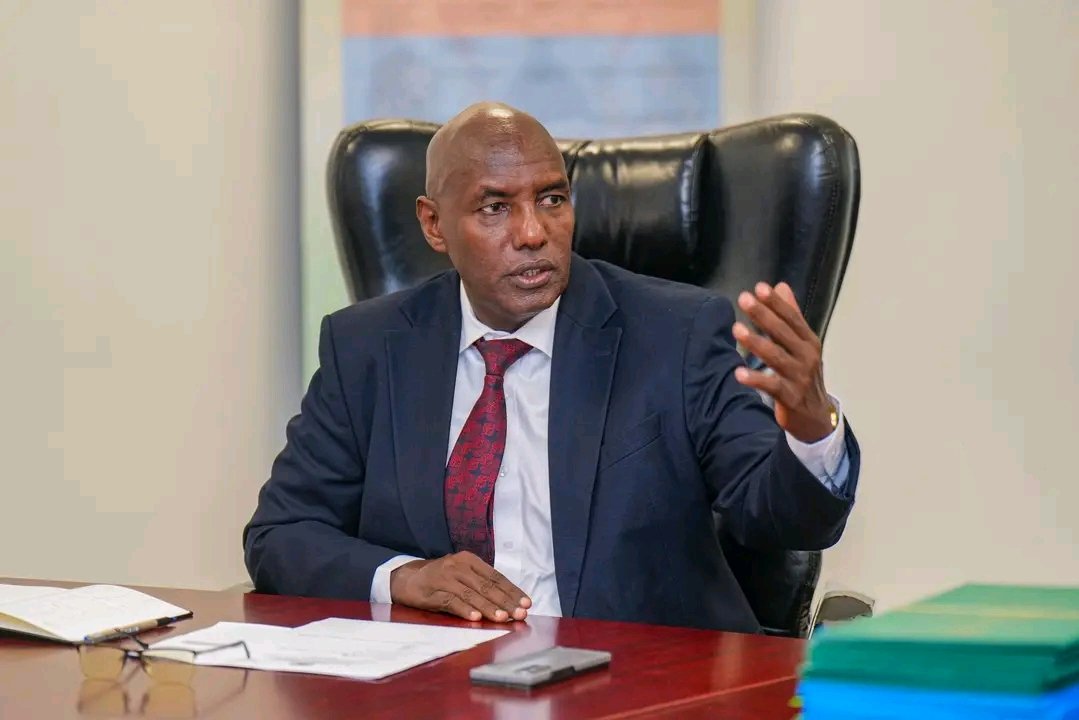
When President William Ruto reshuffled his principal secretaries on Thursday, the move was dressed in the clinical language of continuity and administration. A vacancy had arisen in the State Department for Petroleum. Someone had to fill it. The man chosen was Kello Harsama. To the casual observer, the appointment may have read like unremarkable bureaucratic rotation. To those who have been tracking the man’s career, it was anything but.
Harsama arrives at the Petroleum docket carrying baggage that, in a functioning accountability ecosystem, would have disqualified him from consideration. Over the course of his tenure as Principal Secretary for Arid and Semi-Arid Lands, he became the subject of extensive and detailed allegations of procurement fraud, regional favouritism, supplier coercion, and the politically motivated misuse of humanitarian resources. None of those allegations have been resolved. No investigation has been announced. No charges have been preferred. No parliamentary committee has tabled findings. And now, instead of a summons from the EACC or the DCI, Harsama has received a promotion.
None of the allegations against Harsama have been resolved. No investigation announced. No charges preferred. And now, instead of a summons from the EACC or the DCI, he has received a promotion.
THE MAN AND HIS RECORD
Harsama’s biography is that of a career administrator who rose steadily through Kenya’s provincial administration ranks. He served as District Officer across Meru, Makueni, Narok, Laikipia, Uasin Gishu, West Pokot, and Baringo. He served as District Commissioner in Kajiado and Loitoktok, later rising to County Commissioner in Kajiado. He holds a Bachelor of Education from Moi University and a Master’s degree in Public Administration and Policy from Tsinghua University in Beijing. On paper, it is a solid CV.
But the architecture of Harsama’s public career reveals something more complicated: a pattern of appointments in sensitive, resource-heavy dockets followed by controversy. President Ruto first appointed him as Principal Secretary for Crops Development under the Ministry of Agriculture before reassigning him to the ASAL department. It was in the ASAL docket that the most serious questions about him emerged and festered.
THE ASAL FOOD CARTEL: ALLEGATIONS THAT WERE NEVER INVESTIGATED
In April 2025, Kenya Insights first published allegations from sources within the Ministry of East African Community, ASAL, and Regional Development pointing to systematic corruption in the distribution of government relief food. The allegations were specific, granular, and damning. Suppliers seeking contracts to provide basic food commodities to drought-affected communities across Kenya’s 23 ASAL counties were being forced to quote inflated prices for staples including beans and rice. The excess over the market rate was, according to ministry insiders, being extracted as kickbacks flowing upward to senior officials.
The central figure named in those accounts was Harsama himself. Sources alleged that over 80 percent of relief food contracts under his watch had been awarded to suppliers from his home county of Marsabit, in a pattern that investigators would recognise as procurement gerrymandering designed to consolidate political capital ahead of his anticipated 2027 gubernatorial bid. Harsama lost to incumbent Governor Mohamud Ali in 2022, coming a distant third. He has since made little secret of his intention to try again, with the Warsiitu clan of the Borana community formally endorsing him in July 2025.
The political calculus behind the alleged contract allocation was therefore not subtle: use the levers of a humanitarian procurement function to build a supplier constituency in Marsabit, and use government resources to fund the political groundwork. Relief food, in this construction, was not aid. It was currency. Contractors who refused to participate in the alleged kickback scheme were simply frozen out of government tenders. The procurement process, meant to be competitive and transparent, was allegedly weaponised into an extortion mechanism. Pay up or lose the contract. The drought-stricken communities waiting for the food were incidental to the arrangement.
Relief food was not aid. It was currency. Pay up or lose the contract. The drought-stricken communities waiting for the food were incidental to the arrangement.
The ASAL department manages an annual Treasury allocation estimated at Sh7.4 billion for relief food and non-food items, supplemented by donations from countries, embassies, and institutions including USAID through the World Food Programme. Even a modest directional bias in procurement at that scale represents hundreds of millions of shillings over a year. The 23 ASAL counties, including Turkana, Mandera, Wajir, Marsabit, and West Pokot, depend on this distribution during recurring drought periods. Any manipulation of the supply chain is not administrative misconduct. It is a crime against already desperate populations.
The Standard gave Harsama the opportunity to respond when these allegations first surfaced. His response was remarkable for what it lacked. He dismissed the claims as political, telling the newspaper that everything he had been told was a lie, that it was politics used by opponents to soil his good reputation. He offered no procurement figures. No audits. No alternative explanation for the alleged regional concentration of contracts. His only substantive defence on the Marsabit allegation was demographic: Marsabit is categorised as one of the 23 ASAL counties and qualifies for relief food. This is technically accurate. It does not explain why, if the allegations are true, Marsabit suppliers were receiving a disproportionate share of contracts bearing no relationship to any formula based on population, drought severity, or humanitarian need.
THE CS-PS RIFT AND THE PRESIDENTIAL RESTRUCTURING
The corruption allegations did not come only from anonymous sources. According to reporting published by Kenya Insights in June 2025, Cabinet Secretary Beatrice Askul had herself uncovered evidence of irregularities in the relief food distribution system and began pushing internally for accountability measures. This produced an open conflict between the CS and her own PS, a deeply unusual breakdown that could only have been visible to the Office of the President. The ministry’s leadership was at war over the question of whether to tolerate or confront apparent corruption in its own procurement chain.
Around the same time, President Ruto issued Executive Order No. 1 of 2025, which restructured government ministries and transferred the Special Programmes function away from the EAC and ASAL ministry to the Ministry of Public Service. The timing attracted immediate analysis from governance observers who read it as a deliberate, if quiet, way of stripping Harsama of the procurement function at the centre of the allegations, without publicly acknowledging the scandal that made the stripping necessary. One source close to the presidency described it to Kenya Insights as a corruption probe conducted through the back door of bureaucratic reorganisation.
Harsama reportedly lobbied furiously against the executive order. Sources told People Daily and Kenya Insights that he visited political leaders, including ODM leader Raila Odinga, using financial resources to influence the reversal of the decision. If accurate, this was an extraordinary act: a sitting principal secretary deploying what may have been public resources to reverse a presidential directive that had stripped him of the very function he was accused of looting. The Presidency did not investigate the lobbying. It moved Harsama sideways, left the allegations hanging, and called the matter closed.
INTO THE PETROLEUM SCANDAL’S WAKE
The docket that Harsama now inherits is itself still smouldering from the most damaging procurement scandal in the energy sector in years. His predecessor, Mohamed Liban, resigned in April 2026 alongside KPC Managing Director Joe Sang and EPRA Director-General Daniel Kiptoo, all three implicated in a Sh12 billion fuel importation scandal that left investigators pursuing at least 20 individuals at DCI headquarters.
The scandal centred on the importation of approximately 128,000 metric tonnes of fuel outside the established government-to-government framework, including a consignment aboard the MV Paloma that docked at Mombasa between March 27 and 29, 2026. Preliminary DCI findings indicated that fuel stock levels had been falsified by officials to manufacture a sense of impending shortage, creating the justification for an emergency procurement that bypassed normal controls. The fuel was traced to Saudi Aramco before being redirected through a local Kenyan importer, raising questions about who authorised the emergency and who benefited.
Energy CS Opiyo Wandayi told a parliamentary committee on April 13 that he neither knew about the deal nor approved it. DCI investigators signalled they intended to move beyond the officials who had resigned, toward decisions made at the highest policy levels. That investigation is still ongoing. The department Harsama is now walking into is not a clean slate. It is a crime scene with unresolved forensic questions, an active DCI probe, and a procurement culture that has only recently been stripped of the officials most visibly implicated in its worst instincts.
The department Harsama is walking into is not a clean slate. It is a crime scene with unresolved forensic questions and an active DCI probe.
THE RUTO APPOINTMENT PROBLEM
President Ruto’s decision to move Harsama into the Petroleum docket raises questions that go beyond the individual. It speaks to a pattern of appointments in this administration that reward loyalty and regional political geometry over integrity or institutional fitness. Harsama was a UDA stalwart who ran on the President’s ticket in Marsabit in 2022. His appointment to the PS for Crops Development after the election was widely understood as reward for that loyalty. His posting to ASAL gave him proximity to a Sh7.4 billion annual budget. And now the Petroleum docket, which manages Kenya’s oil, gas, and fuel sector, oversees KPC and the National Oil Corporation, and sits at the intersection of billions in annual procurement.
The Office of the President has never publicly acknowledged the allegations made against Harsama during his ASAL tenure. It has not indicated whether any internal accountability review was conducted. It has not required him to clear his name before being handed a new, more consequential responsibility. What it has done is quietly transfer him, strip his old docket of its contested function through executive restructuring, and now hand him a sector that has just demonstrated, in vivid and costly detail, what happens when senior officials treat procurement as a personal enrichment opportunity.
Placing at the helm of Kenya’s petroleum apparatus a man who has not answered credible allegations of doing precisely that in a different sector is not a continuity appointment. It is a risk appointment. And it is a signal, not to Kenya’s investors or regional partners, but to every procurement officer, every supplier, and every official in the energy chain about what kind of conduct the Ruto administration is prepared to tolerate at senior levels.
THE ACCOUNTABILITY GAP
What is most troubling about the Harsama appointment is not the man himself but what his trajectory reveals about the architecture of accountability in Kenya’s executive. Allegations against him were raised in multiple credible outlets over more than a year. They were specific, sourced, and detailed. They were reported by The Standard, People Daily, and Kenya Insights across 2025. They named a figure, a mechanism, and the communities that bore the cost.
The EACC did not open a public inquiry. The DCI did not announce an investigation. Parliament’s Public Accounts Committee, called upon by civil society to act, did not table findings. The Office of the PS for ASAL did not respond to requests for comment at the time the allegations were published. And now the man at the centre of those allegations is publicly pledging, with evident sincerity, to serve the petroleum sector with dedication, professionalism, and integrity.
Integrity, in Harsama’s case, remains an aspiration. Not a demonstrated standard. The communities of Kenya’s ASAL counties, who depended on relief food that was allegedly being auctioned off by a cartel from above, never received an explanation. They never received a refund. They never received justice. And the man they say presided over that system has now been handed a desk with a new view of one of Kenya’s most critical and lucrative sectors.
He says he is grateful. The question Kenyans should be asking is why the President believes they should be.
Kenya Insights allows guest blogging, if you want to be published on Kenya’s most authoritative and accurate blog, have an expose, news TIPS, story angles, human interest stories, drop us an email on [email protected] or via Telegram


Omtatah Seeks Removal of Three Appeal Judges Over Kenya-US Health Deal Ruling

Blue Origin Rocket Explodes On Launchpad In A Setback For Bid To Catch Musk’s SpaceX

Two Teachers Knew Of Planned Utumishi Girls Dormitory Fire But Failed To Act

Eight Students Arrested In Kenya After Suspected Deadly School Arson Attack

Kenyan Court Orders Suspension Of US Plan For Ebola Quarantine Facility

Mohan Galot’s Empire Faces Collapse As Court Reinstates Sh3 Billion Demand

From Hunger Cartel To Oil Docket: The Troubling Rehabilitation Of Kello Harsama

Ruto Claims Powerful Oil Cartels Are Fighting to Block Dangote Refinery Entry Into Kenya, Vows to Push Ahead

Inside The American Ebola Makeshift Hospital Being Built On Kenyan Soil: Tents, Biocontainment Pods, And A Deal Ruto Cannot Afford To Refuse

Lobby Group Moves To Court To Block Proposed US Ebola Quarantine Facility In Kenya

How Did a Sh468K KRA Salary Allegedly Turn Into Sh30 Billion? Questions Deepen Over Commissioner George Obel and Ciala Resort Owner’s Wealth

Why Ruto’s Favourite Candidate Adan Mohammed Could Be Locked Out of the KRA Top Job

Green Gold, Rotten Roots: How Kenya’s Biggest Avocado Firms Hijacked a Sh5.8 Billion Harvest Ban

Safaricom’s Sh1.4 Billion Reckoning: How Kenya’s Most Profitable Company Stole a Man’s Idea and Got Caught

The Rot Inside Absa: How Bank Insiders Are Looting Nairobi’s Customers

The $24 Million Heist at the End of the World

Denial Under Duress: The Untold Collapse Threatening David Lagat’s DL Group’s Empire

THE INSURER THAT TOOK YOUR PREMIUM AND FORGOT YOUR NAME: How ICEA Lion Left a Client Begging for Sh7.8 Million Across Four Months

DENTIST IN DISGUISE: How Este Medical Kenya’s Co-Founder Allegedly Prescribed Medicines Outside Her Scope, Lied to Police, and Weaponised the Law Against a Foreign Patient

LifeCare on the Brink: SHA Fraud, Stolen Wages, and the Rotten Empire Jayesh Saini Built
-
 News2 weeks ago
Why Ruto’s Favourite Candidate Adan Mohammed Could Be Locked Out of the KRA Top Job
-
 News4 days ago
DENTIST IN DISGUISE: How Este Medical Kenya’s Co-Founder Allegedly Prescribed Medicines Outside Her Scope, Lied to Police, and Weaponised the Law Against a Foreign Patient
-
 Investigations3 days ago
LifeCare on the Brink: SHA Fraud, Stolen Wages, and the Rotten Empire Jayesh Saini Built
-
 Business2 weeks ago
Court Confirms Safaricom Customers Data Was Sold To Betting Companies In Seven-Year Cover-Up
-
 Americas4 days ago
Inside FAFSA Fraud: How Kenyan Cybercriminals Siphoned Millions from America’s Sh12 Billion Student Loan System
-
 Business1 week ago
Blocked: How Mombasa Tycoon Ashok Doshi Has Stopped Imperial Bank Depositors From Getting Their Money
-

 Investigations4 days ago
LSK On The Spot For Renewing Rogue Lawyer Dennis Onyango’s Licence Despite Mounting Evidence He Held Foreign Investors’ Millions Hostage
-

 Business2 weeks ago
Paybill 585555: How Airtel Kenya’s Interoperability Gateway Became A Criminal Pipeline Draining Millions From Unsuspecting M-Pesa Users