
News
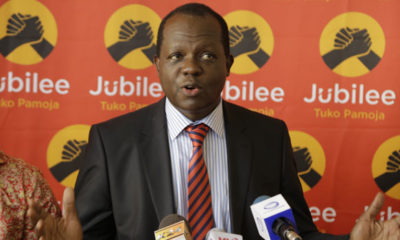
The Judge In The Room: Questions Mount Over The Commercial Court Handling The Tuju Saga As Bribery Arrests Expose What Havi Calls A Judicial Protection Racket
A retired judge soliciting Sh10.4 million in the shadow of a pending ruling. A former Cabinet secretary vowing to die before leaving his property. A sitting High Court judge whose decisions over two years have moved the case inexorably in one direction. Nelson Havi says victims of Kenya’s courts will eventually take the law into their own hands. The question the legal profession refuses to ask aloud is: whose hands are already on the scale?


When the Ethics and Anti-Corruption Commission swept into Karen on the morning of Monday, March 9, 2026, arresting former High Court judge Joseph Mutava, lawyer Kimani Wachira and two associates over an alleged Sh10.4 million bribery scheme, the news consumed Kenya’s legal circles with the ferocity of a brush fire.
What consumed the quieter minds in those same circles was a question that no public statement had yet ventured to answer: if a disgraced former judge and a lawyer were allegedly dispatched to solicit a bribe to influence the outcome of a commercial dispute before the High Court, whose ruling, precisely, were they trying to buy?
The answer, when traced through the public record of court filings, rulings and orders in a dispute that has dragged across four jurisdictions over a decade, leads to a single address in Nairobi’s Milimani Law Courts.
It is the chambers of Lady Justice Josephine Wayua Wambua Mongare of the Commercial and Tax Division.
Justice Mongare has been the presiding judge in the matter of Dari Limited and Raphael Tuju versus the East African Development Bank, Garam Investment Auctioneers and Knight Frank Valuers, in all its most consequential recent iterations.
It is her bench from which the orders clearing the path for the auction of Tuju’s multi-billion shilling Karen properties were issued. It is her name that appears on the ruling, dated March 9, 2026, the same day the EACC was arresting men allegedly sent to prevent that very ruling from taking the shape it ultimately did.
That symmetry, noted across Nairobi’s legal profession with the hushed alertness of those trained in reading between the lines of court documents, is one of the most disturbing features of a saga that senior advocate Nelson Havi has now placed squarely in the domain of systemic judicial criminality.
The Havi Indictment
Havi, whose career has been defined by a willingness to say at full volume what the bar association tends to whisper, did not mince his language.
Writing on his social media platforms this week, the former Law Society of Kenya president trained his fire on what he described as the mutually reinforcing relationship between corrupt judicial officers and the security apparatus that shields them.
“The tribulations of Raphael Tuju and Irungu Nyakera in the hands of criminals facilitated and protected by the police confirms how corrupt the judicial system in Kenya is,” Havi declared.
He went further, issuing a warning that courts of law have historically tended to ignore until its consequences materialise in irreversible ways: “If these known corrupt judges do not stop collecting bribes to auction justice, they will compel their victims to take the law into their own hands.”
The language is deliberately incendiary.
It is also, for those who have followed the Tuju property dispute across its many years and many courts, the kind of language that emerges when a lawyer of Havi’s standing concludes that the formal channels have been comprehensively captured.
What gives Havi’s statement its specific gravitational pull this week is the context in which it lands. The EACC arrests on March 9 were not made in a vacuum.
They followed Tuju’s own public account of events at his Dari Business Park on Ngong Road, where he alleged that individuals identifying themselves as Mr Chebet, Mr Kiprono and Mr Kiprop had arrived claiming to have purchased the property.
(Click to watch video of the arrest)
cce540333edc81614a72b350cbfd27b8cf4fd131
Among those arrested, Tuju confirmed, was a former judge, a lawyer and a broker who he alleged had come to his residence claiming to act on behalf of a judge and demanding money in exchange for influencing the direction of his case.
“They will have to kill me first and organise a big burial for me in Rarieda before they take this property,” Tuju told reporters gathered at the property this week, a man whose defiance has taken on the quality of someone who believes the law has become the instrument of his destruction rather than his protection.
Two Years of Rulings, One Direction
To understand why questions about the commercial court’s conduct have moved from whispered to urgent, it is necessary to trace Justice Mongare’s engagement with the Tuju matter from its earliest recent stages.
In May 2025, it was Justice Mongare who issued interim orders temporarily halting the auction of Dari Business Park and the Entim Sidai Wellness Sanctuary, properties collectively valued at several billion shillings.
At that moment, she was the judge granting Tuju the lifeline he sought, extending the orders and directing that the status quo be maintained until June 24 of that year. The legal community noted this with approval. The bank and its auctioneers were restrained. The properties stayed in Tuju’s possession.
By October 2024, however, the winds in that courtroom had shifted with a completeness that Tuju’s legal team has since characterised in court filings as a cause for alarm. Justice Mongare had, per those filings, issued orders barring Garam Investment Auctioneers, Knight Frank Valuers and the East African Development Bank from disposing of the properties pending the hearing of applications. Those orders were extended on October 20, 2024 and again on February 6, 2025.
Yet the transfer of title to one of the contested properties was allegedly processed and booked for registration on November 29, 2024, and reportedly proceeded to completion on February 18, 2025, a sequence of events that Tuju’s lawyers described in court documents as a brazen violation of subsisting court orders.
Tuju reported the matter to Karen Police Station. He wrote to the Chief Land Registrar. He accused a DCI official of accompanying individuals from Ultra Eureka Limited, the mystery buyer of the Dari Business Park property, to the premises in January 2025 to assert ownership.
The standard of judicial oversight that would ordinarily address such alleged contempt did not materialise in the way Tuju hoped. His lawyers wrote to the Ministry of Lands requesting manual registration of orders. No response arrived. The Registrar’s office, he claimed, had been told the orders did not bind it.
By March 9, 2026, Justice Mongare’s position in the matter was unambiguous. In a ruling whose language was designed to close every remaining door, she struck out Dari Limited’s amended application, describing it as “a blatant abuse of court process, meant to frustrate lawful recovery efforts after years of default and litigation.” The suit, she ruled, was res judicata. The properties were available for auction. The road to Dari Business Park and Entim Sidai Wellness Sanctuary was clear for Garam Investment Auctioneers and those who had acquired title.
The ruling was issued on the same day that the EACC arrested former judge Mutava and his associates on suspicion of soliciting a bribe to influence the very commercial dispute that Justice Mongare’s bench was simultaneously resolving.
The Question No One Is Asking Officially
Kenya’s judicial accountability architecture is designed with deliberate friction. Complaints against sitting judges pass through the Judicial Service Commission.
Investigations of that nature are slow, confidential and rarely terminal for the subject.
The EACC’s mandate covers what it characterises as judicial corruption, but the agency has been careful in its public statements about the Mutava arrests to describe the alleged bribery as an attempt to influence “a case pending before the High Court,” without naming the presiding judge.
That silence is not incidental. It is the institutional language of a system navigating a distinction between a judge whose integrity is intact but whose rulings happen to benefit one party in a bribery scheme, and a judge whose conduct is the scheme. The EACC has not alleged the latter. Neither has Havi, at least not by name.
But the architecture of the question that Havi is asking does not require a named allegation to be devastating.
He is asking why the victims of what he calls corrupt judicial conduct are expected to absorb the consequences of that conduct with the equanimity of people who still trust the institutions destroying them.
He is asking why the police, the same police who accompanied Ultra Eureka operatives to Tuju’s property in January 2025 according to Tuju’s own court filings, are the guarantors of the orders that have dispossessed him.
He is, above all, asking what it means that the men allegedly sent to solicit a bribe arrived at Tuju’s property claiming to act on behalf of a judge. Not a party to the litigation. Not a bank or an auctioneer. A judge.
The Biography of a Consequential Bench
Justice Josephine Wayua Wambua Mongare was appointed to the High Court in 2022, arriving with credentials that the Judiciary’s own profile describes as international in scope.
She holds a Master of Laws degree from Loyola Law School at Loyola Marymount University in Los Angeles, a Bachelor of Laws from the University of Nairobi and a postgraduate diploma from the Kenya School of Law.
Before her appointment, she had served as a senior partner at her own firm and as a consultant in gender, human rights and governance for the United Nations Office on Drugs and Crime, the Red Cross and UNICEF. She was assigned to the Commercial and Tax Division at Milimani.
The Commercial Division is where Kenya’s most consequential private disputes are resolved. It is where the east meets the west of Nairobi’s business class, where bank debt and property ownership intersect with judicial discretion in ways that have historically attracted precisely the kind of interest that the EACC is now investigating. Appointment to that division carries prestige. It also carries exposure.
In the Tuju matter, Justice Mongare has presided over a case involving a Sh4.5 billion loan dispute, properties with an aggregate market value exceeding Sh2 billion, auctioneers with a commercial interest in completion of the sale, a regional development bank with a decade-old foreign court judgment in its favour, and a former Cabinet secretary who has accused every actor in the process, from land registrars to DCI officers, of conspiring against him.
It is among the most politically and financially combustible cases on the Commercial Division’s docket.
Whether the bribery scheme that the EACC disrupted on March 9 was intended to buy a ruling that had already been written, or to prevent one that was about to be issued, or to initiate a process of influence whose ultimate target was the bench itself, are questions that the EACC’s ongoing investigation will need to resolve.
What is already in the public record is that the case was before Justice Mongare. That the ruling came on the day of the arrests.
That Tuju identified the suspects as claiming to act on behalf of a judge.
And that Nelson Havi has concluded, loudly and without retraction, that Kenya’s judiciary is collecting bribes to auction justice.
The Tuju Ultimatum
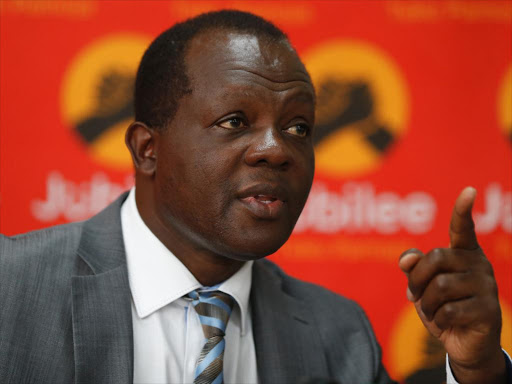
Raphael Tuju.
Tuju has not framed his defiance in the language of legal procedure. He has framed it in the language of a man who believes procedure has been used against him as a weapon.
His declaration that auctioneers would need to organise his burial in Rarieda before taking the Karen property is the statement of someone who has concluded that the courts no longer offer him a remedy. That conclusion, whether or not it is legally accurate, is politically and socially significant.
Tuju is not a marginal figure. He is a former Cabinet secretary, a former member of Parliament, a former senior official of a ruling party.
If a man with those resources and those connections can stand before journalists at his own property and tell them that he expects to be killed before the law takes its course, the statement carries an indictment of the legal system that no bar association communique can adequately address.
His allegation that Monday’s events involved men claiming to act on behalf of a judge gave the EACC an entry point.
The arrests that followed gave the anti-corruption agency a case file. But the architecture of what Tuju is describing, in which judicial decisions, property transfers, police facilitation and bribery schemes operate as a coordinated machinery of dispossession, is not a case file. It is the description of a captured institution.
A Judiciary on Trial
Havi’s reference to Irungu Nyakera alongside Tuju is deliberate and illuminating.
Nyakera, the Nairobi gubernatorial aspirant and patron of the Democracy for Citizens Party, is embroiled in his own property standoff in Kisumu, where the Lake Basin Development Authority has declared him an unlawful occupant after his lease was terminated over Sh25.9 million in rent arrears.
On March 11, more than one hundred individuals allegedly stormed Fairways Hotel, which Nyakera operates, prompting him to fire warning shots. LBDA disowned any knowledge of the attack while reiterating court orders in its favour.
Havi’s point is that the convergence of these two cases, a former Cabinet secretary and a former principal secretary both contesting court-backed evictions in the same week, and both linking police facilitation to their dispossession, is not coincidence.
It is the texture of a judicial system that has, in his characterisation, become an extension of the interests it was constituted to adjudicate against.
The Mutava arrests will generate a prosecution. The prosecution will generate a trial.
The trial, if Kenya’s recent history of high-profile corruption cases is the guide, will generate years of adjournments, procedural battles and eventually, in some courts, outcomes that satisfy no one.
What will not be generated, unless the Judicial Service Commission or the EACC moves with unusual urgency and unusual candour, is any formal examination of the bench from which the rulings in the Tuju matter have issued.
Justice Mongare is a sitting judge. She has not been accused of any wrongdoing. Her rulings are on the record.
They are the rulings of a court that has found, consistently and at every level from the High Court to the Supreme Court, that Tuju’s legal challenges to his property’s auction are without merit.
The fact that men were allegedly sent to pay for a different outcome on the same day that outcome was finalised is, in the absence of evidence directly implicating her, a coincidence that her judicial biography must carry without explanation.
But in the Kenya that Nelson Havi is describing, coincidences of that texture have a weight that formal legal standards alone cannot discharge.
And the question of what Lady Justice Josephine Mongare knew, and when she knew it, and whether she ever knew anything at all, is not a question that the legal profession’s culture of deference to the bench will permit anyone to ask in public for very long.
It is being asked in private, by lawyers who know this case, every single day.
Kenya Insights allows guest blogging, if you want to be published on Kenya’s most authoritative and accurate blog, have an expose, news TIPS, story angles, human interest stories, drop us an email on [email protected] or via Telegram





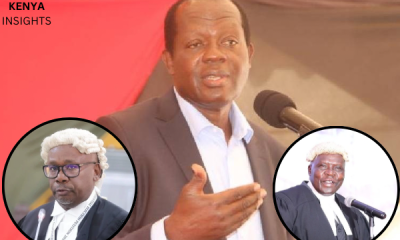




The Judge In The Room: Questions Mount Over The Commercial Court Handling The Tuju Saga As Bribery Arrests Expose What Havi Calls A Judicial Protection Racket

How Little-Known Pesa Print, Linked to State House Tycoons, Won NTSA Tender Worth Sh42 Billion in Traffic Fines

Nyakera Accuses Interior PS Omollo of Orchestrating Predawn Raid on His Kisumu Hotel in Bid to Seize Sh235m Property

THE DIRT: Dissecting Five Firms Requesting Mining Licenses in Kenya

Caught On Camera: Everything You Need To Know About NTSA’S Instant Fines System

Sudan Wants RSF Declared Terrorist Group

The New Master of the Nation: How a Tanzanian Billionaire With a President in His Pocket Just Bought Kenya’s Most Powerful Press

Madagascar Leader Michael Randrianirina Dissolves Government In Surprise Move

CS Wandayi Convenes An Emergency Meeting With Oil Marketers Amid Fears Of Fuel Shortages in Kenya

Sh50 Billion Vanished: Audit Exposes Massive Looting Inside Kenya’s SHA

Alleged Male Lover Claims His Life Is in Danger, Leaks Screenshots and Private Videos Linking SportPesa CEO Ronald Karauri

Russian Man’s Secret Sex Recordings Ignite Fury as Questions Mount Over Consent and Easy Pick-Ups in Nairobi

THE FIRM IN THE DOCK: How Kaplan and Stratton Became the Most Scrutinised Law Firm in Kenya

Multi-Million Dollar Fraud: Three Kenyans Face US Extradition in Massive Cybercrime Conspiracy

Iran Demands Arrest, Prosecution Of Kenya’s Cup of Joe Director Director Over Sh2.6 Billion Tea Fraud

Ex-Inchcape Kenya CEO Sanjiv Shah Charged With Bank Fraud

FBI Investigates Congresswoman Ilhan Omar’s Husband’s Sh3.8 Billion Businesses in Kenya, Somalia and Dubai

A Farm in Kenya’s Rift Valley Ignites a National Reckoning With Israeli Investment

A UN Director Based in Nairobi Was Deep in an Intimate Friendship With Epstein — He Even Sent Her a Sex Toy

Kenya Strips Dutch Climate Body of Diplomatic Immunity Amid Donor Fraud Scandal and Allegations of Executive Capture
-
 News1 week ago
Ex-Inchcape Kenya CEO Sanjiv Shah Charged With Bank Fraud
-
 Development1 week ago
Kenya Strips Dutch Climate Body of Diplomatic Immunity Amid Donor Fraud Scandal and Allegations of Executive Capture
-

 Business2 days ago
Waweru’s Bank Pockets Sh1.16 Billion from KPC IPO While Ordinary Kenyans Fled the Sale
-

 Politics2 weeks ago
NIS Kismu Hotel Secret Tape That Sealed Gachagua’s Fate and MP Ng’eno Death in A Chopper Crash
-

 Investigations3 days ago
SOLD TO THE BULLET: How the Bodyguard Handed MP Ong’ondo Were to His Killers
-
 News2 weeks ago
Investor Sued Over Sh30,000 Fee to Access Runda Road
-

 Investigations1 week ago
I Swore Never To Hire The Chopper Again, Author Recalls Harrowing Experience in Helicopter That Killed MP Ng’eno Alleges Poor Maintenance By Owners
-

 Investigations2 weeks ago
Did Festus Omwamba Take the Fall? The Puzzle of a Senator’s Ouster and a Call to the CS