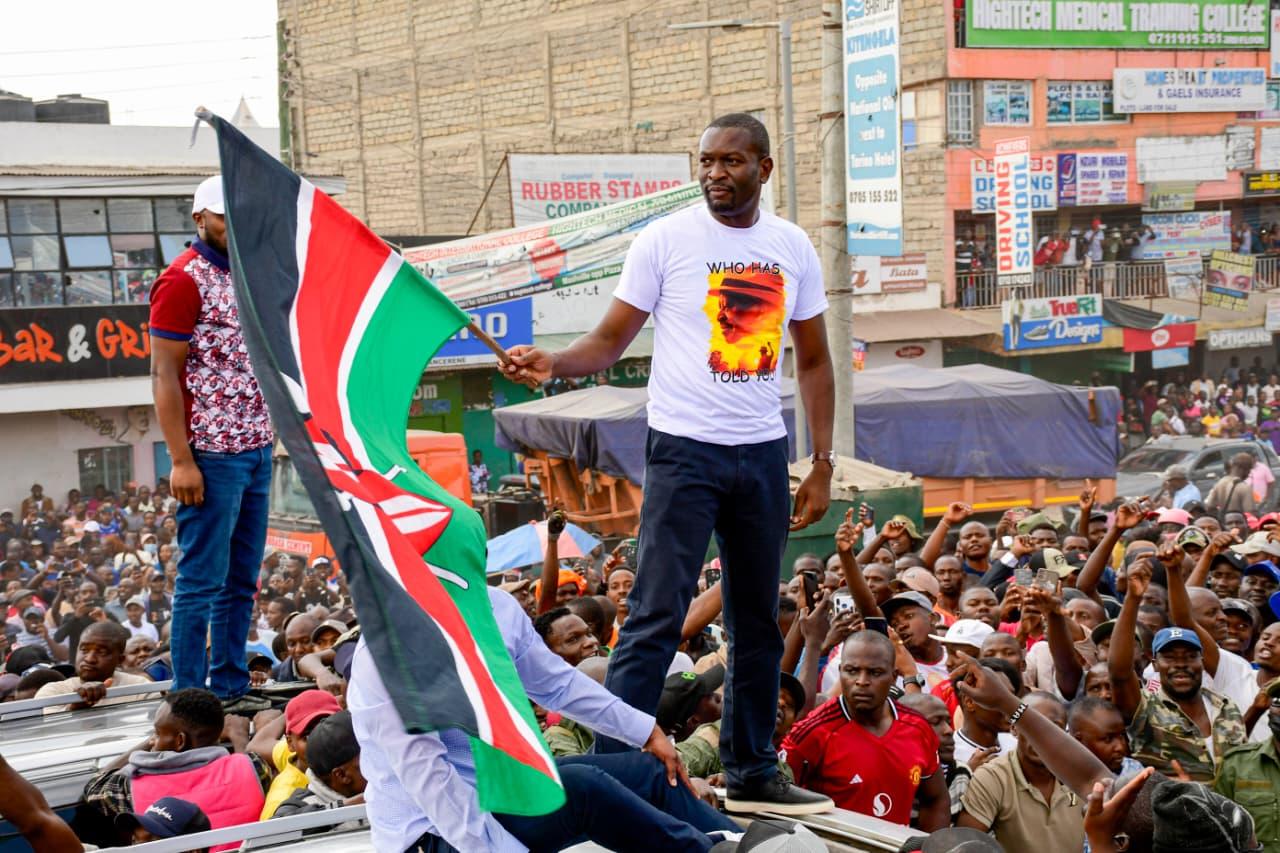
Nairobi Senator Edwin Sifuna has, for the first time, strongly indicated he is ready to answer the call for the presidency in 2027, declaring that the Linda Mwananchi movement is undertaking a digital census of supporters to build what he describes as an irresistible wave to send President William Ruto home.
In a series of interviews and rallies that have energised opposition supporters, the outspoken ODM Secretary General has sought to recast the political debate from ethnic mobilisation to what he terms people-powered regime change, warning that teargas and intimidation will not silence a growing movement.
“I have answered the question. I have said that when the call comes, you cannot run away,” Sifuna told NTV on Tuesday when pressed about his presidential ambitions, in what allies describe as his clearest signal yet that he is positioning himself for the country’s top job.
Speaking on Nation FM, Sifuna drew a sharp contrast with the current administration, dismissing development metrics as a campaign tool.
“Please don’t ask me how many kilometres of road I am going to do. Can I just guarantee you that I will not kill your children? Can I just offer that guarantee?” he posed, framing the 2027 contest as a referendum on governance and human rights rather than infrastructure promises.
Sisi ndio Sifuna, the people versus the state
At the heart of Sifuna’s political strategy is a deliberate attempt to de-personalise the movement while building an infrastructure capable of challenging the Kenya Kwanza coalition’s ground network. He has repeatedly insisted that Linda Mwananchi must outlive any single political figure.
“Don’t make this thing about Sifuna,” he cautioned during the NTV interview, warning that movements collapse when built around individuals. “If only one person stands out, it is very easy to be knocked off the pitch.”
Even as he downplays his own candidacy, Sifuna is assembling what insiders describe as a parallel political structure. Young volunteers are developing a digital platform to allow supporters to register and contribute resources, from sound equipment to vehicles, creating a crowd-sourced campaign machine that bypasses traditional party funding channels.
“We need to know what the numbers are and the sort of infrastructure we need to put in place to harness all this support,” he said. “We need to know how many we are. Is it five million of us, 10 million, or 20 million? It has to be a structured process, not just shouting numbers.”
Voter turnout and the numbers calculus
Sifuna’s focus on numbers reflects an assessment of Kenya’s electoral mathematics. The Independent Electoral and Boundaries Commission is targeting 6.8 million new voters ahead of 2027, with projections pointing to a register of about 27 million voters.
He argues that Kenya does not have a voter registration problem but a turnout problem, citing the 64 per cent turnout in 2022, down from 78.9 per cent in 2017, as evidence that apathy has hurt the opposition more than alleged rigging.

“All of us who are saying Ruto must go must be available to vote him out,” Sifuna said, insisting that unity and high turnout are the only viable paths to victory.
Veteran lawyer Gitobu Imanyara recently echoed similar sentiments, arguing that overwhelming turnout would make manipulation mathematically difficult.
Confrontations and state pushback
The Linda Mwananchi rallies have already encountered resistance. In Kitengela, police dispersed supporters with teargas. In Kakamega, Sifuna claimed his travel plans were leaked, forcing his team to alter their landing plans to avoid disruption.
“I want to warn the state that it will take more than teargas to stop the voice and the movement of the people,” he said, dismissing remarks by Interior Cabinet Secretary Kipchumba Murkomen that the chaos was stage-managed.
Sifuna has called on the Independent Policing Oversight Authority to investigate the use of teargas at his rallies, saying canisters can be traced to specific stations and officers.
A crowded opposition field
Sifuna’s emergence as a potential contender complicates an already fragmented opposition landscape. Wiper leader Kalonzo Musyoka has positioned himself as a possible coalition flagbearer, while former Deputy President Rigathi Gachagua has sought to rally like-minded leaders. Former Interior Cabinet Secretary Fred Matiang’i has also signalled interest in a structured nomination process.
Rather than consolidating under a single party, Sifuna appears to favour a coalition-style arrangement that allows leaders to retain their political vehicles while pursuing a shared reform agenda.
Political analyst Joseph Mutua said the approach preserves room for negotiation and realignment as 2027 approaches.
ODM tensions
Sifuna’s stance has exposed fault lines within the Orange Democratic Movement . Party leader Raila Odinga is part of the broad-based government arrangement, while his brother Oburu Odinga has publicly indicated support for Ruto’s re-election.
Vihiga Senator Godfrey Osotsi has countered that ODM has several leaders capable of running for president, naming Sifuna among them.
Sifuna, who has faced attempts by party officials to remove him as Secretary General, has maintained that the party’s 2027 direction will ultimately be decided by its members.

The Luhya factor
Beyond coalition arithmetic, Sifuna has reignited debate about a possible Luhya presidency. Speaking in Kakamega during the burial of former Lugari MP Cyrus Jirongo , he challenged Prime Cabinet Secretary Musalia Mudavadi and National Assembly Speaker Moses Wetang’ula, both of whom support Ruto.
“To Musalia Mudavadi and Moses Wetang’ula, we want to be on the presidential ballot in 2027. Since you have said you can wait for 2032, support our bid,” Sifuna said.
He argues that the 2027 race should centre on civil liberties, police accountability and constitutionalism rather than ethnic arithmetic or elite power-sharing.
As he prepares to resume rallies in Mombasa and other regions after the Ramadan break, Sifuna insists the movement is only beginning.
Whether Linda Mwananchi can translate online momentum and street mobilisation into electoral power remains to be seen. But with his latest remarks, Sifuna has unmistakably placed himself in the 2027 conversation, setting up a direct contest with both the government and sections of his own party.





Comments