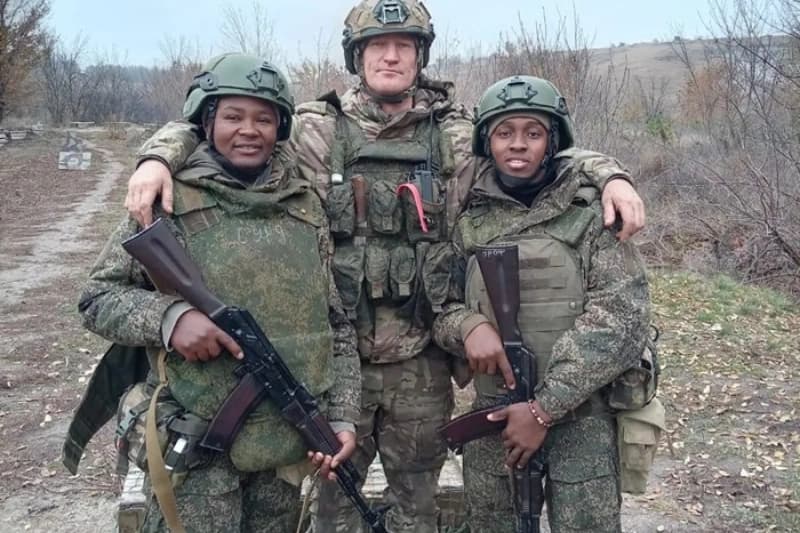
NAIROBI — They were told they would be security guards. One expected to work as a salesman. Another believed he was headed to Russia as a high-level athlete. Instead, all of them were handed weapons after three weeks of perfunctory military training and sent to the front lines of one of the bloodiest conflicts in modern European history.
More than 1,000 Kenyans have now been trafficked into Russia’s war against Ukraine, according to a classified joint report by the National Intelligence Service and the Directorate of Criminal Investigations that was tabled before Kenya’s National Assembly on Wednesday. The figure — far exceeding previous government estimates — has ignited a parliamentary firestorm and triggered demands for the exposure and prosecution of state officials who investigators say are complicit in what amounts to an industrial-scale human trafficking operation with blood on its hands.
The report, presented by National Assembly Majority Leader Kimani Ichung’wah, describes a criminal syndicate so deeply embedded in Kenya’s government apparatus that it has corrupted officers in immigration, the criminal investigations directorate, the anti-narcotics unit, the National Employment Authority and, most shockingly of all, staff inside both the Russian embassy in Nairobi and the Kenyan embassy in Moscow.
“Government offices are not to be used for criminal activities,” Ichung’wah told a hushed House. “Our embassy must be the place where Kenyans can seek refuge, not exploitation.”
The human toll documented in the report is stark. As of this month, 89 Kenyans remain on active front lines in eastern Ukraine. Thirty-nine are hospitalized. Twenty-eight are missing in action. Thirty-five remain confined to Russian military camps. At least 10 confirmed deaths have been recorded — a figure that separate tallies suggest could be as high as 18. Four Kenyans are currently held as prisoners of war in Ukrainian custody. One has completed his contract. One is detained.
The families of those men and women have been left to agonize in silence, some clutching photographs of sons and brothers who vanished months ago after telling relatives they were off to find work abroad.
A Recruitment Machine Hiding in Plain Sight
The operation, investigators found, was not improvised. It was systematic, well-funded and brazen.
Rogue recruitment agencies — at least one of them operating from a commercial address along Koinange Street in central Nairobi and hiding behind the branding of the government’s legitimate Kazi Majuu overseas employment initiative — have been actively head-hunting targets for the Russian military. Their preferred recruits: former Kenya Defence Forces personnel, ex-police officers and unemployed civilians between their mid-twenties and early fifties, men and women desperate enough to believe an offer that seemed, in hindsight, almost too good to be true.
The promised terms were extraordinary. Monthly salaries of approximately 350,000 Kenyan shillings. Signing bonuses ranging from 900,000 shillings to 1.2 million. And the ultimate carrot: eventual Russian citizenship for those who survived long enough to collect it.
What the recruits were not told was that the contracts they signed in Kenya — and countersigned with a shadowy overseas employment agency in Moscow — were written in Cyrillic, a script none of them could read. By the time they understood what they had agreed to, they were already in military camps.
“They are basically just giving you a gun to go and die,” Ichung’wah told Parliament, his voice tight with barely contained fury.
Victims paid as much as 1.6 million shillings in recruitment fees for the privilege of being trafficked. Bank accounts linked to key suspects have since been frozen. Passports, contracts and electronic communications have been recovered as evidence. Multiple arrests are expected.
A State Within the State
What has most alarmed lawmakers is not the existence of rogue private recruiters — those, at least, can be deregistered and prosecuted. What has alarmed them is the evidence that the network could not have operated without active protection from inside the Kenyan government itself.
According to the NIS-DCI report, colluding officials from the Directorate of Immigration Services, the DCI and the National Employment Authority facilitated the movement of recruits through Jomo Kenyatta International Airport without interception. Embassy staff in Moscow helped issue the visit visas that made the travel possible. When airport scrutiny intensified after earlier exposures, traffickers simply rerouted their human cargo through Uganda, the Democratic Republic of Congo and South Africa, exploiting the region’s more porous border systems.
In September 2025, a DCI raid on Great Wall Apartments uncovered 22 victims aged between 24 and 38, being held under the supervision of two Kenyans operating on behalf of a Russian national. The Russian was arrested the following day — and deported back to Russia within 24 hours, raising immediate questions about whose interests were being protected and why justice moved so swiftly in his favor.

Ichung’wah demanded answers. “The Ministry of Interior, through the State Department for Immigration Services, must pinpoint the officers colluding with criminals. The same applies to the DCI and the National Employment Authority. Our ambassador in Moscow must identify the officers within the embassy that may have colluded with these criminals.”
Taita Taveta Woman Representative Lydia Haika, whose parliamentary committee has been flooded with complaints about overseas exploitation, noted that the National Employment Authority had blacklisted some agencies — but that many others continued to operate. “These are issues that come to our committee every day,” she said.
A Continent Being Harvested
Kenya’s crisis is not happening in isolation. Ukraine’s Foreign Minister Andrii Sybiha said in November that Kyiv had identified at least 1,436 foreign nationals from 36 African countries fighting on Russia’s side, warning that the true number was almost certainly higher. A February 2026 report by INPACT, a Swiss-based investigative organization, identified 1,417 African men who since 2023 have signed formal contracts to enlist with Russian forces. Recruitment, the report found, has been accelerating steadily — rising from 177 cases in 2023 to 592 in 2024 and 647 in 2025.
Cameroon leads African nations in confirmed deaths, with between 94 and 96 of its nationals killed in combat. Kenya’s confirmed death toll, while officially lower, is almost certainly undercounted. Identifying and repatriating the dead has proven agonizingly difficult. Foreign Minister Musalia Mudavadi, who announced plans in February to visit Moscow to demand formal bilateral protections for Kenyan citizens, told the BBC that some bodies had been found in Ukrainian territory, requiring coordination with Kyiv even to begin the process of bringing the dead home.
Russia, for its part, has built an elaborate architecture of deception to sustain its African recruitment pipeline. A website called “Fight for Russia,” hosted on Russian servers and launched in January 2025, has carried online application forms for foreign volunteers. Social media campaigns run by influencers, many of them African fighters-turned-ambassadors for Russian military service, have been deployed to reach young men on the continent through platforms they already use daily. In some cases, the FSB, Russia’s federal security service, has been directly implicated in coordinating the networks.
For those who refuse the pitch or try to turn back after arriving, the choices are brutal. Illegal immigrants intercepted in Russia, the INPACT report found, are given two options: deportation, or a contract with the Russian army.
The Economy Behind the Desperation
Every parliamentarian who rose to speak on Wednesday returned, eventually, to the same uncomfortable truth: the traffickers are exploiting a real and desperate hunger for economic survival.
Funyula MP Wilberforce Oundo noted that Kenyans pursue manual and low-skilled jobs abroad not from recklessness but from extreme economic hardship. Baringo North MP Joseph Makilap called on the DCI and NIS to interrogate agencies suspected of sending Kenyans to conflict zones, and urged the government to create local reintegration pathways — farm work, vocational training — for those who have already returned, many of them traumatized, some amputated, some barely functioning.
“The only way we can save ourselves,” said Oundo, “is to continuously build this economy so each Kenyan can have a job. Otherwise, many young people end up maimed or dead in conflict zones.”
Ichung’wah echoed the warning, urging job seekers to verify overseas employment offers exclusively through licensed and regulated agencies. He reminded Kenyans that the Kazi Majuu program — the legitimate government initiative whose name and branding the traffickers have been stealing — exists precisely to provide verified overseas opportunities through channels that do not end in military camps in Kursk Oblast.
What Happens Next
Investigations are ongoing. Kenyan authorities say more arrests are imminent. Foreign Minister Mudavadi’s planned visit to Moscow, if it takes place, will seek a formal bilateral agreement barring the conscription of Kenyan nationals. Kenya has already deregistered more than 600 non-compliant recruitment agencies since the scandal broke.
But the parliamentary session on Wednesday made clear that accountability within the state itself remains the harder problem. Names have not yet been named. The rogue immigration officials, the complicit DCI officers, the embassy staff in Moscow — none have been publicly identified or charged.
Until they are, as Ichung’wah made plain, the pipeline remains open.
“They have made other Kenyans lose lives,” he said. “Others suffer in the battlefield. And the emotional turmoil that the families are going through.”
Outside Parliament, in houses across Nairobi and Kisumu and Eldoret and the Western counties, those families are still waiting for their sons to call.
Reporting contributed by correspondents in Nairobi. Additional information drawn from NIS-DCI intelligence findings presented to the National Assembly, statements by Kenya’s Ministry of Foreign Affairs, and reports by INPACT, France 24, The Washington Post, and Al Jazeera.






Comments