
Africa
Court Rules In Favor Of Somalia In Maritime Border Row With Kenya

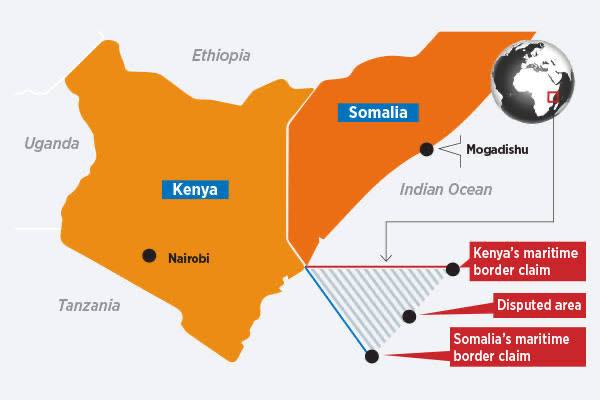
The UN’s top court has ruled largely in favour of Somalia in its long-running dispute with Kenya over their maritime border.
Kenya said on Friday that in addition to withdrawing its participation from the current case, it had joined many other members of the U.N. in withdrawing its recognition of the Court’s compulsory jurisdiction.
It previously accused the International Court of Justice of bias and said it will not accept the ruling.
The case concerned a 38,000 sq mile (100,000 sq km) triangle in the Indian Ocean that is thought to be rich in oil and gas.
The dispute has been at the heart of a diplomatic row between the neighbours.
For the past four decades, Kenya has said a line due east of the point where the two countries meet at the coast represents the maritime border.
Somalia, however, argued in court that the sea frontier should follow on in the same direction as the land border.
The panel of 14 judges sitting in The Hague said that Kenya had not proved that Somalia had previously agreed to its claimed border.
Instead, they drew a new line which has split the disputed area in two.
But with Kenya refusing to recognise the ICJ’s jurisdiction it is not now clear what will happen. The court has no means to enforce its rulings.
In 2009, the two countries had agreed in a memorandum of understanding, backed by the UN, to settle the boundary dispute through negotiation.
But five years later, Somalia said the talks had failed and it went to the ICJ instead. The Reuters news agency reports that Somalia was angered by Kenya selling exploration licenses in the disputed zone to two multinationals in 2012.
The court is supposed to be the final arbiter in disputes between nations.
Kenya argued unsuccessfully that the ICJ should not be involved as the memorandum of understanding was binding.
Then in March it refused to take part in hearings after having asked for a delay to brief a new legal team.
It also objected to the presence on the ICJ panel of a Somali judge, saying he should recuse himself.
Last week, Kenya’s government described the case as a “flawed judicial process”. It added that there was “inherent bias” and that the court was an unsuitable way to resolve the dispute.
Kenya Insights allows guest blogging, if you want to be published on Kenya’s most authoritative and accurate blog, have an expose, news TIPS, story angles, human interest stories, drop us an email on [email protected] or via Telegram











Nyali MP Moha Jicho Pevu Caught Up In Alleged Sh44 Million KPA Debt Scam

Somalia Deputy PM Held at JKIA, Deported Over Questionable Acquisition of Kenyan Passport

The White-Coat Heist: How MP Shah Hospital Ran a Decade-Long Double-Extraction Racket While Hiding Behind Charity Status

The Patriarch, His Children, and a Buried Sh3.9 Billion Fraud: The Story of Titus Muya That Kenya Was Never Meant to Read

The Founder’s Ransom: How Titus Muya Had to Be Paid Sh231 Million to Let Go of Family Bank and Why That Bill Is Now Yours

Kenya’s gambling industry pushes back against a licensing bill

Kenya Airways Sinks Into Deeper Turbulence As American Supplier Sues In New York Court Over Sh129 Million Unpaid Debts

Kenyan player wins a Ksh3.2 million jackpot

IEBC Sets August 10 Date For 2027 General Election

Furious Ruto Lashes Out at Gideon Moi Over Repeated ‘Blackmail, Extortionist’ Headlines on The Standard and KTN

Businessman Philip Waithaka Kinuthia’s Minor Son Allegedly Drove Drunk, Killed Two Peponi Students in Ngong Road Horror Crash as Claims of Cover-Up Intensify

Inside NCBA’s Decline: How a Banking Giant Lost Its Strategic Edge

South Sudan: Adut Salva Kiir’s Shadow Treasury Exposed

Cement, Cash and Courts: How the Hashu Dynasty Crushed the Ramji Brothers for Fourteen Years and Why the Walls Are Now Closing In

Standard Chartered Ghosts Haunt Joshua Oigara At Stanbic As Whistleblower Spills Beans

Inside The Urban Planning Cartel That Owns Nairobi

THE VULTURE AND THE SCHEME How Nairobi West Hospital Became the Most Dangerous Institution in Kenya’s SHA Ecosystem and Why the Books Must Be Audited Now

The President’s Daughter and The Missing Witness: How Adut Salva Kiir’s Shadow Treasury Silenced Its Most Dangerous Critic

How Adil Popat Saved His Empire On The Eve Of Imperial Bank Collapse and Why Kenya’s Mainstream Media Buried The Story

Why John Ngumi Is Running From the EACC and Why the Sh415 Million Payday May Be the Least of His Worries
-
 News2 weeks ago
Businessman Philip Waithaka Kinuthia’s Minor Son Allegedly Drove Drunk, Killed Two Peponi Students in Ngong Road Horror Crash as Claims of Cover-Up Intensify
-
 Investigations1 week ago
THE VULTURE AND THE SCHEME How Nairobi West Hospital Became the Most Dangerous Institution in Kenya’s SHA Ecosystem and Why the Books Must Be Audited Now
-
 Business4 days ago
BURRIED TWICE: The Victoria Bank CEO Yogesh Pattni Files
-

 Business1 week ago
Inside the Billion-Shilling Betrayal: How Senior Treasury Officials Plundered a UN Poverty Fund and Built a Real Estate Empire on the Backs of Kenya’s Rural Poor
-

 Business1 week ago
The Listing That Doesn’t Lie: What the Market Isn’t Saying About Family Bank’s NSE Debut
-

 Business1 week ago
The Banker Who Walked Away: How Yogesh Pattni Survived a Financial Crime Scandal That Shook Kenya
-

 News6 days ago
My Life Is In Danger: Investor Drops Bombshell Expose On Thomas Ogutu CEO VeGrid Ltd And Fugitive Nairobi CEC Charles Kerich – DCI Inaction And Corruption Network Exposed
-
 Business13 hours ago
The Patriarch, His Children, and a Buried Sh3.9 Billion Fraud: The Story of Titus Muya That Kenya Was Never Meant to Read