
Africa
Kenya Starts Pullout From Haiti as MSS Mission Ends
United States soldiers have arrived in Haiti in recent days, while American warships have taken positions off the Haitian coast to block arms smuggling routes that have fuelled gang expansion.

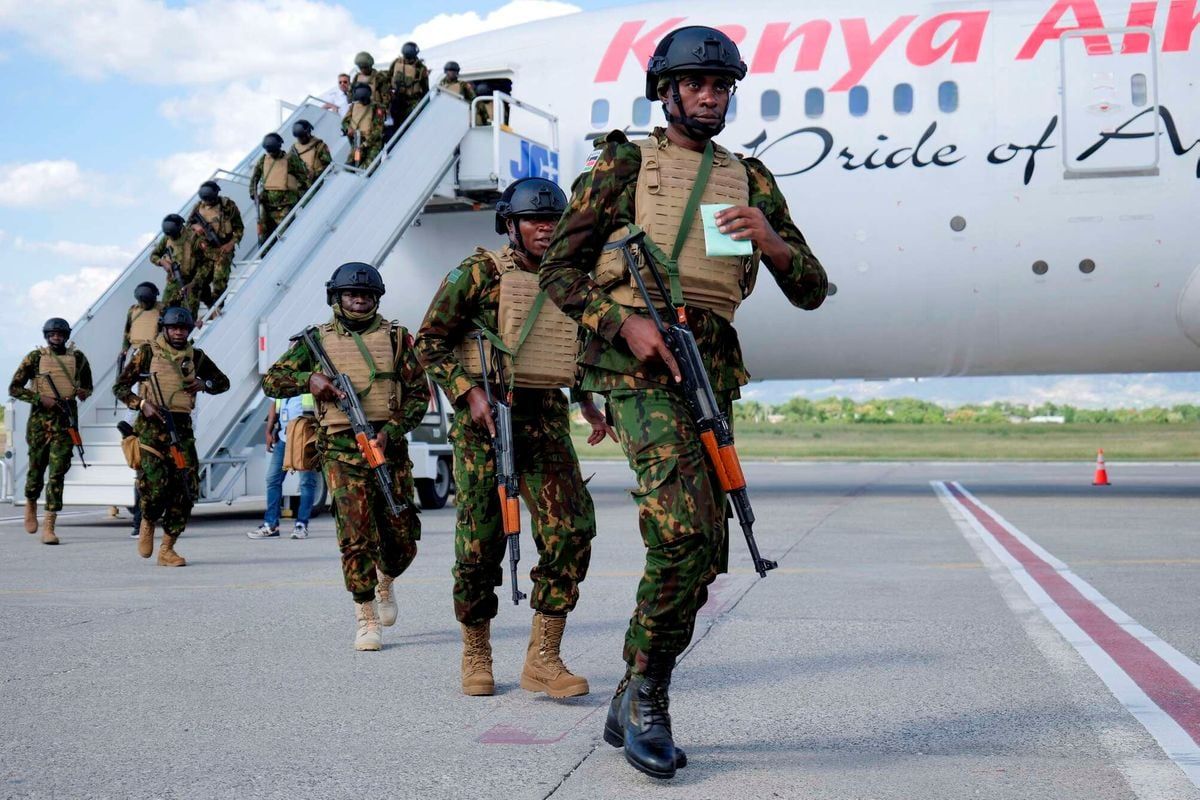
Kenya has started drawing down its police deployment in Haiti as the mandate of the Kenya-led Multinational Security Support mission comes to an end, marking a transition to a new, more robust international force tasked with confronting the country’s powerful criminal gangs.
The deadline for the deployment of Kenyan officers under the newly constituted Gang Suppression Force falls today, Saturday, February 7, signalling the formal close of the MSS mission that Nairobi spearheaded amid widespread scepticism over its feasibility and risks.
Foreign Affairs Principal Secretary Korir Sing’oei said Kenya was exiting the mission having achieved what many doubted was possible when the first contingent of officers landed in Port-au-Prince.
“We have done our job, which was to bring peace and a form of stability,” Sing’oei said. “We are in a good place to begin to draw down our deployment at this point in time.”
He said the mission had faced doubts from the outset, with critics questioning whether Kenya was overstretching itself and whether the risks outweighed the benefits. More than a year later, he argued, the results demonstrated the impact of the Kenyan deployment.
“There was pessimism when we deployed. A year plus later, it is clear that the Kenyan deployment has made a huge difference,” Sing’oei said.
The MSS mission was primarily designed to stabilise key areas and build the capacity of the Haitian National Police rather than pursue gangs directly. Sing’oei acknowledged that the narrow mandate and chronic under-financing limited its operational reach, even as it restored a degree of order around critical infrastructure.
“Our mandate did not include the pursuit of the gangs themselves and that affected the overall ability,” he said, adding that Kenya had pushed at the United Nations for an expanded framework to allow more decisive action.
Those efforts culminated in the approval of the Gang Suppression Force in late 2025. The new force is a 5,550-strong multinational unit supported by the UN and guided by a Standing Group of Partners that includes the United States, Canada, Kenya, The Bahamas, Jamaica, Guatemala and El Salvador.
Unlike the MSS, which was structured largely as a policing and stabilisation operation, the GSF blends policing, counter-insurgency and maritime enforcement capabilities, with a mandate to dismantle gang strongholds, disrupt weapons trafficking and create space for a political process.
The transition is already visible on the ground. United States soldiers have arrived in Haiti in recent days, while American warships have taken positions off the Haitian coast to block arms smuggling routes that have fuelled gang expansion.
Godfrey Otunge, the MSS commander, said the handover to the new force was ongoing, with officers from various countries still arriving to join Kenyan and Haitian personnel.
“The process of transforming the MSS mission to the GSF mission is ongoing,” Otunge said.
Washington has publicly praised Kenya’s role, describing it as decisive at a moment when Haiti’s institutions were close to collapse. US Deputy Secretary of State Christopher Landau, who recently visited Kenya to meet returning officers, said Nairobi’s intervention prevented the country from falling entirely under gang control.
“The government of Haiti would not have survived the onslaught of these gangs without your presence,” Landau told Kenyan officers, calling Kenya an indispensable partner.
Even as the security architecture is reconfigured, Haiti’s political transition remains fragile. The United States has said it will continue working with Prime Minister Alix Didier Fils-Aime despite growing opposition from the Presidential Transitional Council, whose mandate also expires today.
The CPT, created under an April 2024 political accord after the resignation of former Prime Minister Ariel Henry, has been racing to install a successor leadership as its term lapses. Internal divisions have deepened, with some members proposing a new executive authority while others insist the council’s time is over.
Political actors and civil society groups have meanwhile launched a nomination process for the presidency and prime minister’s office in a bid to forge consensus leadership and pave the way for elections, even as some factions boycott the talks.
For ordinary Haitians, the withdrawal of Kenyan officers and the arrival of a new international force brings both hope and uncertainty. Diplomats warn that security gains will remain fragile without a credible political settlement and functioning state institutions.
As Kenya begins to bring its officers home, the coming weeks will test whether Haiti can align a reinforced security presence with a legitimate transitional leadership, a balance many observers say will determine whether the country stabilises or slides back into renewed chaos.
Kenya Insights allows guest blogging, if you want to be published on Kenya’s most authoritative and accurate blog, have an expose, news TIPS, story angles, human interest stories, drop us an email on [email protected] or via Telegram









Two MPs Defrauded of Sh93.5 Million in Karen Land Scam

Gachagua Rejects Sh50 Million Court Compensation, Calls It An Insult

Ghost Firm, Ghost Justice: Two Judges Fingered In KETRACO’S Sh10 Billion Scandal

SH2 BILLION HEIST EXPOSED: How Tatu City’s Foreign Masters Used Dirty Offshore Traps, London Arbitration & Mauritius Liquidation to Strip Local Investors of Their Stake

Dimba Accused of Extorting Bank Executives in Escalating Feud

Humiliated, Handed Sh1,000 and Sent Away: Furious Residents Return Nathif Jama’s Money, Accuse Governor of Arrogance and Inhumane Treatment of Sick Woman

ICC’s Karim Khan Suspended Over Sexual Misconduct Claims

The Conquest of Tatu City, A New Zealander Story

VANISHING ACT: How China Jiangxi International Pocketed Billions in Kenyan Public Contracts, Then Walked Away

THE GROUP CHAT THAT BROKE THE CARTEL: How Kenya’s Biggest Mattress Firms Used WhatsApp to Fix Your Prices, Then Used It to Destroy Themselves

Cement, Cash and Courts: How the Hashu Dynasty Crushed the Ramji Brothers for Fourteen Years and Why the Walls Are Now Closing In

Inside The Urban Planning Cartel That Owns Nairobi

Why Ruto’s Favourite Candidate Adan Mohammed Could Be Locked Out of the KRA Top Job

LifeCare on the Brink: SHA Fraud, Stolen Wages, and the Rotten Empire Jayesh Saini Built

Este Medical Kenya Fights American’s Explosive Complaints

Betika Faces DCI Probe, Directors Arrest and License Revocation Over Massive 29.5 Million Safaricom Customers’ Data Breach

The Rot Inside Absa: How Bank Insiders Are Looting Nairobi’s Customers

Inside FAFSA Fraud: How Kenyan Cybercriminals Siphoned Millions from America’s Sh12 Billion Student Loan System

Fresh Move Launched to Remove Kenya Railways MD Mainga From Office After Awarding Sh817 Million Consultancy Contract

Court Confirms Safaricom Customers Data Was Sold To Betting Companies In Seven-Year Cover-Up
-
 Investigations5 days ago
Cement, Cash and Courts: How the Hashu Dynasty Crushed the Ramji Brothers for Fourteen Years and Why the Walls Are Now Closing In
-
 Investigations4 days ago
Inside The Urban Planning Cartel That Owns Nairobi
-
 Investigations1 week ago
Betika Faces DCI Probe, Directors Arrest and License Revocation Over Massive 29.5 Million Safaricom Customers’ Data Breach
-
 Investigations5 days ago
Fresh Move Launched to Remove Kenya Railways MD Mainga From Office After Awarding Sh817 Million Consultancy Contract
-

 News2 weeks ago
Eight Students Arrested In Kenya After Suspected Deadly School Arson Attack
-
 News1 week ago
How Uhuru’s Deal With Obama In 2015 Paved Way For America’s Ebola Plan In Kenya
-

 Investigations2 weeks ago
The Invisible Hand: Al Jazeera Further Exposes How Safaricom Became The Regime’s Most Powerful Spy
-

 Business6 days ago
TRUST BETRAYED: How Senior DTB Bank Insiders Allegedly Looted Sh149 Million From a Customer’s Account Over Five Years