
Business
Kingdom Bank Aided Fraud, Court Makes A Landmark Ruling That Will Open Floodgates For Lawsuits


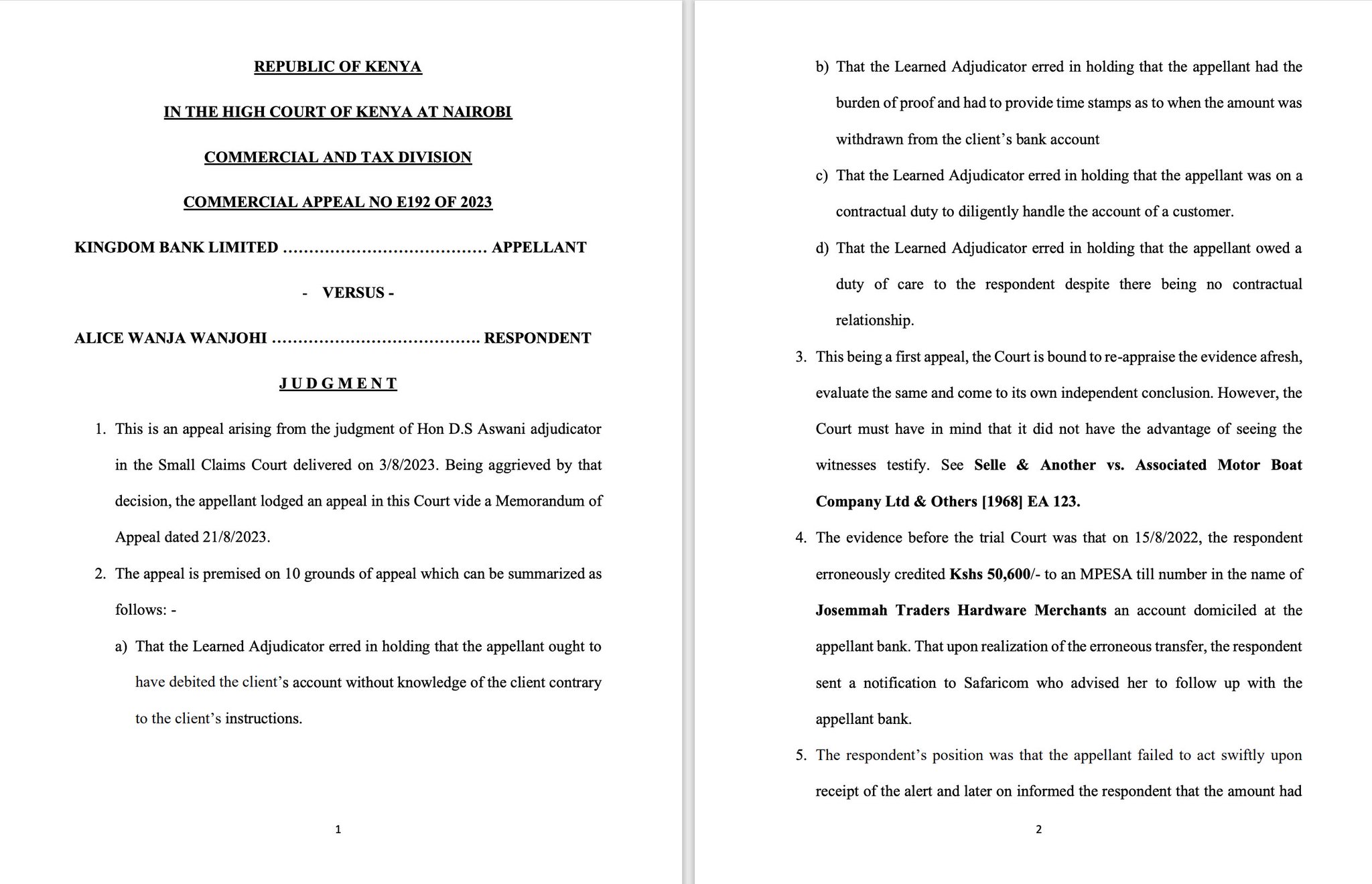
In a landmark ruling that is expected to disrupt the peace of many banks in Kenya, the High Court on March 15, 2024 upheld the decision of the Small Claims court in which a customer successfully sued Kingdom Bank a subsidiary of Co-operative bank after losing Sh50,600 he erroneously credited to an M-Pesa till number that terminated in an account domiciled at the bank. The court held that the bank was liable for the loss.
The High Court judge ruled that despite Kingdom Bank having demonstrated that money was withdrawn before the affected customer reported the erroneous transaction, it failed to show that it tried following up with the customer who withdrew the money to stop the fraud.
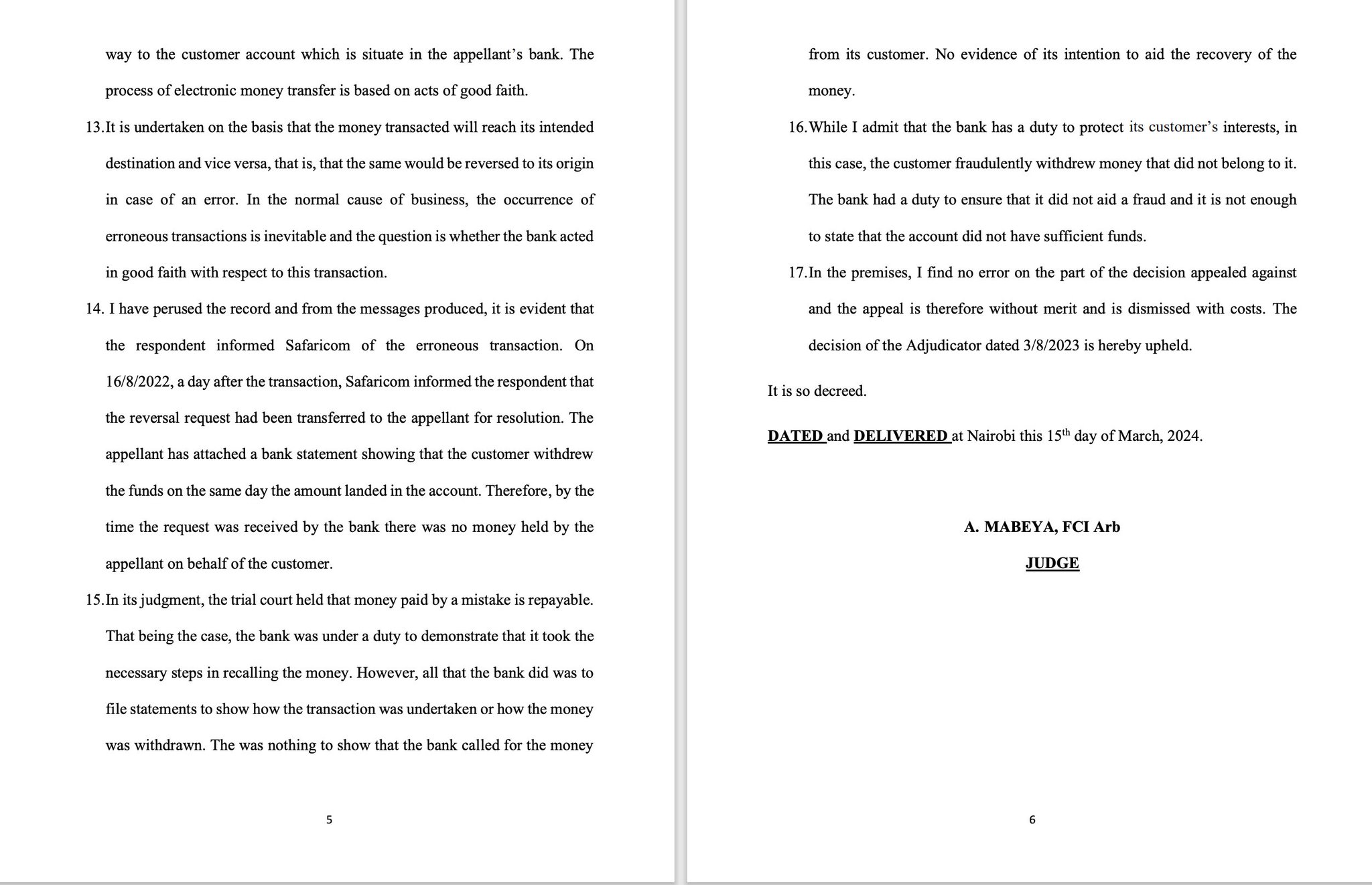
“The bank was under a duty to demonstrate that it took the necessary steps in recalling the money. However, all that the bank did was to file statements to show how the transaction was undertaken or how the money was withdrawn. There was nothing to show that the bank called for the money from its customer. No evidence of its intention to aid the recovery of the money,” said Justice Mabeya, the presiding judge of the Milimani High Court Commercial and Tax Division.
“While I admit that the bank has a duty to protect its customer’s interests, in this case, the customer fraudulently withdrew money that did not belong to it. The bank had a duty to ensure that it did not aid a fraud and it is not enough to state that the account did not have sufficient funds.”
The case of Kingdom Bank and Alice Wanja Wanjohi
In court papers seen by Kenya Insights, Ms Wanja erroneously sent a total some Ksh50,600 to the Kingdom-linked MPESA till.
She reached out to Safaricom upon realizing the mistake informing them of the erroneous transaction but was instead instructed to reach out to the Bank for assistance.
“On 16/8/2022, a day after the transaction, Safaricom informed the respondent that the reversal request had been transferred to the appellant for resolution,” read the court papers.
On reaching out to the Bank, Wanja was informed the money had already been withdrawn by the receiving customer and could not be recovered.
The Bank produced a bank statement showing that its customer withdrew the funds on the same day the amount landed in the account.
Dejected, Wanja went on to sue the Kingdom Bank at the Milimani Small Claims Court, arguing that the lender acted in breach of care.
She pointed out that the Bank failed to stop a fraudulent transaction and in turn shielded its customer.

The High Court finding now raises the bar of the responsibility of banks in protecting the interests of customers who are not even their own.
Banks will be held responsible for loss of cash erroneously sent by clients to unintended Safaricom M-Pesa tills numbers, which terminate into accounts held by the lenders.
The High Court has held that banks will have to demonstrate that they took all the “necessary steps in recalling the money” to stop their clients from illegally profiting from such erroneous transactions or be held liable for the losses suffered by affected M-Pesa users.
This could open up banks to thousands of lawsuits involving M-Pesa customers who accidentally send money to the wrong till numbers terminating in banks and end up losing the money amid the tedious process involved in requesting for reversals.
Safaricom has over 606,000 enterprises using its payment service, Lipa na M-Pesa, to accept payments for goods and services, pointing to the popularity of the service that transacted Sh1.63 trillion in the financial year ending March 2023.
Kenya Insights allows guest blogging, if you want to be published on Kenya’s most authoritative and accurate blog, have an expose, news TIPS, story angles, human interest stories, drop us an email on [email protected] or via Telegram














Nyali MP Moha Jicho Pevu Caught Up In Alleged Sh44 Million KPA Debt Scam

Somalia Deputy PM Held at JKIA, Deported Over Questionable Acquisition of Kenyan Passport

The White-Coat Heist: How MP Shah Hospital Ran a Decade-Long Double-Extraction Racket While Hiding Behind Charity Status

The Patriarch, His Children, and a Buried Sh3.9 Billion Fraud: The Story of Titus Muya That Kenya Was Never Meant to Read

The Founder’s Ransom: How Titus Muya Had to Be Paid Sh231 Million to Let Go of Family Bank and Why That Bill Is Now Yours

Kenya’s gambling industry pushes back against a licensing bill

Kenya Airways Sinks Into Deeper Turbulence As American Supplier Sues In New York Court Over Sh129 Million Unpaid Debts

Kenyan player wins a Ksh3.2 million jackpot

IEBC Sets August 10 Date For 2027 General Election

Furious Ruto Lashes Out at Gideon Moi Over Repeated ‘Blackmail, Extortionist’ Headlines on The Standard and KTN

Businessman Philip Waithaka Kinuthia’s Minor Son Allegedly Drove Drunk, Killed Two Peponi Students in Ngong Road Horror Crash as Claims of Cover-Up Intensify

Inside NCBA’s Decline: How a Banking Giant Lost Its Strategic Edge

South Sudan: Adut Salva Kiir’s Shadow Treasury Exposed

Cement, Cash and Courts: How the Hashu Dynasty Crushed the Ramji Brothers for Fourteen Years and Why the Walls Are Now Closing In

Standard Chartered Ghosts Haunt Joshua Oigara At Stanbic As Whistleblower Spills Beans

Inside The Urban Planning Cartel That Owns Nairobi

THE VULTURE AND THE SCHEME How Nairobi West Hospital Became the Most Dangerous Institution in Kenya’s SHA Ecosystem and Why the Books Must Be Audited Now

The President’s Daughter and The Missing Witness: How Adut Salva Kiir’s Shadow Treasury Silenced Its Most Dangerous Critic

How Adil Popat Saved His Empire On The Eve Of Imperial Bank Collapse and Why Kenya’s Mainstream Media Buried The Story

Why John Ngumi Is Running From the EACC and Why the Sh415 Million Payday May Be the Least of His Worries
-
 News2 weeks ago
Businessman Philip Waithaka Kinuthia’s Minor Son Allegedly Drove Drunk, Killed Two Peponi Students in Ngong Road Horror Crash as Claims of Cover-Up Intensify
-
 Investigations1 week ago
THE VULTURE AND THE SCHEME How Nairobi West Hospital Became the Most Dangerous Institution in Kenya’s SHA Ecosystem and Why the Books Must Be Audited Now
-
 Business16 hours ago
The Patriarch, His Children, and a Buried Sh3.9 Billion Fraud: The Story of Titus Muya That Kenya Was Never Meant to Read
-

 Business5 days ago
BURRIED TWICE: The Victoria Bank CEO Yogesh Pattni Files
-

 Business1 week ago
Inside the Billion-Shilling Betrayal: How Senior Treasury Officials Plundered a UN Poverty Fund and Built a Real Estate Empire on the Backs of Kenya’s Rural Poor
-

 Business2 weeks ago
The Listing That Doesn’t Lie: What the Market Isn’t Saying About Family Bank’s NSE Debut
-

 Business1 week ago
The Banker Who Walked Away: How Yogesh Pattni Survived a Financial Crime Scandal That Shook Kenya
-

 News7 days ago
My Life Is In Danger: Investor Drops Bombshell Expose On Thomas Ogutu CEO VeGrid Ltd And Fugitive Nairobi CEC Charles Kerich – DCI Inaction And Corruption Network Exposed