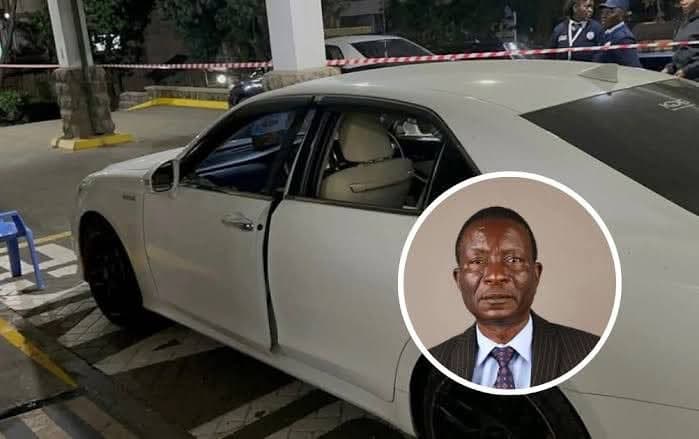
He sensed it. For weeks before the night they finally caught up with him, Kasipul Member of Parliament Charles Ong’ondo Were had been telling anyone who would listen that his life was in danger. He had gone to the police. He had told his colleagues. He had said it to the media. Yet when darkness fell over Nairobi on Wednesday, April 30, 2025, and his white Toyota Crown turned off Parliament Road into the evening traffic, the danger was not approaching from outside — it was already seated inside the car with him.
Now, months after the fatal shots rang out near the City Mortuary roundabout along Valley Road, a devastating new exposé by KTN News has given Kenya its most detailed and harrowing account yet of how the plot unfolded. The broadcaster obtained exclusive CCTV footage spanning multiple cameras across Nairobi’s inner city — footage that, frame by chilling frame, shows the MP’s bodyguard not as his last line of defence, but as the door through which his killers walked.
“The bodyguard allegedly abused his position of trust to deliver the MP into the hands of his executioners.”
Senior Assistant Director of Public Prosecutions Gikui Gichuhi did not mince words when she opened the State’s case before High Court Judge Lady Justice Diana Kavedza at Kibera High Court in February 2026. The killing of Ong’ondo Were, she told the court, was the result of a carefully orchestrated conspiracy. One suspect was the overall mastermind who ordered and financed the operation. Another supplied the murder weapon. A hired gunman pulled the trigger. And the bodyguard, Allan Omondi Ogola, delivered the MP to all of them.
A DAY THAT BEGAN AS ANY OTHER
The CCTV record of April 30, 2025 begins innocuously enough. At 8:37am, Were’s white Toyota Crown, registration KDM 783A, was captured entering Bunge Towers — Parliament’s administrative complex. The MP had a full legislative day ahead. Kenya’s Finance Bill 2025 was on the table, and the National Assembly was humming with political tension. A continent away from that tension, in a restaurant along Kimathi Street, two men were eating lunch and watching the parliamentary proceedings on a screen. They were not watching for the Finance Bill. They were watching for the moment the Speaker would rise to close the day’s business and send Charles Ong’ondo Were into the street.
At 3:14pm, as the afternoon began its slow slide toward evening, a vehicle bearing registration number KAZ 645Z entered the cameras’ field of view near the Parliament roundabout, approaching from Harambee Avenue. It was accompanied by a motorcycle. The two moved together with a practiced coordination that had nothing to do with ordinary Nairobi traffic — making deliberate loops around Parliament Lane, doubling back along Harambee Avenue, the motorcycle maintaining close proximity to the car at all times.
At 3:18pm, a man identified in court as the co-driver of KAZ stepped out near Equity Bank. He wore a checked long-sleeved shirt, blue trousers and brownish shoes. He carried a sling bag. He paused, entered the Equity Bank parking area, spoke briefly with the motorcycle rider, and returned to the car. Eleven minutes later, at 3:29pm, the same exchange was captured inside Equity Bank parking. The two men were coordinating. County Hall cameras then caught the sling-bag suspect pacing near Parliament’s entrance, crossing the road, making phone calls, watching.
KDM 783A, meanwhile, sat parked near Family Bank along Parliament Road. Were was still inside Bunge Towers. It would be another four hours before he emerged. Four hours in which the killing machine around him tightened its formation.
THE BODYGUARD BOARDS LAST
At 4:09pm, KAZ 645Z found parking. The sling-bag suspect stepped out again, walked toward Family Bank, lingered for several minutes, and returned. The waiting was meticulous, professional, unhurried. These were men who had done this before — or men who had been told exactly what they were doing and by whom.
Then came the moment that would stand as the most damning single image in this entire investigation. At 7:15pm, with the evening already darkening over Nairobi, CCTV cameras captured a man in a suit running after KDM 783A in Ukulima House parking. That man was Allan Omondi Ogola — the MP’s own bodyguard, one of the accused persons now facing a murder charge at Kibera High Court. He caught the car. He climbed in.
Moments later, KDM exited through the DCI gate and drove to Parliament to collect Were at approximately 7:20pm. Almost simultaneously, KAZ 645Z left Equity Bank parking, while the sling-bag suspect positioned himself outside Parliament’s entrance, his face pointed at the door, waiting for the legislator to emerge.
“He fired four shots at close range. These shattered the window and went into Were’s hand and chest.”
At 7:24pm, Were’s vehicle left Parliament. It headed toward Holy Family Basilica roundabout. At the same instant, the sling-bag suspect mounted the waiting motorcycle, which immediately swung into pursuit along Parliament Road. KAZ 645Z, having already looped past the Senate gate, executed a U-turn at the Basilica roundabout at 7:26pm, now heading in the same direction as the MP’s vehicle — all three moving together through the Nairobi night like a dark and practiced tide.
THE M-PESA STOP THAT SEALED HIS FATE
On Wabera Street, footage from cameras mounted at the Standard Building recorded KDM pulling over near an M-Pesa shop at 7:35pm. A man in a suit — the bodyguard, investigators confirm — stepped out of the back seat and walked into the shop. He deposited Sh20,000 into Were’s phone. The M-Pesa attendant, who would later record a statement with the Directorate of Criminal Investigations and furnish detectives with the shop’s own CCTV footage, watched the transaction without knowing she was a witness to the preamble of a murder.
Outside, on the street, the sling-bag suspect had dismounted from the motorcycle and walked toward the parked MP’s vehicle, donning a maroon beanie. He made phone calls. Then he walked away. The motorcycle idled. When KDM eventually pulled back into traffic and proceeded toward Kenyatta Avenue, the motorcycle resumed its pursuit. By 7:39pm, both vehicles were on Valley Road, heading toward Hurlingham roundabout. Were was sitting, in stark contradiction of all security protocols for VIPs, in the front passenger seat. His bodyguard sat behind him.
The assassins had long established this arrangement. They had been watching. They knew exactly which window to aim for.
SEVEN SECONDS ON VALLEY ROAD
Traffic backed up at the Nairobi Funeral Home roundabout — the chokehold the killers had been steering their target toward since 3:14pm that afternoon. At 7:40pm, KDM 783A was stationary. The motorcycle stopped alongside it. One man dismounted. He walked quickly to the front passenger door. He was wearing a balaclava now. He raised the weapon and fired four shots at point-blank range, shattering the window, the bullets entering Were’s hand and chest.

No sooner had the gunman turned back to the motorcycle than the rider gunned the engine, speeding back toward the city centre. The bodyguard, who was sitting directly behind the man he was supposed to protect, later told investigators that the shooting caught him completely unawares and that he had taken cover before giving chase — a statement the prosecution has treated with open scepticism given the mountain of CCTV evidence now placed before the court.
Were’s driver rushed him to Nairobi Hospital. He was pronounced dead on arrival.
THE WEAPON, THE VEHICLE AND THE DIRTY MONEY
Ballistic investigators recovered a Sarsilmaz handgun and a Retay Falcon pistol linked to the murder, as well as to three prior armed robberies in Kiambu and Nairobi counties, the last occurring just days before Were’s death. The guns were not improvised street weapons. They were professional tools, part of an armoury that pointed to an organised criminal network with access to significant financial resources.
The vehicle KAZ 645Z, which had spent the entire afternoon of April 30 circling Parliament in pursuit of Were, was subsequently identified as a car that had previously belonged to an assistant police commissioner. It had changed hands for the suspiciously low price of Ksh 300,000 — a fraction of its market value.
That transaction left a digital trail so clean and so obvious that it has prompted serious questions among investigators and analysts alike: was the trail genuine, or was it deliberately lit, a controlled explosion designed to burn a specific figure within the security apparatus?
A search of suspect Edwin Oduor Odhiambo’s Nairobi residence produced two pistols with ammunition, five SIM cards, and multiple mobile phones now under forensic examination. At the home of William Imoli Shighali, another suspect, detectives found police uniforms, more than USD 4,800 in cash, and further mobile devices. In the home of suspect Juma Ali Hikal — an active Administration Police officer at the time of his arrest — investigators found ammunition and teargas canisters.
Preliminary police investigations established that meetings to plan the killing took place both in Nairobi and in Homa Bay County.
A deposit of Ksh 850,000 was paid to secure the hit squad’s services. Bodyguard Allan Ogola allegedly received Ksh 80,000 described as transport money, while both he and driver Walter Owino Awino were in constant communication with the planners before and after the murder.
Mobile phone triangulation placed all five original suspects in proximity to the crime corridor throughout the day.
THE STATE’S LONG SHADOW
The five charged before Kibera High Court are William Imoli alias Imo, Edwin Odour Odhiambo alias Machuani, Ebel Ochieng alias Dave Calo — a neighbour of Were’s in Kasipul, Homa Bay County, and a board member of the Lake Basin Development Authority — Isaac Kuria, and Allan Omondi Ogola, the bodyguard. All five have denied the charges. Two of them, Kuria and Ogola, were ordered to undergo mental assessments at Kamiti Prison before their trial could proceed.
Three suspects were denied bail after Ochieng allegedly threatened to kill the prosecutor handling the case — a development that sent a visible chill through the court.

But it is a name that does not appear on the charge sheet that has sent the loudest tremor through Kenya’s political class.
Embakasi East MP Babu Owino, went on KTN Prime and named Were’s main personal assistant, identified only as Calvince, as someone arrested in connection with planning the murder.
What made this allegation explosive was Babu Owino’s further claim: that Calvince had previously been employed at the Lake Basin Development Authority when it was headed by Raymond Omollo, who now serves as the Interior Principal Secretary.
“These things are being organised by the State. Are you aware that he was the one who was planning and executing the assassination of Ong’ondo Were?”
Omollo has not been charged. His office did not respond to inquiries by the time of publication. But the implication, made on national television by a sitting Member of Parliament, is one that has proved impossible to ignore — that the killing of Charles Ong’ondo Were was not merely a criminal conspiracy between a bodyguard, a hired gun and a few desperate men. It was, in the telling of those closest to it, a state-facilitated execution.
CCTVS ARE NOT ORNAMENTS
The Ong’ondo Were case has become, among other things, a landmark demonstration of what surveillance infrastructure — long dismissed in Kenya as decorative — can do when investigators choose to use it. Thousands of minutes of CCTV footage were reviewed. Cameras at Parliament, at Equity Bank parking, at the Standard Building on Wabera Street, at Valley Road businesses, at the Rubis petrol station in Hurlingham where the KAZ driver was captured pacing and making prolonged calls after the shooting — all of it assembled into a prosecution narrative that has left very little room for the accused to manoeuvre.
The chief inspector in charge of forensic imaging and acoustics testified at Kibera High Court that there was consistent interaction between the motorcycle rider, the driver and co-driver of KAZ across multiple locations, visible use of mobile phones, and synchronised stopovers at M-Pesa outlets and petrol stations along the MP’s route. The conclusion was direct: from 3:14pm to 7:40pm, the kill team moved with Were through the city as surely as his own shadow.
What the cameras could not capture — what no camera has ever captured — is the moment a man accepts money to betray the person whose life he is paid to guard. That moment happened somewhere in a hotel room, or across a table in Homa Bay, or in a quiet phone call on a night before the cameras switched on. The prosecution will attempt to reconstruct it through call data records, witness testimony and forensic analysis. Whether those threads lead all the way to the corridors of Interior Ministry headquarters remains the question that Kenya is now asking aloud.
A NATION WATCHES AND WAITS
Ong’ondo Were had publicly complained of threats to his life in February 2025. He had gone to the police. He had told Homa Bay Governor Gladys Wanga, who subsequently confirmed his concerns. He had been a marked man for months, and the machine that was marking him had been patient. When it finally moved, it moved in daylight, through the city, in a vehicle that had once belonged to a senior officer of the state, with a bodyguard holding the door open.
The trial continues before Justice Kavedza. The prosecution has promised further witnesses and further evidence.
Lead investigator Inspector Oliver Nabonwe has indicated that the probe extends to multiple counties and multiple scenes of crime not yet fully documented for court. Somewhere in those scenes, investigators believe, lie the fingerprints of whoever gave the final authorisation for what happened on Valley Road on the evening of April 30, 2025.
There is a Swahili proverb that Kenyans have been repeating since this story broke: Kikulacho ki nguoni mwako. The thing that devours you is within your own clothes. For Charles Ong’ondo Were, the man sitting behind him was not just within his clothes. He was holding the map to the ambush.
The cameras were watching. Every frame of what they saw is now in evidence. Whether justice will follow those frames to their logical conclusion — to whoever sits at the top of the chain that ordered, financed and directed this assassination — is the question that will define whether this nation’s institutions mean what they claim.


Comments