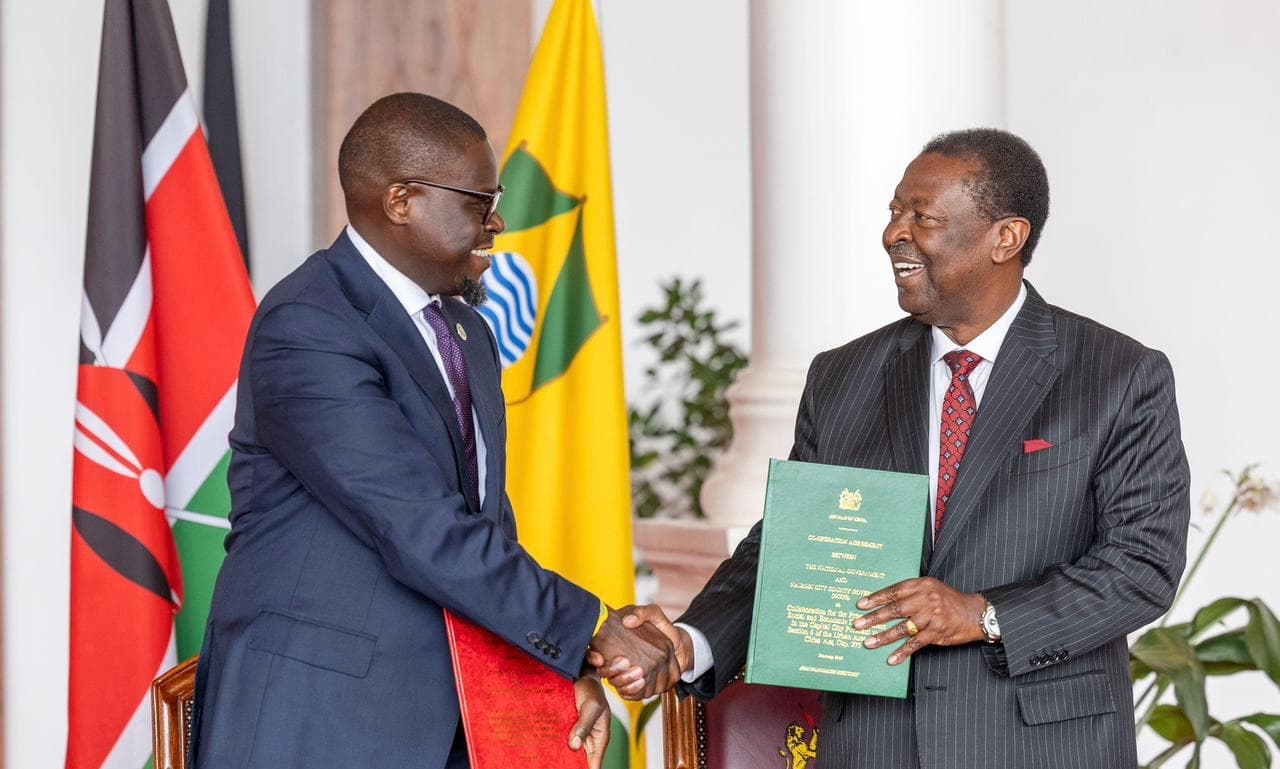
Nairobi Governor Johnson Sakaja has formally agreed to serve as the deputy of Prime Cabinet Secretary Musalia Mudavadi on a powerful new joint steering committee for the capital, in the most dramatic restructuring of the city’s governance since the controversial Nairobi Metropolitan Services era.
The bombshell arrangement, sealed at a high-profile ceremony at State House on Tuesday afternoon and witnessed personally by President William Ruto, places the elected governor of Africa’s fourth-largest city in a subordinate role to a national government official who does not hold an elected county mandate.
The cooperation agreement, backed by Sh80 billion in projected investment, was signed by Mudavadi on behalf of the national government and Sakaja on behalf of Nairobi City County.
It formalises a joint governance framework that critics say blurs the constitutional lines defining Kenya’s devolved system, even as its architects insist it represents nothing more than a funding boost for a cash-strapped city.
“What we are formalising today is not a transfer of functions. Let me repeat, there is no transfer of functions taking place. For the avoidance of doubt, I have no interest in running the city; my hands are already full,” Ruto declared at the ceremony, in remarks that his supporters found reassuring and his detractors found unconvincing.
Under the two-tier structure established by the pact, a Joint Steering Committee chaired by Mudavadi with Sakaja deputizing will set overall policy direction and coordinate national ministries and agencies with county officials.
A second-tier Implementation Committee, comprising Nairobi County Executive Committee members and national Principal Secretaries, will oversee day-to-day project execution.
For a governor who spent three years loudly proclaiming that Nairobi would never again be run from State House, Tuesday’s signing ceremony represented a politically jarring reversal.
Only six days earlier, at the Nairobi County Assembly, Sakaja had thundered that the NMS era was a “defilement of devolution” that saddled the county with Sh16 billion in pending bills and broke the spirit of the public service.
“In 2020, Nairobi got into a misadventure. The NMS experiment left us with a Sh16 billion hole in pending bills, low staff morale due to mistreatment and a defilement of devolution,” Sakaja told MCAs on February 11, in what now reads as either a prescient warning or an elaborate setup for Tuesday’s ceremony.
The governor was at pains to reframe the deal in terms sharply distinct from that dark chapter. “This is not an NMS takeover. That was a misadventure that left behind Sh16 billion in debt. This is not a transfer of function. This is a cooperation that recognises Nairobi as the nation’s capital,” he said. “It demonstrates that, 13 years later, the President has heard us.”

But the question of whether Nairobians were consulted before their governor agreed to sit underneath a national government appointee in the management of their city is already proving divisive.
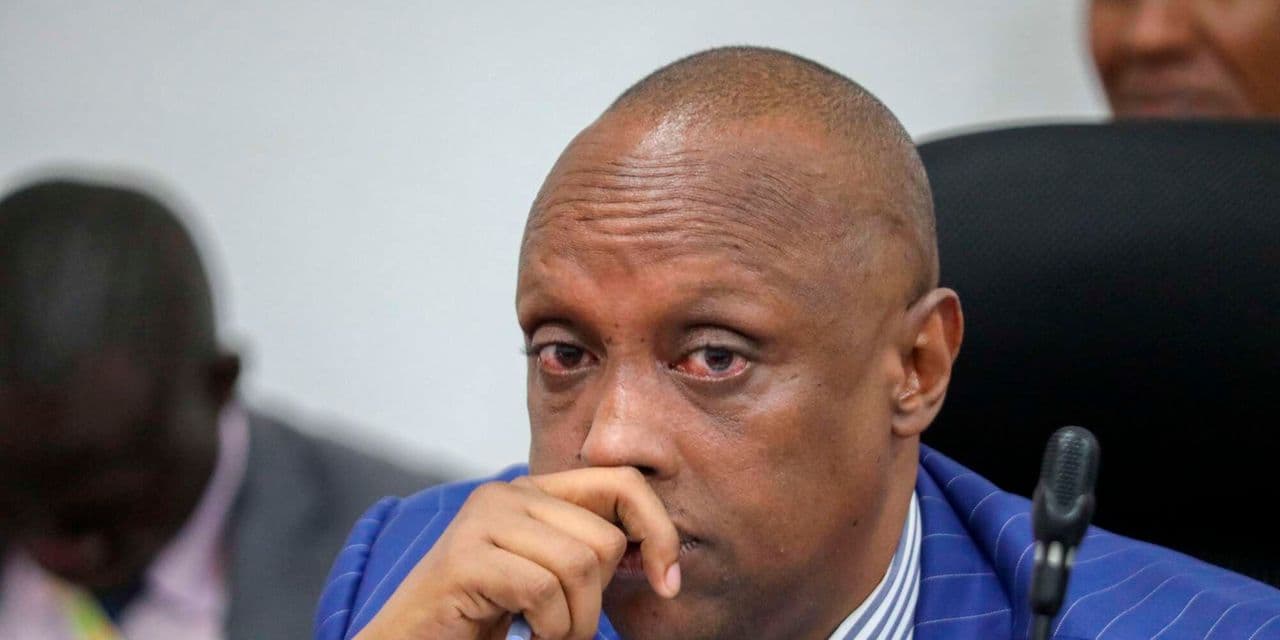
Nairobi Senator Edwin Sifuna, who learnt of the signing from a media invite and not from City Hall, was unambiguous in his fury.
“The Governor of Nairobi assured us he wasn’t transferring any functions to the National Government. I’m surprised to see a scheduled signing ceremony at State House this afternoon,” Sifuna posted on X as the ceremony was underway. “As we await to see what the actual thing is, I remind Sakaja Johnson to be mindful of the provisions of the Constitution and the need for involvement of the electorate and the leadership of Nairobi prior to making such decisions. Any unconstitutional clawback to devolution shall be strenuously resisted. A comprehensive statement shall follow.”
The senator’s concerns are grounded firmly in the Constitution. Under Article 187, the transfer of a county function to the national government requires a formal deed of transfer, approval by the County Assembly, and proof that the function can be more effectively performed nationally. No such deed has been tabled before the Nairobi County Assembly, and Sifuna has made clear he has seen neither the deed nor an assembly resolution.
Principal Secretary for Housing and Urban Development Charles Hinga added fuel to the fire last week when he told a city diplomacy forum that it was only a matter of time before the government fully took over Nairobi. “Nairobi is not a county but a capital city, so collaboration with the national government is inevitable despite what people say,” Hinga said, adding that the city under the current arrangement was “dysfunctional.” His remarks were widely seen as laying the political groundwork for exactly the kind of deal signed on Tuesday.
President Ruto tried to smother the flames, assuring Kenyans that the agreement would be subjected to public participation and scrutiny by the Nairobi County Assembly before full implementation. “The sooner we start, the sooner Nairobians benefit from modern infrastructure and efficient city management,” he said.
The pact, anchored on Section 6 of the Urban Areas and Cities Act 2019 which recognises Nairobi as Kenya’s capital city and mandates intergovernmental cooperation on funding and service delivery, spans five key sectors. Solid waste management will see a city-wide garbage collection system go live on April 1, backed by a 3,500-member “Green Army” and a new treatment plant at the Ruai facility capable of converting waste into power and fertiliser. Road infrastructure commitments include the rehabilitation of 62 kilometres of city roads through the Kenya Urban Roads Authority at a dedicated cost of Sh2.1 billion. On water and sewerage, the Athi Water Works Development Agency will lead long-term supply projects including a new dam in Maragua, the Northern Collector II Tunnel, and expansion of trunk sewer lines. The national government has committed to settling public lighting bills on all nationally-funded road projects. Ruto also announced contracts for 110,000 housing units in Nairobi City County, a Sh5 billion modern market at Gikomba, and construction of hostels to accommodate 14,000 students.
Sakaja cited New York and Paris as capitals that receive substantial national government support while remaining under locally elected leadership, arguing that Nairobi was entitled to no less. He pointed to an increase of 140 million litres of water per day through the Northern Collector Tunnel as an early fruit of the collaboration, with plans underway to add nearly 200 million additional litres daily through upcoming projects.
The deal is the first capital-specific intergovernmental framework of its scale since devolution began in 2013. Its architects call it a defining moment in Nairobi’s urban history. Its critics call it devolution’s most sophisticated undoing yet, dressed up in the language of cooperation.
What is beyond dispute is this: for the first time since the NMS era that Sakaja himself called a defilement, the governor of the capital city will be sitting at a committee table, and Musalia Mudavadi will be at its head.





Comments