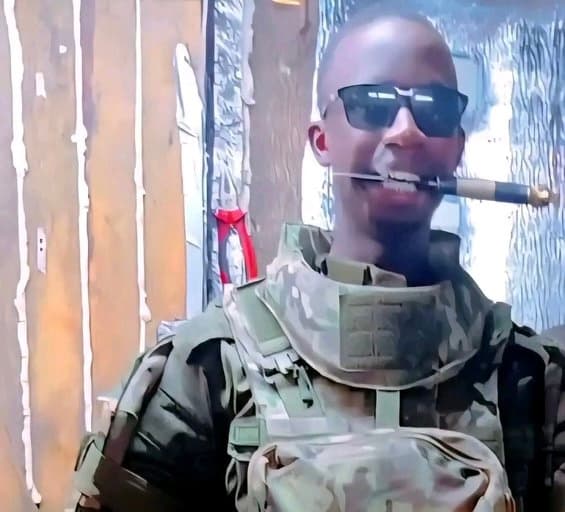
NAIROBI, Kenya — The voice note was brief. It was calm. And it would be the last time Susan Kuloba ever heard her son’s voice.
“Nawapenda sana, mkae poa,” David Shitanda told his mother in Swahili — I love you all very much, stay well — before disappearing into the fog of a war that had nothing to do with Kenya, and everything to do with a young man who had run out of options.
Hours later, he was dead.
Shitanda, affectionately known to his family as Davi, was killed in a missile strike while fighting for Russian forces in the ongoing Russia-Ukraine conflict. He was in his mid-twenties. The whereabouts of his body remain unknown.
His mother is still waiting.
The voice note, which has since been widely shared online and reduced thousands of Kenyans to tears, was not just a farewell. It was a business transaction born out of desperation. In the recording, Davi walks his mother through what to do if he does not come back alive.
“Hizo documents nimekutumia, kesho naenda mission na incase of anything utapigiwa simu uambiwe kama nimekufa ama kama nitakuwa uhai. Kama nitakuwa nimego utachukuwa hizo documents utapeleka kwa immigration ama kwa embassy utaclaim; utasema mimi ni mtoto wako kila kitu utapeana, kuna paychek utapatiwa, ule mwenye atainherit ni mzazi wangu,” he said.
He had sent her documents. He had arranged for a death payment. He had thought of everything except the possibility of surviving.
He did not survive.
From Lang’ata to the frontlines
Davi’s story did not begin in a war zone. It began in a schoolyard.
In 2015, pupils of Lang’ata Road Primary School poured into the streets in one of the most startling protests Kenya had ever seen. They were small children facing teargas, demonstrating against what they alleged was an attempt by then-Deputy President William Ruto to grab their school’s playground for the expansion of his Weston Hotel. The images of uniformed schoolchildren choking on teargas went around the world.
David Shitanda was one of those children.
He never completed secondary school. According to his mother, he sat his Kenya Certificate of Primary Education exams and immediately began fending for his family, too young to be carrying such weight but too poor to put it down. He worked construction sites in Nairobi. He tried his luck in Somalia. He spent time in Canada. Every road eventually brought him back to the same wall — the grinding reality of a country that had failed to build a future for him.
Last year, someone told him Russia was paying well. He went.
46 Kenyans. Two survivors.
A friend identified only as Karis, who was injured in the same strike that killed Davi, broke the news to Susan Kuloba in a text message that she later shared publicly.
“Am sorry David succumbed to a missile attack. We were together, I also got injuries. I’m in the hospital. I don’t know what to say, my heart is torn into pieces losing two friends at a go,” Karis wrote.
What followed was perhaps the most devastating detail of the entire story. According to information passed to Davi’s family, there were 46 Kenyans present during the attack. Only two walked away.
If the figure holds, it represents one of the single deadliest incidents involving Kenyan nationals in the entire conflict, a mass casualty event that unfolded thousands of kilometres from Nairobi without a single official statement from the Kenyan government before the day was out.
A crisis hiding in plain sight
Davi was not alone in making that journey. He was not even unusual.
A joint intelligence report compiled by Kenya’s National Intelligence Service and the Directorate of Criminal Investigations, tabled before Parliament this month, revealed that more than 1,000 Kenyan nationals have now been recruited to fight for the Russian army. The figure is five times higher than earlier estimates of around 200 Kenyans.
According to the report, many of the recruits were lured by unlicensed recruitment agencies and rogue middlemen who dangled promises of salaries as high as $35,000 upfront and $3,000 monthly.
Unemployed youth, former military personnel and ex-police officers were specifically targeted.
The recruiters used tourist visas routed through Istanbul and Abu Dhabi to funnel Kenyans into Russia, where, the report says, many found themselves in military training camps rather than the civilian jobs they had been promised.
Some had their passports confiscated. Some had their movements restricted. Some ended up on the frontlines with a weapon they had never asked to carry.
The Kenyan Embassy in Moscow had issued a public warning just four days before Davi was killed. The warning noted that many of those who reached out to the embassy had been promised employment, high salaries and residency arrangements that did not exist upon arrival. It urged Kenyans to verify job offers through official government channels and avoid travel arranged through social media or unlicensed agencies.
For Davi, the warning came too late.
“He fought against greedy leadership as a child”
Activist Boniface Mwangi, who helped amplify the story on social media Thursday morning, described Davi’s death as a damning indictment of the country’s political class.
“David Shitanda did not deserve to die so young, thousands of kilometers away from his home and family,” Mwangi wrote on X. “David’s brief life on earth personifies how Kenyan leadership is failing its youth. As a kid in primary school, he fought against greedy leadership. As an adult, the same failed leadership forced him to seek a livelihood in a foreign land, fighting and dying in another man’s war.”
The post drew more than 1,400 reactions within hours of being published.
For many Kenyans, the story struck a nerve not just because of its tragedy but because of its terrible symmetry. The same boy who once stood in a schoolyard demanding his right to a future had been driven by that future’s absence to die on a Ukrainian battlefield for a country not his own.
Susan Kuloba is yet to receive her son’s body. She is yet to receive any formal confirmation from Russian authorities. She has a set of documents her son sent her, a compensation claim she has been told to make, and a voice note she will never stop hearing.
“Nawapenda sana,” he told her. I love you all very much.
She loved him too.
Kenya Insights could not independently verify the casualty figures at the time of publication. The Russian Embassy in Nairobi denied issuing visas to Kenyans for the purpose of joining the military.






Comments