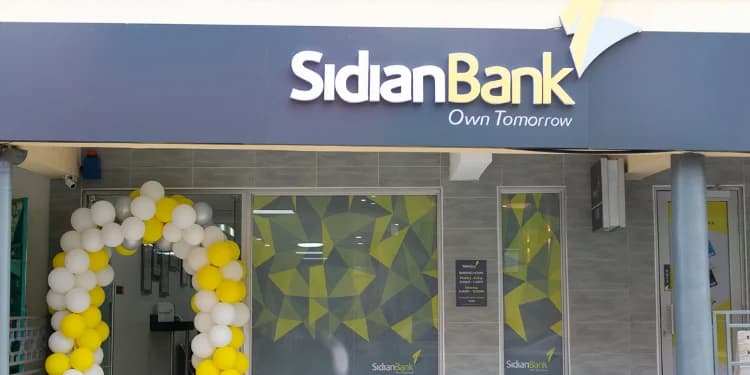
The Consumer Federation of Kenya has formally petitioned the Central Bank of Kenya to launch an immediate forensic audit into the explosive financial turnaround of Sidian Bank, a mid-tier commercial lender whose net profit surged 502 per cent to Sh1.73 billion in the year ended December 31, 2025, from Sh287 million in the prior year.
In a written petition to the banking regulator, Cofek secretary general Stephen Mutoro described the bank’s ascent as one that bore the hallmarks of political capture rather than organic market competition, and called on the CBK to determine whether the allocation of billions of shillings in public sector deposits to a relatively obscure institution had followed due process under Kenya’s public finance management laws.
“What we are witnessing is not a turnaround story. It is the capture of public resources by a politically connected institution,” Mr Mutoro said in an interview.
“Taxpayer money parked in county governments, the Social Health Authority, the National Social Security Fund, and the housing levy is being used to inflate the balance sheet of a bank that should be lending to small businesses but is instead hoarding government securities. The Central Bank must act before this becomes a full-blown scandal.”
The petition places Sidian at the centre of a growing national debate about the relationship between political power and the allocation of public sector banking mandates in Kenya, a conversation that has already drawn scrutiny from the Senate, the High Court, and from as senior a figure as former Deputy President Rigathi Gachagua, who alleged in a televised interview in February 2025 that a senior state official had strong-armed public institutions to channel funds into a favoured bank.
Gachagua declined to name the institution, but the breadcrumbs left by the subsequent cascade of public sector mandates won by Sidian led many analysts and commentators to draw their own conclusions.
The Numbers That Shocked the Market
Sidian Bank’s financial disclosures for 2025 read less like the results of a small commercial lender and more like the sudden materialisation of a systemic shift in the Kenyan banking landscape.
Customer deposits surged 63 per cent to Sh72.3 billion over the course of the year, nearly tripling the Sh27.6 billion the bank held at the end of 2023 and catapulting it from the lower end of the Tier 3 bracket to a position where it commanded 1.83 per cent of total industry deposits by September 2025. Total assets grew 51 per cent to Sh90.8 billion.
Net interest income rose 54.4 per cent to Sh4.4 billion, while non-interest income surged 129 per cent to Sh3.8 billion.
Within that latter figure lies one of the most striking and unexplained items in the bank’s published results: a line described as “other income” that vaulted from Sh188.76 million to Sh2.09 billion, an elevenfold increase that constituted 55 per cent of total non-interest income for the year.
The bank has not disclosed the composition of this item in its published financial extracts, a silence that Mr Mutoro said the CBK should require it to explain.
Equally striking is what the deposit bonanza did not produce.
Despite customer deposits nearly doubling, Sidian’s loan book expanded by only 10.7 per cent to Sh27.5 billion.
The bulk of the new public sector money was channelled instead into Treasury bills and government bonds, a portfolio that rose to Sh48.6 billion by the end of September 2025, up from Sh19.3 billion a year earlier.
The bank was, in effect, borrowing at low or zero cost from the state and lending straight back to the state at sovereign rates, generating a virtually risk-free spread that accounts for the lion’s share of its profit surge.
“The bank is effectively trading on the idle deposits of public agencies to generate risk-free returns,” Mr Mutoro said.
“It is not fulfilling its mandate to SMEs. It is not creating credit. It is simply arbitraging the gap between what it pays on deposits, if it pays anything at all, and what it earns from government securities. That is not banking. That is rent-seeking enabled by political connections.”
The Architecture of Public Sector Capture
The mechanics of Sidian’s transformation are traceable to a series of public sector mandates that began accumulating from late 2023 and accelerated sharply in 2024 and 2025.
The pattern reveals a lender that progressed systematically through the constellation of state institutions, winning mandates from a succession of parastatals whose combined deposits provided the raw material for an unprecedented balance sheet expansion.
The most significant single mandate came from the National Social Security Fund. In the financial year ended June 30, 2024, the NSSF designated Sidian Bank as the recipient of Sh800 million in fixed deposits, its single largest placement with any bank that year.
The allocation was all the more remarkable given that Sidian had received zero from the pension fund in any prior year, and that the NSSF simultaneously slashed its total fixed deposit portfolio by more than 75 per cent compared to the previous year, from Sh10.8 billion to Sh2.6 billion.
Even as the fund shrank its overall exposure to term deposits, it concentrated more than a third of what remained in a bank with which it had no prior relationship.
The Social Health Authority, launched in October 2024 as the replacement for the defunct National Hospital Insurance Fund, designated Sidian as one of only six authorised collection agents for SHIF contributions, placing the bank in the same category as KCB, Co-operative Bank, Absa, Equity, and Diamond Trust Bank, lenders whose assets and deposit bases dwarfed Sidian’s at the time of the appointment.
The bank was simultaneously authorised to receive housing levy deductions from employers across Kenya, a stream of statutory payments that flows monthly from the payroll of every formal sector worker in the country.
The Nairobi County Government delivered the most visible and politically charged mandate in November 2025, when County Secretary Godfrey Akumali issued a circular on October 28 directing the chief executive officers of all county health facilities to close their accounts at Co-operative Bank, a Tier 1 institution with a long and stable track record in public sector banking, and reopen them at Sidian.
The directive followed a resolution passed at the 69th meeting of the Nairobi County Executive Committee, and was to take effect by November 7, 2025, giving health facility managers nine days to execute one of the most consequential banking switches in the history of Nairobi county government.
Senator Edwin Sifuna, Nairobi’s ODM senator, was unsparing in his assessment of the directive. “The health facilities in Nairobi have been banking with Co-operative Bank, a tier-one bank with a solid history and reputation,” he said in a letter to Governor Johnson Sakaja dated November 12.
“How you wake up one day and direct all of them to move to a tier-three bank cannot be explained any other way than corruption at play.”
Governor Sakaja appeared before the Senate Committee on Devolution and Intergovernmental Relations on November 24 to defend the decision.
He said the previous bank had delayed salary processing for county health workers, that its interest rates were unfavourable, and that Sidian had presented the best commercial offer in a competitive process. “Sidian had a cheaper interest rate and gave us a better offer. It is a good deal. We invited many banks, and Sidian presented the best package. As for ownership, every bank has owners, but what matters is good service,” the governor told the committee.
Senator Richard Onyonka pressed Sakaja directly on whether the bank’s ownership structure had influenced the decision, a question the governor declined to answer with specificity.
The committee did not receive documentation of the competitive process or comparative offers from other banks.
The relationship between Nairobi County and Sidian has since deepened further.
Documents tabled before the Nairobi City County Assembly budget committee reveal that the county is pursuing a memorandum of understanding with the bank that would place Sidian at the heart of Nairobi’s revenue collection architecture, managing billions in annual inflows from parking fees, business permits, and land rates.
The proposed arrangement would also cover the management of the Facility Improvement Fund for county hospitals and donor funds. The budget committee’s report was silent on the fee structure, raising questions about the cost to the county government that its members have noted remain unanswered.
The Shareholders and Their Connections
The story of Sidian’s ownership transformation is inseparable from the story of its deposit bonanza. Centum Investment Company, which had held a majority stake in the bank through its subsidiary Bakki Holdco since 2015, began divesting in October 2023 after a planned Sh4.3 billion sale to Nigeria’s Access Bank collapsed in January of that year.
The piecemeal divestiture that followed introduced an entirely new group of shareholders whose identities and connections have drawn sustained public interest.
The largest individual block in the bank is now held by Wizpro Enterprises Limited, a company incorporated in September 2017 with Solomon Muriithi Maina as its sole director and shareholder.
Wizpro holds 24.95 per cent of Sidian’s issued share capital. Mr Maina is the chairman of KTDA Management Services Limited, the firm that manages the affairs of the Kenya Tea Development Agency, one of the most powerful agricultural institutions in the country and an entity whose patronage networks extend deep into tea-growing communities in the Mount Kenya region, a political heartland of President William Ruto.
The second-largest block, at 24.36 per cent, is held by Afram Limited, a company registered in July 2016 and controlled by a single director and shareholder, James Maina Muthoni.
Pioneer General Insurance Limited holds 16.89 per cent, with its UAE-based shareholders, including Abcon International LLC, Parkview Investments Limited, and Medillon Trading FZE, providing international capital to the consortium.
Former Ugandan Attorney-General William Byaruhanga, a close confidant of President Yoweri Museveni and a major real estate investor in Kampala, holds 14.63 per cent through Kenbe Investments, a vehicle he built by acquiring 50 per cent of Centum’s Bakki Holdco in May 2024 for Sh1.032 billion.
Telesec Africa, which had previously been owned by Kiharu MP Ndindi Nyoro before he transferred ownership to John Mbugua Maina in 2020, holds 3.47 per cent.
Centum completed the sale of its final remaining 13.6 per cent interest in Sidian on March 12, 2026, closing a 22-year investment that began when the bank operated as K-Rep Bank.
Total cash recoveries by Centum across all transactions now stand at approximately Sh5.2 billion against an original investment of Sh4.7 billion, a modest nominal return that the investment firm acknowledged was likely negative in real terms across the full holding period.
The board was overhauled in October 2025, when former Cabinet Secretary James Macharia was named chairman, succeeding Centum’s James Mworia. Mr Macharia, who served as Cabinet Secretary for Health and later for Transport and Infrastructure under President Uhuru Kenyatta before leaving government in 2022, had previously been Group Managing Director of NIC Bank, where he had worked alongside Chief Executive Chege Thumbi, who now leads Sidian.
Mr Mutoro said the accumulation of politically connected shareholders and the board appointment of a former senior state official, followed immediately by an unprecedented flood of public sector deposits, represented a pattern that regulators could not afford to ignore.
“This is not a bank that grew by competing in the marketplace,” he said. “It grew by winning state business through connections. The question the CBK must answer is whether the threshold for being classified as a Tier 2 bank was met through prudent banking or through executive fiat.”
Reclassification Achieved Three Years Ahead of Schedule
The Central Bank of Kenya formally reclassified Sidian from Tier 3 to Tier 2 in September 2025, after the bank’s deposit market share crossed the 1 per cent threshold for the first time.
At the time of reclassification, Sidian’s deposits represented 1.83 per cent of all customer deposits in the Kenyan banking system, up from 0.7 per cent at the start of the year. Its asset base of Sh94.8 billion constituted 1.2 per cent of the industry.
The reclassification came three years ahead of the schedule that Sidian’s management had originally set when presenting the new ownership’s strategic plan to shareholders.
The bank had targeted mid-tier status by 2028. That a goal intended to take five years was achieved in less than twenty-four months of the new ownership taking control has astonished analysts who track the Kenyan banking sector.
No other Kenyan lender has grown deposits by 162 per cent in two years while simultaneously vaulting from Tier 3 to Tier 2 and delivering a sixfold profit jump.
“When a bank grows this fast, this suddenly, and entirely on the back of public sector cash, you have to ask whether the risk management frameworks are adequate, whether the governance structures are sound, and whether the allocation of public deposits followed due process,” Mr Mutoro said.
“The CBK’s own prudential guidelines are premised on the assumption that growth of this nature emerges from competitive market dynamics. When it emerges from politically allocated state mandates, the supervisory calculus is entirely different.”
The Loan Book That Did Not Grow
For a bank whose founding mission was to provide financial services to small and medium enterprises, the divergence between deposit growth and lending growth in 2025 represents a fundamental departure from its stated purpose.
Sidian was established in 1984 as K-Rep Bank by Kimanthi Mutua under the Kenya Rural Enterprise Program, a project designed explicitly to channel credit to informal sector traders and microenterprise owners who were excluded from mainstream commercial banking.
Forty years later, the bank’s deposit base has nearly tripled in twenty-four months. Its loan book, by contrast, grew by only 10.7 per cent in the full year to December 2025.
At the nine-month mark in September, the loan book was effectively flat at Sh25.1 billion, a situation that chief executive Chege Thumbi attributed to the sluggish economy. “As the economy picks up, in line with our mission to empower the entrepreneurs, we expect the loan book to grow in months ahead,” he said in November 2025.
Interest income from loans and advances actually fell 4.9 per cent to Sh4.48 billion in 2025 despite the nominal increase in the net loan balance, suggesting tighter yields on the existing portfolio.
The gap was more than covered by the explosion in government securities income.
The bank’s holdings of Treasury bills and bonds nearly doubled over the course of the year, with the stock reaching Sh48.6 billion by the end of September, generating Sh3 billion in earnings from government paper in the nine-month period alone, up 134.7 per cent from Sh1.3 billion a year earlier.
The bank’s base lending rate stands at 16 per cent, a level that consumer advocates say remains punitive for the SMEs it claims to serve, particularly when the deposit base from which it funds that lending consists in large part of public sector funds earning minimal interest.
The bank’s cost of funds remained suppressed at Sh3 billion in nine months despite the deposit base nearly doubling, a statistic that reflects the low or zero cost of public sector deposits relative to the market rates that commercial deposits attract.
Bunge La Mwananchi Petitions the High Court
The consumer lobby’s petition to the CBK is not the only legal challenge Sidian’s relationship with the state has attracted. Civil rights group Bunge La Mwananchi, together with activists Lawrence Oyugi and Komrade Bush, petitioned the High Court in November 2025, arguing that Nairobi County’s directive to move public health facility accounts to Sidian breached multiple constitutional provisions.
The petition named the Nairobi City County Government, the County Executive Committee Member for Finance and Economic Planning, the acting County Secretary, and the Attorney-General as respondents, citing Articles 10, 35, 43, 201, 227, and 232 of the Constitution, provisions relating to public participation, access to information, social and economic rights, and integrity in public service.
The petition remains before the court. Sidian Bank maintained in its public statements around the SHA controversy that it “only facilitates collections, remitting directly to SHA accounts” and does not hold or manage the funds collected on behalf of the authority.
The distinction, while legally significant, has done little to quieten concerns about the accumulation of public money in a lender whose governance and ownership have become, in the perception of critics, intertwined with political power.
Capital Injections and the Empire Being Built
Sidian’s shareholders have not been passive beneficiaries of the deposit windfall. They have been active participants in capitalising the bank to handle the growth.
A Sh3 billion rights issue was completed in the year, with chief executive Chege Thumbi confirming in November 2025 that the final Sh580 million tranche had been received and was awaiting allotment.
This followed an earlier Sh3 billion capital injection, meaning shareholders have collectively deployed at least Sh6 billion in fresh equity since the new ownership consortium took control in late 2023.
The bank’s shareholders’ funds grew 41.1 per cent to Sh9.72 billion in 2025, bolstered by retained earnings of Sh2.33 billion alongside the rights issue proceeds.
Core capital stood at approximately Sh6.8 billion as of September 2025, above the CBK’s new minimum of Sh3 billion, the interim threshold that ten other Kenyan banks failed to meet by year-end.
Despite the record profitability, no dividend was declared for 2025, with retained earnings directed toward balance sheet expansion.
Mr Thumbi confirmed in November that the bank was in discussions with shareholders about raising an additional Sh3 billion in new capital.
“The shareholders are building an empire on the back of the taxpayer,” Mr Mutoro said.
“The question is whether this empire is being built in compliance with banking laws and prudential guidelines, or whether it is being built through the selective allocation of state business to politically connected individuals. The CBK has a duty to find out.”
Expansion Plans and Branch Growth
Alongside the financial engineering, Sidian has been pursuing a physical expansion that has accelerated sharply since the new ownership took control.
The bank opened its 47th branch in Bomet Town in April 2025, part of a stated plan to expand from its current footprint to more than 100 locations, a trajectory that management has linked to its SACCO partnerships, which now number more than 120 institutions across Kenya.
The expansion is being funded by the capital raised through successive rights issues and by the retained earnings generated by the government securities strategy.
The appointment of James Macharia as chairman in October 2025 was widely interpreted by market observers as a signal that the bank intended to shift its lending strategy toward larger corporate and institutional mandates, drawing on his experience at NIC Bank, where he oversaw the lender’s expansion into Tanzania and Uganda.
The board’s composition, now featuring an economics professor, a global accounting firm partner, and a former Cabinet Secretary with extensive public sector connections, reflects an institution positioning itself for a qualitatively different tier of business.
Regulators Silent, Opposition Intensifies
The Central Bank of Kenya did not respond to requests for comment on whether it intended to act on Cofek’s petition.
The NSSF did not respond to queries about why it shifted the bulk of its 2024 term deposits to Sidian, a bank with which it had no prior relationship, at a time when it was simultaneously cutting its overall term deposit exposure by more than three-quarters.
The Social Health Authority has maintained that its selection of collection agents followed consultations with employers about preferred payment channels. Nairobi County has stood by Governor Sakaja’s assertion that the bank selection followed a competitive process in which Sidian offered the most favourable terms.
Mr Mutoro said Cofek would pursue the matter through parliamentary oversight channels if the CBK failed to act on the petition. He said the organisation was in contact with members of the National Assembly’s Finance and National Planning Committee, as well as with senators who had already raised questions about the Nairobi County mandate.
“We are not making accusations without evidence. The evidence is in the bank’s own financial statements and in the public procurement records,” he said. “What we are asking for is an independent, transparent inquiry into how a small bank with a marginal market share became the preferred repository for billions in public money in the span of two years.”
Sidian Bank declined to comment on Mr Mutoro’s call for a CBK investigation.
A source close to the bank, who spoke on condition of anonymity, described Cofek’s allegations as unfounded and motivated by political considerations, without elaborating on what those considerations might be.
What Regulatory Standards Require
The Banking Act and the CBK’s prudential guidelines impose specific obligations on the regulator when a bank undergoes growth of the magnitude Sidian has experienced.
The guidelines on liquidity risk management require institutions to stress-test their funding structures against scenarios in which large institutional depositors withdraw funds simultaneously, a risk that is acutely relevant for a bank whose deposit base has tripled on the back of a small number of state-linked relationships.
The concentration risk provisions further require banks to monitor and limit excessive dependence on single depositors or categories of depositors.
Sidian’s liquidity ratio, at 69 per cent in the first quarter of 2025, was well above the 20 per cent regulatory minimum, suggesting the bank was managing the excess liquidity through its government securities strategy rather than extending credit.
The core capital adequacy ratio of 12.4 per cent against a minimum of 10.5 per cent indicated the bank remained within prudential bounds.
But the question Mr Mutoro and other critics are raising is not whether Sidian is presently solvent.
It is whether the process by which public funds were allocated to it was transparent, competitive, and consistent with the Public Finance Management Act’s requirements for the banking of public money.
SIDIAN BANK: KEY FINANCIAL INDICATORS 2025
Net profit: Sh1.73 billion (up 502% from Sh287 million in 2024)
Total assets: Sh90.8 billion (up 51% from Sh60.2 billion)
Customer deposits: Sh72.3 billion (up 63% from Sh44.38 billion)
Net loans and advances: Sh27.53 billion (up 10.8%)
Government securities portfolio: Sh48.6 billion (September 2025)
Net interest income: Sh4.43 billion (up 54.6%)
Non-interest income: Sh3.8 billion (up 129%)
Shareholders’ funds: Sh9.72 billion (up 41.1%)
CBK classification: Tier 2 (reclassified from Tier 3 in September 2025)
Branch network: 47 branches (target: 100+)
SIDIAN BANK: PRINCIPAL SHAREHOLDERS (as at March 2026)
Wizpro Enterprises Limited (Solomon Muriithi Maina): 24.95%
Afram Limited (James Maina Muthoni): 24.36%
Pioneer General Insurance Limited (UAE-linked): 16.89%
Kenbe Investments (William Byaruhanga, former Uganda AG): 14.63%
Pioneer Life Investments Limited: 3.06%
Telesec Africa Limited: 3.47%
Note: Centum Investment Company completed its full exit in March 2026.





Comments