
NAIROBI — Twice in four weeks, Kenya’s Anti-Terrorism Police Unit has stood at the gate of Jomo Kenyatta International Airport and turned back one of Mogadishu’s most powerful men.
Twice, the men arrived on Somali diplomatic passports. Twice, immigration officers found a second document in their possession; a Kenyan one that Nairobi says has no business existing.
On Sunday it was Abshir Mohamed Ahmed, better known across Somali political circles as Abshir Bukhaari, State Minister at the Office of the President under Hassan Sheikh Mohamud.
He landed from Mogadishu, was pulled aside by immigration and ATPU officers, and was on a return flight the same day.
Kenyan security sources say he was carrying, alongside the disputed Kenyan passport, a bag holding an undisclosed sum of cash enough, sources indicate, to trigger a terrorism-financing and money-laundering inquiry rather than a routine customs flag.
Kaab TV, citing security sources, reported that the detention centred on suspected terrorism financing tied to Bukhaari’s travel documents.
Bukhaari has not responded publicly to the allegations, and Villa Somalia has offered no comment on either his case or that of the official deported before him.
That official was Jibril Abdirashid Haji, Somalia’s Second Deputy Prime Minister, escorted onto a Mogadishu-bound flight in late June after arriving with a valid Somali diplomatic passport and a Kenyan one that immigration officers flagged as fraudulently obtained.
Haji, according to multiple accounts, admitted to holding the Kenyan document but refused to surrender it, insisting the matter belonged before a court. He was held in the JKIA VIP lounge before being placed on a Daallo Airlines flight out of the country. Regional and international outlets confirmed the expulsion came within days of Hassan Sheikh Mohamud’s own visit to Nairobi for talks with President William Ruto, an optic Villa Somalia has yet to explain.
Two officials, one government, one modus operandi: a legitimate diplomatic passport to clear the front door, and a second Kenyan identity document allegedly fraudulent in both cases sitting quietly in the same travel bag.
Kenya’s own security apparatus is now on record, twice, treating that pattern as serious enough to warrant ATPU involvement rather than a paperwork fine.
THE MINNESOTA SHADOW
The timing does Bukhaari no favours. His deportation lands in the middle of the largest East African financial-crime story to touch Washington in years the unraveling of the Feeding Our Future network and related Minnesota fraud schemes, in which federal prosecutors have secured dozens of convictions over an estimated $250 million diverted from pandemic-era child nutrition, healthcare and daycare programmes.
FBI Director Kash Patel has publicly called the exposed fraud only the visible tip of a far larger network, warning implicated individuals of denaturalization and deportation.
Somali MP Abdillahi Hashi Abib, a Foreign Affairs Committee member who built his national profile exposing a multimillion-dollar embezzlement scheme inside parliament’s own leadership, and who was expelled from the chamber days after publishing it — has told American outlets that the Minnesota schemes are not an isolated diaspora crime wave but the export product of a corruption architecture built inside the Somali state itself.
Abib has publicly named Bukhaari as a senior figure within Dam Jadiid, the activist network descended from Al-Islah, Somalia’s Muslim Brotherhood-linked current, which has long supplied Hassan Sheikh Mohamud’s inner circle and political machinery.
Abib’s more specific claim that the cash found on Bukhaari traces to Minnesota fraud proceeds now being laundered into Nairobi real estate through concealed ownership, and that Kenya is acting in quiet coordination with U.S. investigators to close the safe haven has not been confirmed by any government agency, Kenyan or American.

No court filing yet ties Bukhaari personally to the Feeding Our Future network or its successor cases.
At this stage it is an allegation from a vocal political adversary of Villa Somalia, not an established fact, and it is reported here as such.
What is separately documented is that a wanted figure in the Minnesota fraud investigations was tracked to a hideout inside Somalia and extracted back to the United States in the same window confirmation that the pipeline Abib describes has at least one verified, documented endpoint.
A GOVERNMENT UNDER PRESSURE, AT HOME AND ABROAD
The expulsions land at the worst possible moment for Hassan Sheikh Mohamud. Somalia’s federal government institutions technically lapsed on 15 May 2026 with no agreed successor arrangement, and Mogadishu has since been rocked by militia clashes that killed and displaced civilians.
Kenyan security officials, separately, have voiced concern that figures connected to Villa Somalia have had a hand in organising armed groups near the shared border, a concern that colours how seriously Nairobi is now treating any Somali official who arrives with irregular paperwork.
Somalia has summoned Kenya’s ambassador over the Bukhaari incident, and diplomatic temperatures are rising by the week. Nairobi has given no indication it intends to soften its posture.
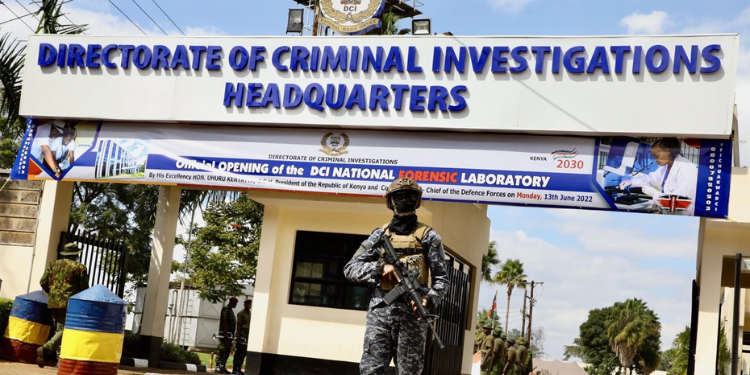
ATPU’s presence in both cases rather than ordinary immigration handling signals Kenya regards this as a security file, not a visa dispute, and its officials are under no obligation to narrate their intelligence assessments to satisfy Mogadishu’s discomfort.
THE QUESTIONS VILLA SOMALIA HAS NOT ANSWERED
Two senior officials from the same administration, caught within a month of each other holding Kenyan passports that Kenya itself says should not exist, is not coincidence it is a pattern with an issuing authority somewhere behind it. Neither Bukhaari, Haji, nor the Somali government have explained who facilitated those documents, how deep the practice runs inside Villa Somalia’s senior ranks, or why cash was moving alongside a state minister’s paperwork.
Abib has described lawyers scrambling inside Villa Somalia to alter property titles ahead of what he calls a tightening net a claim this publication cannot independently verify, but one that will not lose relevance while Kenyan and American investigators keep pulling on the same thread from opposite ends.
Bukhaari is back in Mogadishu. The passport questions are not.


Comments