
Business
The Offshore Empire Behind Kenya’s Dirty Fuel
How Mombasa tycoon Mohamed Jaffer’s Mbaraki Holdings, registered in the tax haven of Mauritius, sits at the apex of One Petroleum — the company at the centre of a substandard fuel scandal that has sent four senior energy officials to police cells and left millions of Kenyan motorists wondering what was pumped into their tanks.

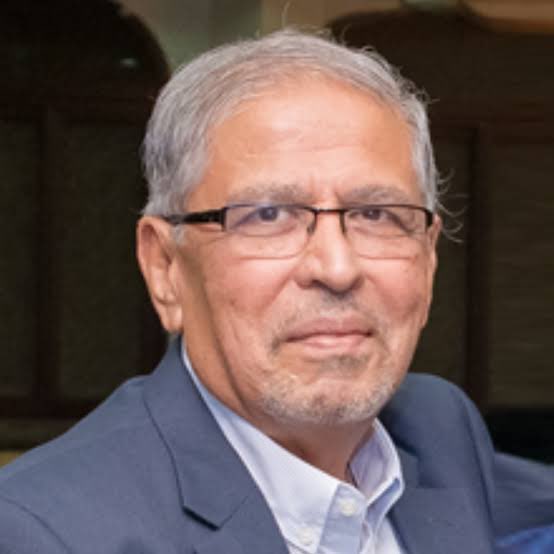
“Mbaraki Holdings Limited, registered on the 19th floor of Newton Tower in Port Louis, controls more than 80 per cent of One Petroleum — and the taxman has been chasing this empire for fifteen years.”
THE COMPANY IN THE SHADOWS
Long before four senior government officials were bundled into police vehicles on the night of April 2, there was a company registered in Mauritius, an island nation that has become Africa’s preferred address for the business of concealment. Mbaraki Holdings Limited, whose postal address sits on the nineteenth floor of Newton Tower along Sir William Newton Street in Port Louis, owns 41,098 of One Petroleum Limited’s 51,000 ordinary shares. That is 80.6 per cent of a company that the Kenyan government quietly cleared to import petrol at three times the official government-to-government rate, in the middle of a geopolitical crisis, without public tender, without competitive pricing, and without any apparent concern about the identity of the people ultimately pocketing the premium.
The Business Registration Service records that each of those ordinary shares is valued at Sh100, giving One Petroleum a nominal capital of Sh5.1 million.
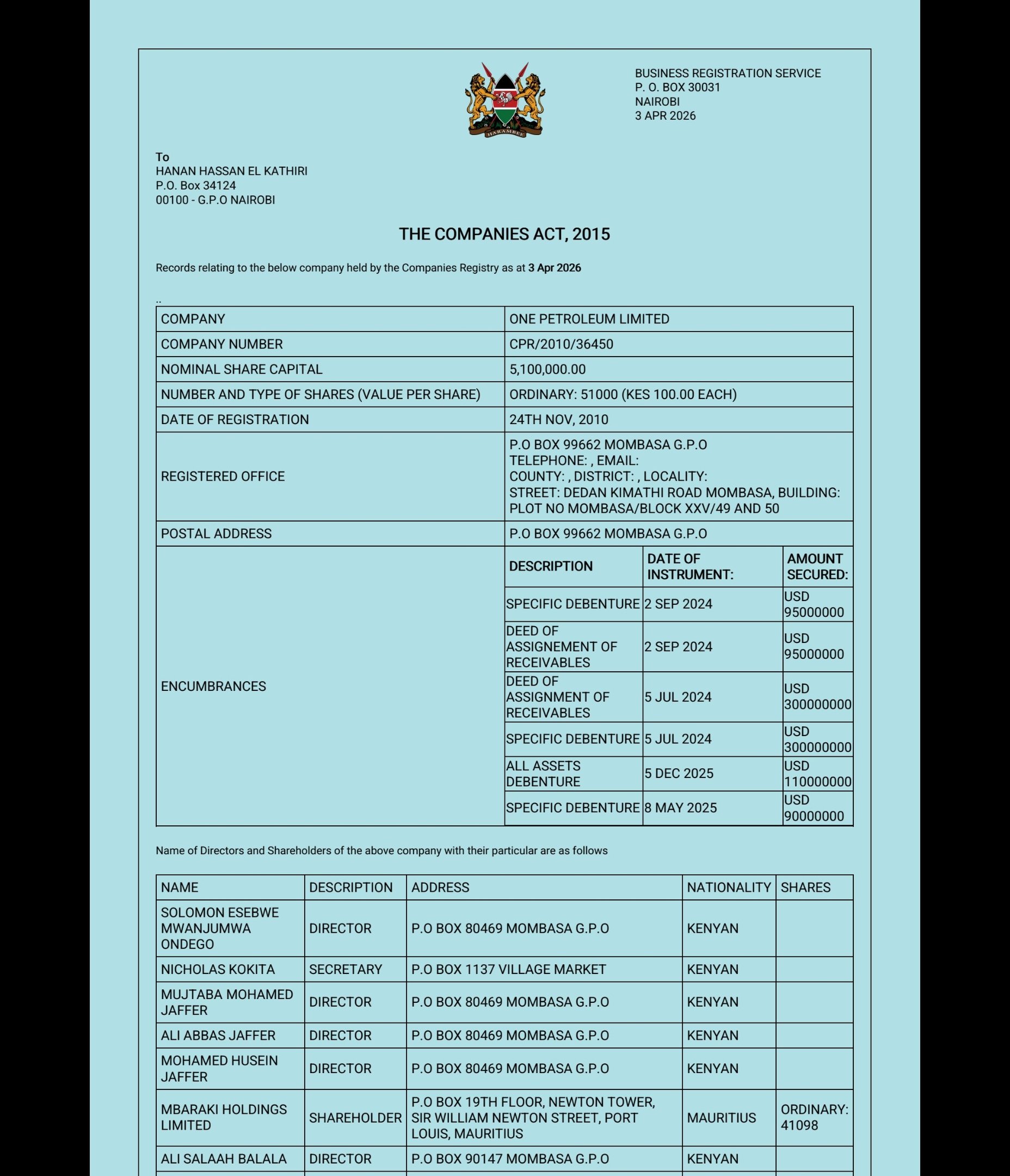
The premium charged on the 60-tonne emergency import, at $290 per tonne against the $84 per tonne benchmark of the G-to-G deal, was roughly $12,360 above the standard rate on cargo value alone.
But that figure tells only the surface story.
The real money flows from the pricing formula: the inflated premium was embedded into the Energy and Petroleum Regulatory Authority’s national pump price calculation for the April 15 to May 14 cycle, effectively distributing the cost of One Petroleum’s windfall across every Kenyan motorist who filled up at a fuel station.
Industry sources at the time projected a spike of at least Sh19 per litre, a figure that would translate to hundreds of millions of shillings transferred from the pockets of ordinary citizens to an offshore holding company that the Kenya Revenue Authority has been pursuing through the courts for years.
The structure of One Petroleum’s ownership is a textbook example of what financial regulators across East Africa have identified as the classic tax-minimisation architecture.
A locally registered operating company, taxed and regulated in Kenya, is majority-owned by a Mauritius entity, which benefits from the island’s preferential rates, its double taxation agreements, and its reputation for the kind of opacity that keeps beneficial ownership away from public scrutiny.
The KRA has long flagged Mauritius-routed structures as vectors for profit shifting and dividend stripping. What makes the Jaffer case exceptional is not that the architecture exists.
It is that it has been allowed to sit at the heart of a government fuel supply arrangement worth billions of shillings, apparently undisturbed by the regulators charged with overseeing both the energy sector and the tax base.
THE DYNASTY AND THE DISPUTED BILLIONS
Mohamed Jaffer was born in Mombasa on March 10, 1948, the great-grandson of Dewji Jamal, one of the earliest South Asian merchants to settle on the East African coast in the 1860s.
The family history is one of genuine entrepreneurial achievement. Dewji’s descendants were bankers to King George V, helped establish the Kenya National Chamber of Commerce, and built the first power plant in Lamu.
But the story that Mohamed Jaffer has written across four decades is one that goes considerably beyond legitimate commerce.
Today Jaffer chairs MJ Group, a conglomerate that company filings and industry analysts value at over Sh16.3 billion.
The group’s tentacles reach across grain handling, liquefied petroleum gas importation, petroleum product storage, edible oil and fertiliser terminals, and now petrol importation through One Petroleum.
The scale of the empire is not in dispute.
What is in dispute, and has been for the better part of fifteen years, is whether any of it has been built on a foundation of honest tax compliance.
“The KRA served Jaffer with an assessment claiming he earned Sh300 million in business in 2007 while claiming he was resident in Dubai — yet the proceeds were banked in undisclosed Mombasa accounts.”
Court records from Miscellaneous Civil Application 312 of 2011 before the High Court reveal the anatomy of one of the earliest confirmed tax disputes.
KRA investigations established that Jaffer had earned Sh300 million in grain business in 2007 and a further Sh15.8 million, on which additional tax of Sh90 million was assessed.
In 2009 he earned Sh300 million and Sh31.9 million, again drawing an additional assessment of Sh90 million.
When confronted, Jaffer’s defence was that he had been residing in Dubai during those years and his only income in Kenya came from his salary as a company director.
Yet the KRA’s forensic analysis of his bank records told a different story.
Investigators discovered that the proceeds from grain sales were deposited into accounts at Co-operative Bank on Nkrumah Road, Mombasa, and at Diamond Trust Bank’s Mombasa Branch, accounts that had never been disclosed in his tax returns.
The taxman was explicit: monies banked from the proceeds of grain sales were not declared for tax purposes. The case went on for years.
A decade later, in October 2020, KRA detectives raided African Gas and Oil Company’s Mombasa premises, seizing bank statements, financial reports, import declarations, stock records and delivery and sales records.
The probe centred on a suspected Sh200 million tax evasion scheme, with KRA’s acting coordinator for the southern region John Bisonga saying preliminary findings pointed to the company having reduced its tax liability by under-declaring and undervaluing imports.
African Gas and Oil Company is the entity through which Jaffer controls Kenya’s LPG market.
Its brand, Pro Gas, with its distinctive pink cylinders, became a household name as the government’s Gas Yetu subsidised cooking gas project mysteriously collapsed.
By 2021, KRA had filed a consolidated court action over Sh68 million in alleged tax evasion by the Jaffer family’s oil and gas firms, targeting One Petroleum Limited, Grain Bulk Handlers Ltd, One Gas Ltd, and African Gas and Oil Company Ltd.
The High Court in Mombasa quashed the authority’s decision to withdraw tax compliance certificates from those four companies, giving the family a temporary reprieve.
But the underlying tax disputes, spread across multiple entities and spanning more than a decade, have never been resolved. The compliance certificates were restored. The questions never went away.
In a Tax Appeal Tribunal matter in May 2024, Mohamed Jaffer Hassanali Khaki, a partner in Kenya Bonded Warehouse Company, challenged additional income tax assessments of Sh46,155,544.70 issued by the Commissioner of Domestic Taxes.
KRA’s investigation had revealed significant variances between the partnership’s income as derived from banking analysis and the income declared in tax returns, as well as capital additions to the business from sources that could not be traced to bank statements.
The pattern, investigators noted, was consistent with the kind of unreported income that has characterised the KRA’s encounters with Jaffer-linked entities across the years.
THE MONOPOLY MACHINE
To understand why the registration of One Petroleum’s parent company in Mauritius matters so acutely, it is necessary to understand the scale of the commercial empire that Mbaraki Holdings ultimately represents.
The MJ Group’s dominance of Kenya’s critical import infrastructure has been the subject of parliamentary investigations, court battles, competition complaints and diplomatic cables spanning three decades.
At virtually every juncture, Jaffer has prevailed.
Grain Bulk Handlers Limited, which the MJ Group controls at 80 per cent, held exclusive rights to handle bulk grain imports at berths 3 and 4 of the Port of Mombasa from 2002 onwards.
In 2020 a Parliamentary Committee on Finance reported that the company controlled 98 per cent of Kenya’s grain imports, processing wheat, rice and maize destined not just for Kenya but for Uganda, South Sudan, Rwanda, the Democratic Republic of Congo and the World Food Programme.
The eight-year exclusivity period that Kenya Ports Authority had initially granted to allow cost recovery expired on February 15, 2008. Jaffer’s lawyers kept it running for sixteen more years.
The Court of Appeal eventually ruled in February 2024 that KPA had erred in blocking Portside Freight Terminals from building a competing facility at the port. The ruling, delivered by Justices Pauline Nyamweya, Imaana Laibuta and George Odunga, was hailed as the end of an era.
It was premature.
By June 2025, the Supreme Court had nullified the Portside contract, finding that KPA had bypassed constitutional procurement procedures when awarding the deal. The apex court’s intervention preserved Jaffer’s position at the port, now through Bulkstream Ltd, formerly Grain Bulk Handlers. Three decades in, the monopoly remained intact.
“Traders complained that reliance on a single handler led to clearance delays and high storage charges — yet the exclusive mandate, expired in 2008, continued unchallenged for sixteen more years.”
In the cooking gas sector the story is structurally identical. African Gas and Oil Company, according to Energy Cabinet Secretary Davis Chirchir, controls 75 per cent of Kenya’s LPG supply.
The company’s AGOL plant in Mombasa, expanded to a storage capacity of 25,000 tonnes, sits adjacent to the planned Sh16 billion terminal of Tanzanian billionaire Rostam Aziz, whose entry into the Kenyan market represents the most serious competitive threat Jaffer has faced in thirty years.
Through Proto Energy Limited, the maker of Pro Gas, Jaffer controls production. Through AGOL, he controls importation and storage. Through the port terminal at Mbaraki, he controls receipt. The integration is total.
The Gas Yetu episode illuminates how that control is exercised when challenged.
In 2016 the government launched the Mwananchi Gas Project, an ambitious plan to supply five million low-income households with subsidised 6kg cooking gas cylinders at Sh2,000 each, with refills at Sh840.
The project was allocated Sh2.2 billion for 2017 to 2019, later supplemented to Sh2.9 billion. A consortium led by Allied East Africa won the tender but lacked the capacity to deliver.
It turned to Jaffer’s AGOL, which supplied 67,251 cylinders in the first batch.
Those cylinders were subsequently rejected by the National Oil Corporation of Kenya as defective and unsafe, with faulty valves raising fire risk concerns. The tender purchase orders were then cancelled by the Principal Secretary.
Gas Yetu quietly died.
Pro Gas, with its bright pink cylinders, stepped into the vacuum. DCI Director George Kinoti announced in October 2018 that his office would investigate the loss of billions. Years later, no charges have been filed.
THE SEMLEX FILES AND THE MIDNIGHT MINISTER
Perhaps the most internationally documented dimension of the Jaffer family’s business methods is the Semlex driving licence affair, exposed through a trove of 160,000 leaked internal documents analysed by the Organised Crime and Corruption Reporting Project, The Elephant and Africa Uncensored.
The documents reveal Mujtaba Jaffer, Mohamed’s son and now a director of One Petroleum, as the principal broker between the Belgian biometric firm Semlex and Kenyan government officials in the procurement of the country’s digital driving licence contract.
Semlex, whose global playbook involves cultivating politically connected middlemen to deliver government contracts through opaque tender processes, landed in Kenya in 2008.
Its path to the Ministry of Transport’s preferred bidder list was smoothed by a series of manoeuvres that the leaked emails document in uncomfortable detail.
Sheila M’Mbijjewe, then a Central Bank of Kenya committee official and later the state bank’s deputy governor, was simultaneously a director of two obscure Kenyan companies owned by the Jaffer family: Computer Source Point Ltd and Infocard Africa Ltd. Those entities served as the nominee vehicles through which the contract arrangement was channelled.
In one email, Mujtaba Jaffer, who regularly addressed Semlex CEO Albert Karaziwan as ‘brother’, referenced a late-night meeting with the Minister of Transport at which the contract’s trajectory was apparently determined.
In another, he gave the late politician Njenga Karume his ‘blessing’ to make decisions on his behalf regarding the contract.
The OCCRP’s analysis showed the individuals involved planned to make millions of dollars personally from the arrangement, at the expense of Kenyan drivers who today pay Sh3,000 for a digital driving licence, double the cost of the previous credential.
When confronted by reporters, Mujtaba Jaffer acknowledged that Computer Source Point and Infocard Africa were no longer active. He offered no other response.
LAND, LOANS AND THE SGR BILLIONS
The Jaffer empire’s relationship with public money is not confined to the energy sector.
Court records document a pattern of engagements with public institutions that repeatedly results in outcomes favourable to the tycoon and unfavourable to the public interest.
Miritini Free Port Limited, a company associated with Jaffer, received Sh1,475,486,485 from the National Land Commission in December 2015 as compensation for land acquired during the construction of the Standard Gauge Railway.
A further Sh360 million in interruption costs brought the total to nearly Sh1.84 billion.
High Court Justice Eric Ogola subsequently ruled that the compensation was unlawful. The court found that the land in question, Plot MN/VI/4805, had been unlawfully acquired from squatters who had been allocated it as resettlement compensation after being evicted from the Sheikh Sayed Children Centre in Bombolulu.
The Commissioner of Lands had cancelled their survey plan without notice, consolidated the plots, and allocated them to Miqdad Enterprises, which sold to Miritini Free Port. ‘The NLC paid part of the compensation money to a wrong party either knowingly or inadvertently,’ Justice Ogola ruled. Miritini Free Port has been fighting in court ever since to keep the money.
As of late 2024, a Mombasa High Court judge had failed to deliver a ruling in the matter on six separate occasions.
A National Assembly Lands Committee investigation into the Miritini Free Port area in 2023 uncovered multiple overlapping legal disputes involving African Gas and Oil Company Limited, Miritini Freeport Limited, Semix Enterprises Limited, Creekport Limited and Mjad Investment Limited, all entities connected to the Jaffer network.
Lawmakers were alarmed to discover that the land register previously maintained by the defunct Commissioner of Lands had not been made available to the National Land Commission, creating a fog that the Jaffer companies had, by all appearances, exploited.
On the loans side, the East African Development Bank went to court in 2016 seeking to recover $3.6 million, equivalent to over Sh464 million at current rates, from a defaulted 1998 loan originally advanced to Kenya Bus Services Mombasa Limited.
The EADB sued Mujtaba Jaffer and others as guarantors.
The Court of Appeal eventually ordered the matter be reheard after finding that the trial judge had erred in dismissing the bank’s suit. The case continues.
THE FUEL THAT FAILED THE TEST
Against this backdrop of accumulated controversy, the substandard petrol consignment that triggered the arrests of April 2 takes on a significance beyond a regulatory failure in the petroleum supply chain.
The fuel, imported under the emergency authorisation that One Petroleum received from the Ministry of Energy, was tested by a quality assurance manager at Kenya Pipeline Company after arrival.
The tests revealed sulphur levels above Kenya’s specifications. The official declined to authorise discharge. Pressure was reportedly applied on that official to release the fuel. He refused and escalated the matter to investigators. DCI detectives moved the same night.
Energy Principal Secretary Mohamed Liban, EPRA Director General Daniel Kiptoo, KPC Managing Director Joe Sang and petroleum official Simon Wafula were arrested in a coordinated operation that stretched past midnight.
Their homes were searched. Documents and unspecified amounts of cash were recovered. The four were ferried to DCI headquarters on Kiambu Road for questioning before being detained at Gigiri and Capitol Hill police stations.
KPC promptly named a replacement acting Managing Director.
The four face potential charges under the Economic Crimes Act, including provisions on failure to maintain accurate records and stocks of petroleum products.
“The quality assurance manager detected elevated sulphur levels, declined to authorise offloading, and escalated to investigators. Four government officials were in handcuffs before the night was over.”
Investigators are examining two separate but potentially related questions.
The first is whether the fuel consignment delivered by One Petroleum was deliberately substandard, or whether quality degradation occurred elsewhere in the supply chain.
The second, and politically more explosive, is whether the holding of the substandard consignment was used to manufacture an artificial fuel shortage that could then be attributed to the Iran crisis, creating conditions under which further emergency imports at premium prices would be justified.
Multiple police sources told local media that detectives believe the disputed consignment may have contributed to the shortage narrative that had been building in public commentary since the Strait of Hormuz closure.
If that suspicion is borne out, it would represent a remarkable circle: a company whose controlling shareholder is registered in a Mauritius tax haven, with a long history of alleged tax manipulation and regulatory capture, importing substandard fuel at triple the government rate, potentially engineering a shortage, and positioning itself to profit further from the crisis it helped amplify.
The Jaffer name, and the Mbaraki Holdings structure behind it, sits at the centre of every line of that scenario.
THE OFFSHORE ARCHITECTURE AND WHAT IT CONCEALS
Mauritius has long occupied a peculiar position in the financial architecture of African business.
Its double taxation agreements with Kenya, signed in 2012 and effective since 2014, reduce withholding tax on dividends paid from Kenyan subsidiaries to Mauritius-registered parent companies.
The standard withholding tax rate on dividends paid to non-resident shareholders is 15 per cent under Kenyan law. Under the Kenya-Mauritius DTA, the rate can fall to 5 per cent for qualifying holdings.
For a company generating billions in revenues from government fuel contracts, grain handling monopolies and LPG importation, the difference in withholding tax between a Kenyan parent and a Mauritius parent is not academic. It is a very large number.
The KRA has spent years trying to combat Mauritius-routed profit shifting. In guidance and litigation, the authority has challenged structures where Kenyan-source income is routed through Mauritius entities that lack genuine economic substance, arguing that the treaty benefits should not apply where the Mauritius entity is a shell.
Mbaraki Holdings Limited, registered at the nineteenth floor of Newton Tower in Port Louis, has not published accounts, made regulatory filings visible to the Kenyan public, or disclosed the identity of its ultimate beneficial owners.
What is known is that it controls more than 80 per cent of a Kenyan company that just imported fuel at triple the government rate and is now at the centre of a criminal investigation.
The nominal capital structure of One Petroleum makes the offshore character of the arrangement even more stark.
The company is registered with Sh5.1 million in nominal share capital.
Mbaraki Holdings controls the overwhelming majority of that capital. Any significant dividends or management fees paid upward from One Petroleum to Mbaraki Holdings would flow offshore, potentially taxed at the preferential DTA rate or structured in ways that further reduce Kenyan tax exposure.
In a country where the KRA routinely misses revenue targets and the government has deployed Sh17 billion from the petroleum stabilisation fund to cushion consumers from the price spikes partly attributable to One Petroleum’s premium import, the irony is not subtle.
THE POLITICAL SURVIVAL MACHINE
Mohamed Jaffer has been a feature of Kenyan power since the era of President Daniel arap Moi. His ability to survive political transitions, maintain regulatory access across successive administrations and insulate his business interests from the consequences of legal proceedings is itself a phenomenon worth examining.
Industry observers describe him as Kenya’s pre-eminent example of what economists call regulatory capture: a private actor so embedded in the regulatory and political infrastructure of a sector that the line between the regulator’s interest and the businessman’s interest becomes indistinguishable.
In the run-up to the 2022 general election, Jaffer backed Raila Odinga. President Ruto, who won, was Jaffer’s opponent’s ally. Post-election, industry sources reported that the new administration targeted the tycoon’s businesses through regulatory changes designed to break his dominance.
Whether that targeting was sustained, or was itself a negotiating posture, became clearer in October 2023, when Jaffer stood at a state ceremony in Nairobi and received an award from President Ruto for his contributions to entrepreneurship and industry in Kenya.
The rapprochement was complete.
Within months, One Petroleum was being incorporated into the government-to-government fuel supply framework, expanding from emergency importer to formal participant in the country’s strategic fuel arrangements.
The defamation case currently running in the Mombasa Magistrate’s Court adds a further dimension. Abubakar Ali Joho, brother of Mining Cabinet Secretary Hassan Joho, testified about a letter he received following his family’s entry into port logistics through Portside Freight Terminals and Heartland Terminals.
His investigations traced the defamatory content to Matilda Maodo Kinzani, an employee of Jaffer’s Bulkstream Ltd. Kinzani faces charges under the Computer Misuse and Cybercrime Act.
Abu Joho told the court that he and Jaffer were business neighbours who competed in rail services and cargo handling. The defamatory material linked his family to drug trafficking and embezzlement, and was widely circulated on WhatsApp groups during the 2024 nationwide protests.
Jaffer associates who had previously prevailed in a procedural court matter were recorded saying, ‘We know the system.’ Nobody who heard the recording doubted that this was true.
THE QUESTIONS THAT DEMAND ANSWERS
Kenya’s Directorate of Criminal Investigations now holds several pieces of a puzzle that extends well beyond the four officials currently in custody. The substandard petrol is the trigger event. But the deeper questions are structural.
Why was a company whose majority shareholder is registered in a Mauritius tax haven, and whose ultimate beneficial owners are not publicly disclosed, allowed to participate in a strategic national fuel supply arrangement without due diligence on its offshore ownership? Why has the KRA, which has been in litigation with Jaffer-linked entities over tax compliance since at least 2011, not yet resolved those disputes or published the outcomes? Who authorised One Petroleum’s incorporation into the G-to-G framework, and what checks were conducted on the company’s compliance history? And if the substandard consignment did contribute to an artificial shortage that drove emergency import demand, who in the Ministry of Energy, EPRA or KPC knew, and what was the chain of instruction?
The four arrested officials bear accountability for whatever decisions they made or failed to make regarding the fuel’s quality and release.
But they are mid-level actors in a system that has been shaped, over decades, by the commercial priorities of the empire that sits behind One Petroleum.
That empire is registered, at its apex, in Mauritius. Its tax trail is contested.
Its regulatory relationships are the envy of every corporate lawyer in Mombasa. And its latest venture has produced petrol that could not pass a quality test, imported at a price that Kenyans will pay for months, through a structure designed to keep its true ownership as far from public scrutiny as the nineteenth floor of Newton Tower allows.
The DCI’s investigation is a beginning, not an end. What Kenya needs is not just the prosecution of the officials who approved the bad fuel.
It needs an audit of the Mbaraki Holdings structure, a review of all tax arrangements between One Petroleum and its Mauritius parent, a public accounting of every premium paid under the emergency import framework, and a reckoning with the question of how, in a country that claims to be serious about anti-money laundering and beneficial ownership transparency, a company this politically sensitive can be majority-owned by an offshore entity that answers to no one in Kenya.
Kenya Insights allows guest blogging, if you want to be published on Kenya’s most authoritative and accurate blog, have an expose, news TIPS, story angles, human interest stories, drop us an email on [email protected] or via Telegram








Poison at the Pump: How Kenya’s Fuel Marking System May Be Exposing Millions to Cancer-Causing Chemicals

The Offshore Empire Behind Kenya’s Dirty Fuel

Inside Nyayo House: The Kitchen Cartel That Demands Sh100,000 for a Stove

JSC Rot: “Why I Paid Over Sh4 Million for a High Court Slot” — Explosive Claims by ‘Incoming Judge’

Fly 748 Is Back And Flies You To Mombasa From Just Sh6,500

KRA Introduces WhatsApp Tax Filing and How It Works

Trump Says Iran War Almost Over, Warns Of Weeks More Heavy Strikes

Sold And Abandoned: How Diageo and Asahi Are Locking Kenya’s EABL Minority Shareholders Out Of East Africa’s Biggest Corporate Heist

Treasury Hands Sh358M Brief to Eric Gumbo’s Firm While Bypassing Standard Rules — and the Lawyer Is Already Deep Inside Ruto’s State Machine

Understanding Crash Betting: How It Works and What to Know Before You Play

Tuju Forcefully Removed From His Karen Property With Masked Officers In Unmarked Vehicles In Early Morning Raid

Nowhere To Hide: Govt Begins Tracing Hustler Fund Defaulters Using National IDs To Recover Unpaid Sh12 Billion

How Little-Known Pesa Print, Linked to State House Tycoons, Won NTSA Tender Worth Sh42 Billion in Traffic Fines

Named: Havi Says Mutava Confessed He Was Collecting The Bribe For Lady Justice Josephine Mongare, So Why Is JSC Still Silence?

The Man With The Golden Pen: How NLC’s Joel Ombati Is Accused Of Masterminding Kenya’s Biggest Infrastructure Land Heist

THE HANDSHAKE THAT BECAME A NOOSE: How Tuju’s Alleged Intimate Access to EADB’s Yeda Apopo Produced a Sh294 Million Deal With No Written Contract, and Why That Trust Destroyed an Empire

‘They Will Eat You Alive’: Retired Teacher Warns Against Bashy African Credit as Sh500,000 Loan Spirals Into Sh1.5 Million Fight

Waweru’s Bank Pockets Sh1.16 Billion from KPC IPO While Ordinary Kenyans Fled the Sale

Men Linked to Akasha Drug Dynasty Charged With Death Threats and Assault at Nairobi Nightclub

The New Master of the Nation: How a Tanzanian Billionaire With a President in His Pocket Just Bought Kenya’s Most Powerful Press
-
 Business1 week ago
THE HANDSHAKE THAT BECAME A NOOSE: How Tuju’s Alleged Intimate Access to EADB’s Yeda Apopo Produced a Sh294 Million Deal With No Written Contract, and Why That Trust Destroyed an Empire
-
 News1 week ago
Men Linked to Akasha Drug Dynasty Charged With Death Threats and Assault at Nairobi Nightclub
-

 News1 week ago
City Lawyer Kimani Wachira Caught Up In Bribery Web Fights Claims
-

 Business2 weeks ago
Big Shame: EY and PwC Found Guilty of Fraud and Corruption in Kenya as World Bank Bans Lay Bare Scandal Inside the Global Audit Elite
-
 Investigations3 days ago
Forged Legacy: How Kaplan and Stratton’s Peter Gachuhi Is Accused of Faking a Top AG’s Will as State Claims Damning Evidence
-
 Business3 days ago
THE BANK THAT BROKE THE TRUCKER: How NCBA’s Asset Financing Empire Is on Trial Before London’s Most Feared Arbitral Tribunal
-
 Investigations2 weeks ago
Is Equity Bank Becoming A Fraudsters’ Den?
-
 Business3 days ago
How Firm Linked To Mombasa Tycoon Jaffer Was Allowed To Import Fuel At Bloated Price And Set To Make Billions In Profits From Iranian War Crisis In Kenya