Luxury vs. Legacy: The Battle for Maasai Mara’s Soul
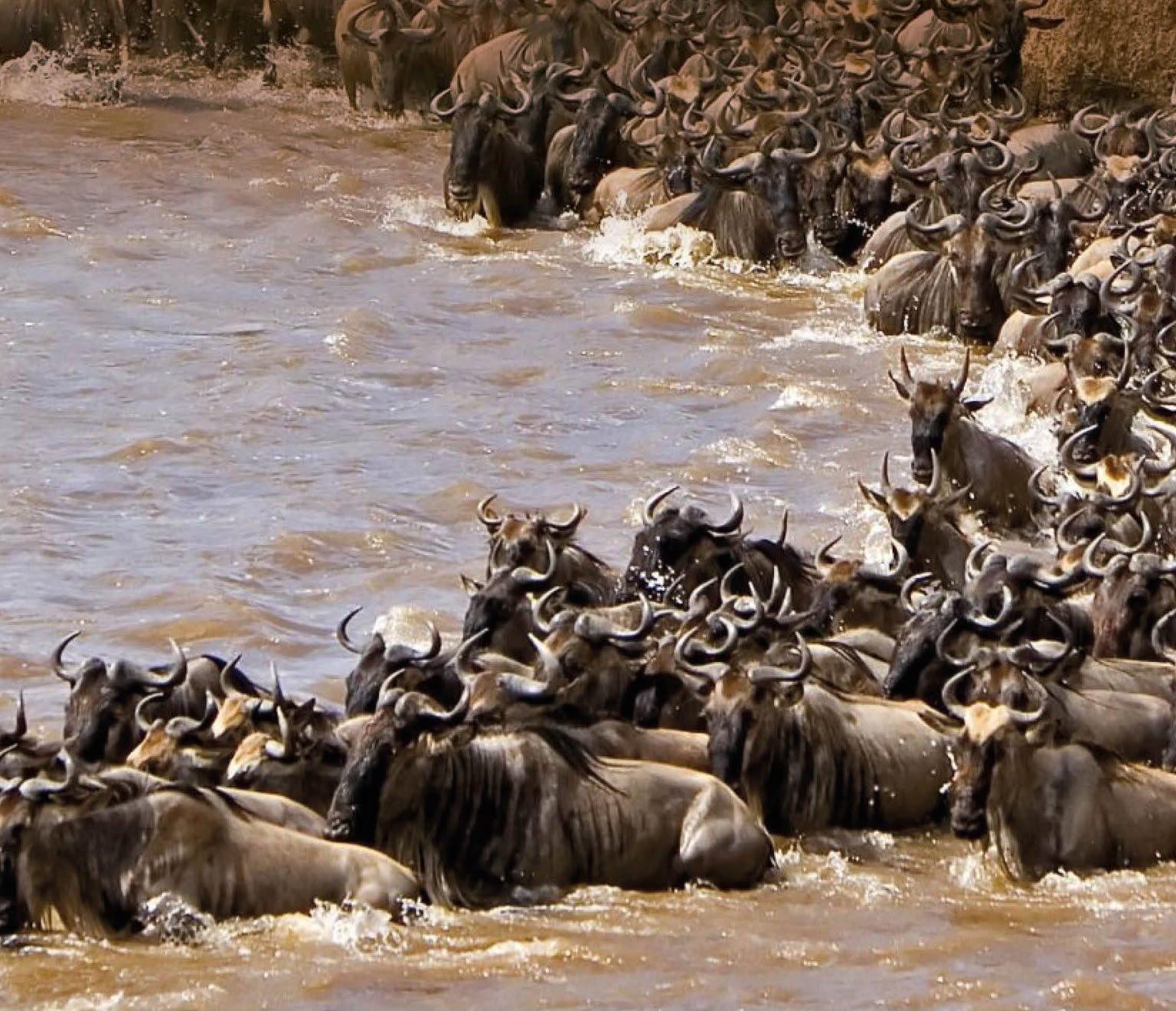
When the first wildebeest herds arrive at the Sand River crossing each year, they carry with them the weight of millions of years of evolution. The migration between Kenya’s Maasai Mara and Tanzania’s Serengeti represents nature’s most spectacular choreography, a movement so vast it can be seen from space.
But this year, the ancient rhythms of survival are colliding with something decidedly modern: a controversy over whether one of the world’s most exclusive hotel brands belongs in the middle of it all.
The storm began brewing long before August 2025, when the Ritz-Carlton Maasai Mara Safari Camp welcomed its first guests. According to documents from the Seventh Stakeholders Forum of the Greater Serengeti-Mara Ecosystem, held just months earlier in Tanzania’s Serengeti National Park, the very type of development now standing on the Sand River’s banks had already been identified as a critical threat to the region’s survival.
Between March 28 and 30, 2025, scientists, conservation professionals, and government representatives from both Kenya and Tanzania gathered under the auspices of the Greater Serengeti-Mara Conservation Society.
Their mission was urgent: assess the state of one of Africa’s most important ecosystems and chart a path forward. What they concluded should have sent shockwaves through every planning office in Narok County.
According to the forum’s official summary, current tourism pressure in the Maasai Mara has reached unsustainable levels.
The scientists didn’t mince words, stating plainly that mass tourism is actively impairing the wildebeest migration and compromising the ecological integrity of the entire system.
Among their recommendations was a stark directive: prohibit the establishment of new lodges and camps in designated wilderness areas, and withdraw licenses for facilities located in sensitive zones.
The forum went further, specifically calling out the need to avoid tourism infrastructure construction in locations that negatively affect protected areas or block wildlife corridors.
They identified the Sand River area as a dry season refuge, a technical designation that carries enormous ecological significance. When water becomes scarce across the vast plains, these refuges become concentration points where animals gather to survive. Building permanent structures in such locations doesn’t just inconvenience wildlife. It threatens their survival.
Yet five months after this forum concluded, Governor Patrick Ole Ntutu of Narok County stood alongside Marriott International executives at the grand opening of the Ritz-Carlton camp.
Photographs from that August 15 ceremony show the governor smiling beneath an inaugural plaque, celebrating a development that operates under a franchise agreement between the Kenyan company Lazizi Mara Limited and the American hospitality giant.
The same governor whose signature appears on the Maasai Mara National Reserve Management Plan 2023-2032, a document that explicitly placed a moratorium on new lodges and camps through 2033.

How did a luxury hotel brand secure permission to build in a location that planning documents were designed to protect? The answer lies in a single letter from Felix K. Koskei, chief of staff to President William Ruto.
According to reporting by The New York Times, Koskei granted Marriott what he termed a one-time exemption from the moratorium, justifying it as part of the government’s commitment to cultivating a favorable business environment for domestic and foreign investment.
That exemption effectively nullified years of collaborative conservation planning. The management plan, developed through joint scientific assessments between national and county governments, became subordinate to political expediency with the stroke of a pen. For conservation advocates, the message was unmistakable: no protection is permanent when political connections and commercial interests align.
The scientific case against the location appears formidable. According to The New York Times, Grant Hopcraft, an ecologist who has been tracking wildebeest movement since 1996, wrote directly to Kenya’s Environment and Land Court stating that the proposed lodge sits directly on a major wildlife corridor between the Serengeti and Maasai Mara.
Joseph Ogutu, a Kenyan researcher at the University of Hohenheim in Germany with over three decades of migration research in the Mara, supported this assessment, telling the Times that five decades of data consistently indicate the river location is critical for wildlife.
The Kenya Wildlife Service tells a different story. In a statement issued in late November, the agency asserted that GPS collar data collected from more than 60 migratory wildebeest between 1999 and 2022 demonstrates the Sand River site does not fall within a migration corridor.
The agency explained that each GPS collar represents herds numbering between 2,000 and 100,000 animals, suggesting their dataset captures comprehensive movement patterns across decades.
This fundamental disagreement over data interpretation sits at the heart of the controversy. Both sides claim scientific rigor, yet reach diametrically opposed conclusions about whether the location poses risks to migration routes. For observers trying to assess the competing claims, the context matters enormously.
The forum summary document notes that wildebeest migration on the Mara-Loita Plains has collapsed dramatically, with populations declining from 140,000 to fewer than 15,000 animals.
This isn’t theoretical concern about future impacts. It’s documentation of migration collapse that has already occurred elsewhere in the ecosystem. The animals didn’t die. They simply stopped migrating when their traditional routes became compromised.
According to the forum findings, the broader ecosystem faces multiple compounding pressures. Tourism infrastructure has expanded dramatically, with expert estimates cited in The New York Times indicating growth from 95 camps in 2012 to 175 by 2024.
Each new development brings increased vehicle traffic, with The Times reporting that safari cars often drive off-road, disturbing animals and damaging vegetation. Light pollution and noise from lodges affect wildlife behavior patterns, while wastewater from facilities flows into the Mara and Sand river systems.
The forum scientists warned that some rivers formerly flowing year-round are becoming seasonal due to vegetation loss. They calculated that a drought lasting merely ten days during dry season could result in mass mortality of up to 300,000 migratory wildebeest. Against this backdrop, constructing a facility requiring substantial water consumption in an area identified as a dry season refuge raises profound questions about long-term sustainability.
Dr. Meitamei Olol Dapash, a Maasai elder who directs the Institute for Maasai Education, Research and Conservation, filed suit against Marriott International, Ritz-Carlton, Lazizi Mara Limited, and local authorities on the same day the camp opened.
According to The New York Times, his lawsuit alleges the camp was built in the middle of a corridor used by wildebeest during the Great Migration, which occurs primarily between July and September. His demands are uncompromising: dismantle the camp, restore the landscape, and plant native trees before next year’s migration begins.
Court-issued gag orders have since silenced Dr. Dapash from speaking publicly about his case, according to the Daily Nation. The legal mechanism prevents him from discussing the matter while courts consider the merits, effectively removing the most prominent critic from public debate during the crucial period when attention might generate political pressure for change.
The procedural irregularities alleged around community consultation raise disturbing questions about environmental governance. According to The New York Times, Julius Manchau Liaram, a Maasai herder, discovered his name and signature on documents indicating community approval for the project.
Liaram told the Times he never attended any meeting about the Ritz-Carlton and would not have approved it had he been consulted. He reported the matter to police immediately, suspecting that whoever used his name assumed he would never discover the forgery.
The National Environment Management Authority maintains it conducted proper community consultation and received consent. But when community members claim they never participated in meetings and their signatures were forged, the integrity of the entire approval process comes into question.
These aren’t minor administrative irregularities. They strike at the fundamental legitimacy of development decisions affecting ancestral lands and communal resources.
Justin Landry, the Ritz-Carlton camp’s general manager, told The New York Times that an environmental impact assessment was conducted in April 2024 and the development received proper approval.
He emphasized that 90 percent of the camp’s team comes from Kenya, with 40 percent drawn from local communities, and that the company supports inclusive growth and community connection.
Yet the employment statistics don’t address the core environmental concerns or the procedural questions about how approval was obtained.
As Dominic Kasoe, a 30-year-old local resident, told The Times, he wants tourism in the Mara and recognizes its benefits, but not at the expense of wildlife or local rights. His description of multinational companies operating without regard for communities was blunt: parasites.
The analytical document examining whether Maasai Mara needs a Ritz-Carlton raises pointed questions about political ethics and environmental governance.
It notes that several individuals with direct ties to Governor Ole Ntutu attended the March forum, including Samuel Leposo Ndorko, Stephen Minis, and Jackson Mpario.
These officials heard firsthand the scientific warnings about unsustainable tourism pressure and recommendations to prohibit new developments in sensitive zones. Their subsequent participation in approving and celebrating the Ritz-Carlton opening cannot be attributed to ignorance of scientific consensus.
The document describes this as a conscious choice to prioritize mass development over scientific recommendations crucial for ecosystem survival. It frames the decision as demonstrating negligence or disregard for scientific norms, while also contravening what it characterizes as the values and culture of the Maasai people.
The controversy extends beyond the Ritz-Carlton. The analytical document identifies another lodge under construction by a prominent Kenyan senator from Narok County, allegedly located within the Olkinyei Forest near the Olare Orok River in the heart of the reserve’s principal protection zone.
When elected officials responsible for representing communities and ensuring legal compliance are themselves allegedly violating conservation regulations, it suggests systemic rather than isolated problems.
The document poses a series of probing questions: How was a construction license granted for this location? Was proper environmental assessment conducted? What technical justification supported approval? Who signed the authorization? How does a senator elected to represent the Maasai people and ensure legal compliance fit within the approval process for new lodge construction that management plans explicitly restrict?
These aren’t rhetorical questions. They demand answers that could reveal whether environmental protections serve genuine conservation purposes or merely provide bureaucratic theater that political connections can easily bypass.
The forum scientists emphasized that effective conservation requires institutional integrity, administrative transparency, and unwavering respect for regulations.
Without these foundations, environmental protection becomes hollowed out, subordinated to what the analytical document describes as power devoid of morality and profit without restraint.
The scientists proposed developing a joint work plan between Kenya and Tanzania for transboundary conservation, building on existing frameworks like the East Africa Community Climate Finance Strategy and the Lusaka Agreement on Illegal Wildlife Trade. Large-scale infrastructure developments along reserve borders run counter to the coordinated management approach designed to reduce cross-border environmental stress.
The Kenya Wildlife Service statement addressing the controversy dismisses much criticism as outdated material from 2018 and 2020, suggesting that images and narratives circulating online may reflect competing commercial interests. The agency notes that five permanent safari camps and over two seasonal camps already exist along the Sand River, none attracting similar opposition. It argues this demonstrates the location doesn’t obstruct migration corridors.
But this reasoning misunderstands how ecosystems reach tipping points. Ecological systems don’t collapse linearly. They absorb pressure incrementally until suddenly they can’t, and then change becomes catastrophic and often irreversible. The question isn’t whether previous developments caused problems. It’s whether cumulative pressure has reached levels where additional development triggers systemic failure.
Emmanuel Sananka, a 26-year-old software engineer who grew up in the Mara and lives near the reserve, articulated the precedent concern to The New York Times.
If Marriott and Ritz-Carlton are permitted to remain despite the moratorium, it establishes that anyone with sufficient resources and connections can operate similarly, disregarding people and wildlife. The community needs assurance that their voice matters even when confronting powerful corporations.
Tilal Ole Sairowa, a 71-year-old Maasai elder and livestock keeper, told The Times that two generations of Maasai children have attended schools built by tourism revenue, received healthcare from tourist-funded hospitals, and benefited from tourist-supported scholarships. The community doesn’t oppose tourism. They want it managed better by local government and park authorities.
This distinction deserves emphasis. The controversy isn’t driven by anti-tourism sentiment or opposition to economic development. It’s driven by recognition that tourism infrastructure expansion has outpaced the ecosystem’s capacity to sustain it, and that political processes have failed to enforce the protections that management plans establish.
The Kenya Wildlife Service cites government commitment to corridor protection, pointing to Cabinet approval for securing the Nairobi National Park to Athi-Kapiti wildlife corridor.
The agency notes that the wildebeest migration has received international recognition from the World Book of Records and World Tourism Market as the world’s greatest annual terrestrial wildlife migration and leading African tourism destination.
These achievements are genuine and worth celebrating. But they don’t resolve the fundamental question: if corridors are being protected in some locations while exceptions are granted in others, what determines which areas receive genuine protection and which become available for luxury development? The answer appears to be political connections rather than scientific criteria.
Marriott International has plans for additional East African expansion, with The New York Times reporting that a JW Marriott Mount Kenya Rhino Reserve and a JW Marriott luxury safari lodge in Serengeti National Park are scheduled to open in early 2026.
The Serengeti property will operate within a protected UNESCO World Heritage site, raising questions about whether similar controversies will emerge there.
Jonathan Koshal, a 39-year-old Maasai guide who owns Eye of Masai tour company, told The Times that the dirt and grass wall surrounding the Ritz-Carlton camp clearly demonstrates the company’s intention to separate guests from everyone else. The wall doesn’t keep wildlife out, however. The Times reported that tracks appear every few feet along the perimeter where animals have attempted to climb over or walk through.
This physical barrier epitomizes the broader separation between luxury tourism and conservation reality. Tourists paying premium rates for exclusive experiences remain disconnected from the environmental pressures their presence creates and the community impacts their isolated accommodations generate.
Sarah Dusek, co-founder and chief executive of Few & Far, an ecolodge company operating in South Africa’s Limpopo region, told The Times that sustainability must mean more than avoiding harm. Companies need to actively drive positive change and environmental restoration.
Her Luvhondo ecolodge limits capacity to six tented suites while rewilding and restoring approximately 247,000 acres.
This model represents the alternative approach that conservationists advocate: smaller footprints, temporary rather than permanent structures, genuine community partnerships, and commitment to landscape restoration that exceeds the area directly occupied.
It demonstrates that luxury tourism and environmental stewardship aren’t inherently incompatible, but achieving both requires prioritizing conservation over capacity.
The analytical document concludes that the Ritz-Carlton Maasai Mara Safari Camp and the senator’s lodge directly contravene the forum findings and recommendations while breaching mandatory provisions in the Maasai Mara National Reserve Management Plan 2023-2032.
It characterizes these developments as epitomizing unsustainable tourism models that the scientific and conservation community has worked for decades to restrain, recognizing the inextricable links between ecological integrity and Maasai cultural survival.
The document’s final assessment is unequivocal: Maasai Mara does not need a Ritz-Carlton. The reserve requires environmental conservation supported by responsible, high-quality tourism rather than luxury infrastructure that exceeds ecological limits and compromises cultural and spiritual values in pursuit of immediate profit.
Whether this conclusion prevails depends on factors beyond scientific evidence or community preference. It depends on whether courts uphold environmental regulations or defer to presidential exemptions. Whether media attention generates political pressure for accountability.
Whether international consumers choosing safari destinations consider environmental governance alongside thread counts and infinity pool views. Whether the community voices that forged signatures attempted to silence ultimately prove stronger than the corporate and political power aligned against them.
The wildebeest will return to the Sand River when seasonal patterns dictate. They’ve made this journey for longer than human civilization has existed. The question confronting Kenya isn’t whether animals can adapt to obstacles in their path. Ecological research demonstrates that when critical routes become compromised, migrations don’t adjust, they collapse.
The question is whether a nation that has built substantial economic prosperity on wildlife tourism will enforce the protections its own management plans establish, or whether those protections evaporate whenever political connections and commercial interests demand exceptions.
The answer will determine not just the fate of one luxury camp, but the credibility of environmental governance across Kenya’s protected areas.
If presidential exemptions can override decade-long moratoria, if community consultation can be satisfied through forged signatures, if scientific consensus can be dismissed when contradicted by government agencies defending politically connected developments, then no ecosystem is actually protected. Management plans become suggestions rather than requirements, binding only on those lacking sufficient political influence to obtain exemptions.
The Maasai elders, conservation scientists, and local guides leading opposition to the Ritz-Carlton aren’t fighting against tourism or economic development.
They’re fighting for the principle that some places remain too ecologically and culturally significant to sacrifice for luxury accommodations, regardless of how much revenue they might generate or how many jobs they might create.
They’re fighting for the idea that environmental protections mean something beyond words in planning documents that political power can erase.
Whether they succeed will reveal whether Kenya’s commitment to conservation extends beyond international marketing campaigns to actual enforcement when protecting ecosystems conflicts with commercial opportunity.
The world is watching. So are the wildebeest, though they don’t yet know that their ancient pathways have become a courtroom battleground where their survival hangs on legal arguments about GPS data, presidential prerogatives, and whether profit should triumph over preservation.








Comments