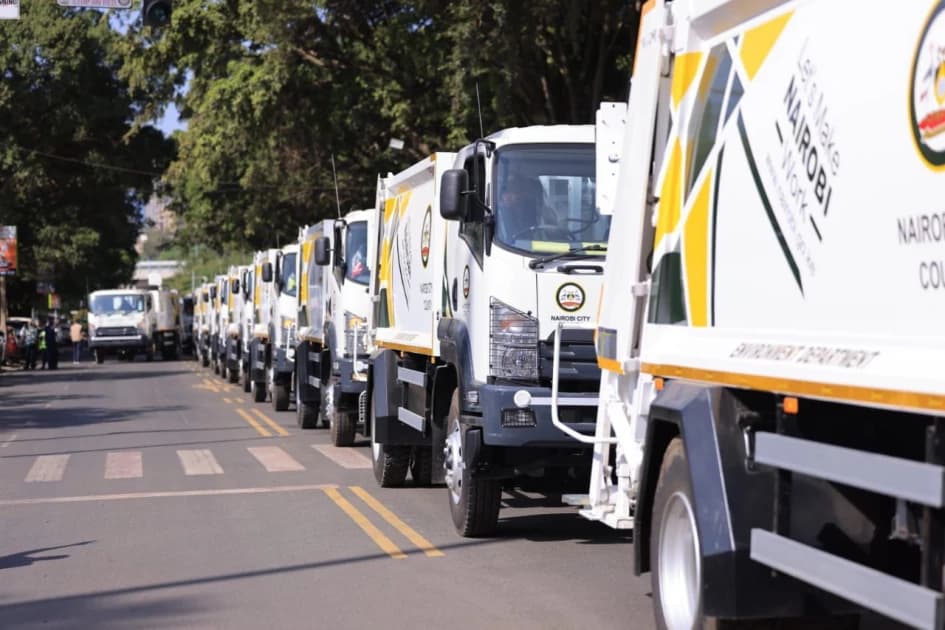
A Mombasa-based lawyer has been thrust into the centre of one of Kenya’s most explosive procurement controversies after her name appeared on the incorporation documents of a local shell company engineered to capture a multibillion-shilling Nairobi garbage contract, in a saga that has already claimed the life of a senior City Hall official at the departure terminal of Jomo Kenyatta International Airport, triggered a High Court conservatory order, prompted a parallel investigation by the Ethics and Anti-Corruption Commission and drawn comparisons to the very country from which the Ghanaian waste firm at the heart of the deal has been effectively expelled.
Heeral Vishal Soni, an advocate of the High Court of Kenya operating out of Mombasa and listed as a partner at Soni and Associates Advocates LLP, is the sole Kenyan director in Zoomlion Waste Services Limited, a company incorporated on August 23, 2025 in which Zoomlion Ghana Limited holds all the shares.
The two Ghanaian principals behind the venture are Joseph Kwame Siaw Agyepong, the flamboyant executive chairman of the Jospong Group of Companies and the man who built Zoomlion into a continental sanitation behemoth, and Said Haidar, a Ghanaian national who has travelled frequently with Soni in recent months.
That Soni holds no shares, serving as a director without equity, has done nothing to quiet the questions swirling around her role in an arrangement that procurement experts say was structured from the inside out.
The timing of Zoomlion Waste Services Limited’s birth in the Kenyan company registry is, on its own, damning. The entity was incorporated on August 23, 2025.
The Nairobi City County government only advertised the tender it was destined to win on December 18, 2025, nearly four months later. Bids closed and were opened on January 8, 2026. Zoomlion Waste Services was the only entity to submit a response.
In a project of this scale, complexity and projected duration involving the primary waste infrastructure of a capital city of more than six million people, a single bid is not a market outcome. It is an administrative outcome: the product of deliberate choices about how a tender is structured, timed and classified to guarantee a result already decided elsewhere.
The contract, formally designated Tender No. NCC/ENV/RFP/100/2025-2026, grants Zoomlion Ghana Limited exclusive rights to design, construct, operate, maintain and eventually transfer to the county an integrated solid waste management system for Nairobi.
Its scope takes in waste collection and haulage across the capital, control of the 76-acre Dandora dumpsite, sorting, recycling and disposal infrastructure, and the construction of a waste-to-energy facility that the national government has projected could generate electricity and produce fertiliser by 2027. Its duration was advertised as twenty-five years, a period that will outlast at least three gubernatorial terms and bind administrations not yet elected to financial obligations whose full terms have never been disclosed to the public.
“A single bid in a project of this scale is not a market outcome. It is an administrative outcome: the product of deliberate choices about who was meant to win.”
Procurement expert, speaking on condition of anonymity
The notification of award was issued in United States dollars rather than Kenya shillings, an irregularity that alarmed Treasury officials who reviewed the agreement.
No dedicated funding mechanism, no escrow arrangement, no clearly defined management fee schedule and no guaranteed minimum waste supply commitment appears in the contract as reviewed by City Hall’s own technical team.
That team characterised the document in language that ought to have stopped the deal cold, warning that the absence of provisions addressing ISPO arrangements, escrow mechanisms, management fee schedules, minimum waste supply guarantees and dedicated funding sources exposed the project to serious operational and financial risk. City Hall signed it anyway.
The procurement pathway chosen by the county government is itself a confession of irregular intent. By virtue of its financing, construction and long-term operational components, the contract falls squarely within the Public Private Partnership Act 2021 and should have been processed through the PPP Directorate under the National Treasury, a route that would have imposed independent technical review, public participation obligations and mandatory Attorney General approval before execution.
Instead, the county ran it under the Public Procurement and Asset Disposal Act 2015, a statutory choice that stripped the deal of those safeguards and allowed a tender that should have attracted global competitors to be compressed into a window so short that only a company already incorporated in Kenya and already in conversation with City Hall could realistically respond.
The tender document adds insult to that injury. It carries a clause stating the process is open to both local and international bidders while bearing none of the classification initials that legally designate a tender as an Open International Tender.
In the absence of those designations, Kenyan companies were nominally eligible while the structural conditions of the process ensured that only a firm already positioned and incorporated in Kenya before the advertisement could realistically respond within the compressed window available. Zoomlion Waste Services Limited had been in existence for exactly that purpose since August.
A DEATH AT THE DEPARTURE GATE
It was on February 16, 2026, at 5:05 in the morning, that Charles Gathara, who had served for over a decade as a senior official in City Hall’s Water and Sanitation department and who had been appointed to chair the county’s tender evaluation committee for the Zoomlion project, arrived at the Jomo Kenyatta International Airport at the head of a technical due diligence team bound for Accra.
The mission, shrouded in the kind of secrecy that had defined the entire procurement, was to tour Zoomlion’s operations in Ghana and return satisfied that the company they had already awarded the contract to was capable of delivering on it.
That sequence, due diligence conducted after contract award rather than before it, is the procedural equivalent of buying a house and only then inspecting the foundations.
An aviation workers’ strike grounded the airport. Gathara and his colleagues waited. Sources with knowledge of the internal dynamics at City Hall told Kenya Insights that Gathara had, in the weeks preceding the trip, raised objections to aspects of the deal that his colleagues were unwilling to discuss openly and that those objections had placed him in sharp conflict with figures whose financial interests in the contract’s smooth progress were considerable.
The Weekly Citizen, which first reported details of the incident, stated that Gathara had specifically differed with Soni over questions relating to kickbacks associated with the procurement. Then, while waiting for the strike to resolve, Gathara collapsed. He was pronounced dead at the airport.
His colleagues departed without him. Kenya Airways flight KQ508, a Boeing 737-86N, eventually lifted off at 8:53 in the evening after a delay of more than fifteen hours.
A Zoomlion protocol team had been waiting in Accra since early morning. The delegation spent three days at the company’s facilities, touring sites and receiving a presentation prepared by the very contractor whose capacity they were supposed to be independently verifying.
Walter Omwenga, the deputy director for environment and final disposal who was among those who made the trip, would later confirm to journalists that the exercise involved physically inspecting what a bidder had claimed it could do, without explaining why that verification was happening after the contract had been signed rather than before. Gathara was buried on February 27, 2026 at his family home in Gathoni, Embu. He was 55.
The decision to proceed with the Ghana trip on the day of Gathara’s death, without pausing to investigate the circumstances of his collapse or to question the propriety of an exercise that was already ethically compromised, has drawn quiet condemnation from governance advocates and procurement law practitioners who reviewed the episode at Kenya Insights’s request. One senior advocate, speaking without attribution, described the optics as extraordinary even by the standards of Kenyan county procurement, which are not known for their exacting ethical rigour.
PRESIDENT, GOVERNOR AND A GHANAIAN TYCOON
The fingerprints of the national government are visible throughout a transaction that City Hall has presented as a routine county procurement.
On August 13, 2025, at the Devolution Conference in Homa Bay, the Jospong Group of Companies was allocated a stand at the exhibition grounds, which President William Ruto visited on the opening day.
The President subsequently praised Zoomlion for its waste management model and told Kenyans that his administration was working with Nairobi Governor Johnson Sakaja to resolve the capital’s garbage crisis.
Ten days later, Zoomlion Waste Services Limited was incorporated in Nairobi with Soni as its Kenyan director. The tender was advertised four months after that. In a January 20, 2026 address in Nairobi, Ruto confirmed that the national government had been party to the procurement process. The deal, in other words, was State House before it was City Hall.
What was kept from Nairobians is what the President and the Governor already knew: that the company they were endorsing had, by the time of their public enthusiasm for it, accumulated a record in its home country that Ghana’s own new government found sufficiently alarming to terminate their relationship with it entirely. In June 2025, President John Mahama of Ghana cancelled Zoomlion’s long-standing contract with the Youth Employment Agency over transparency concerns and fairness failures affecting thousands of low-paid street cleaners. Mahama directed that all payments to Zoomlion made after the contract’s expiration would undergo a thorough audit.
Civil society in Ghana had spent years documenting what critics described as a monopoly over public sanitation built on political connections and procurement structures that crowded out competitors.
The Jospong Group and Zoomlion had previously been blacklisted by the World Bank over integrity concerns. None of that history appeared to trouble the administration that was simultaneously rolling out the red carpet for the same firm in Nairobi.
MOMBASA ALREADY BURNING
The Nairobi scandal did not arrive in a vacuum. Mombasa County had already walked the same road, and the results were no less troubling. Governor Abdulswamad Shariff Nassir signed a 35-year waste management contract with Zoomlion valued at Sh17 billion, a sum that amounts to roughly 131 million United States dollars, in circumstances that civil society organisations on the coast described as a procurement conducted entirely in darkness, without public participation and without transparency on the terms binding Mombasa residents for a generation.
The Centre for Litigation Trust, a Mombasa-based civil rights group, sued the county government and obtained a court order demanding disclosure. The Ethics and Anti-Corruption Commission in Mombasa subsequently opened an investigation into the contract, a probe that remains active.
It is in the context of that Mombasa contract that Soni’s presence becomes still more significant.
As the sole Kenyan director of the vehicle through which Zoomlion has sought to embed itself in both of Kenya’s most populous county jurisdictions, she sits at the intersection of two procurement controversies, both involving the same Ghanaian principals, both under judicial and anti-corruption scrutiny, and both structured in ways that excluded competitive participation and public oversight.
Whether she played a facilitative legal role, a commercial intermediary role or something still more substantive is a question that investigators at the EACC in Mombasa are now formally examining.
COURTS STEP IN WHERE OVERSIGHT FAILED
On March 5, 2026, Justice Moses Ado of the Milimani Commercial and Tax Division issued a conservatory order barring the Nairobi county government, its environment chief officer, its director of supply chain management and the county secretary from executing or implementing the Zoomlion contract pending the hearing and determination of a petition challenging the deal.
The order was obtained on an application filed by Jeremy Emilio, who argued that the award was illegal and unconstitutional on multiple grounds, including the absence of the Attorney General’s approval, which is legally required for any contract of this nature and value.
The High Court has since extended those orders, with the matter now scheduled for further directions on April 27, 2026.
The petition also raises concerns about the Sh350 million bank guarantee submitted by Zoomlion as part of the tender process, which Emilio argues is disproportionately low relative to the scale and projected value of a contract that, across its twenty-five year tenure, is expected to run to billions of shillings.
That figure is consistent with a tender document that, as advertised, specified no price at all: a blank financial cheque drawn on the residents of Nairobi and endorsed by an administration that appears to have decided on the contractor before the advertisement was written.
The petition further argues that at least two local companies are currently executing waste management contracts in Nairobi under earlier tenders: one for the supply of heavy equipment at Dandora, another for solid waste collection in Kibra constituency.
Some of those contractors had already encountered delays in receiving county payments at the time the Zoomlion concession was awarded, an irony that captures something essential about how Nairobi’s governance actually works: local firms, including those with political backing, were left chasing county invoices while the county assembled a quarter-century monopoly for a foreign company its own technical team had not yet verified could do the job.
Adding yet another layer to what has already become a juridical and reputational catastrophe for Governor Sakaja, the Environment and Land Court separately ordered Nairobi County to clear all illegally dumped trash at Umoja residential estate and enforce waste segregation compliance within 135 days, a judicial rebuke of a county government that awarded a generation-long garbage contract to a single foreign bidder while failing to collect the rubbish from its own residential estates.
DANDORA: THE PRIZE BENEATH THE RUBBISH
Understanding what Zoomlion has been handed requires understanding what Dandora actually is.
The 76-acre site at the eastern edge of Nairobi has operated as the capital’s primary waste disposal facility for decades, absorbing the refuse of one of the fastest-growing urban populations in Africa in conditions that courts have now twice found to constitute a violation of constitutional rights.
In February 2026, the Environment and Land Court awarded Sh25.8 million in damages to 1,032 waste pickers who suffered health violations through prolonged exposure to pollution at the site, holding Nairobi County and the National Environment Management Authority jointly responsible.
The court’s findings established Dandora not merely as an environmental nuisance but as a site of systematic constitutional failure whose remediation carries an enormous financial and infrastructural obligation.
It is control of that site, along with the revenue streams associated with waste collection across a metropolis of six million people, recycling operations, composting, and ultimately the generation of electricity from solid waste, that Zoomlion has secured through a contract structured, in the assessment of City Hall’s own technical reviewers, without any of the financial safeguards that would normally be required before a public authority surrenders control of a strategic infrastructure asset for a quarter century.
The waste-to-energy component alone, if it performs as projected, would give Zoomlion effective control of a private power generation facility in Nairobi built on a site owned by the public and operated at public expense, for twenty-five years, with no guaranteed return mechanism to the county government identified anywhere in the contract.
The conservatory order obtained by Emilio means that none of this can proceed while the courts examine whether any of it was legally possible in the first place.
But the order has not resolved the deeper questions raised by the scandal: how a company was incorporated in Kenya four months before the tender it was going to win was advertised, why the official who objected to the procurement terms died at the airport on the day his colleagues left to validate those same terms, what role a Mombasa advocate with no disclosed financial stake in the arrangement has been playing in a deal that spans two county governments, two anti-corruption investigations and a conservatory order from the Commercial Court, and what President Ruto and Governor Sakaja knew, and when they knew it.
Ghana spent years discovering what a Zoomlion contract with insufficient safeguards actually costs. Kenya appears determined to learn the same lesson the expensive way. The next court date is April 27. The accounting, when it comes, may take considerably longer.








Comments