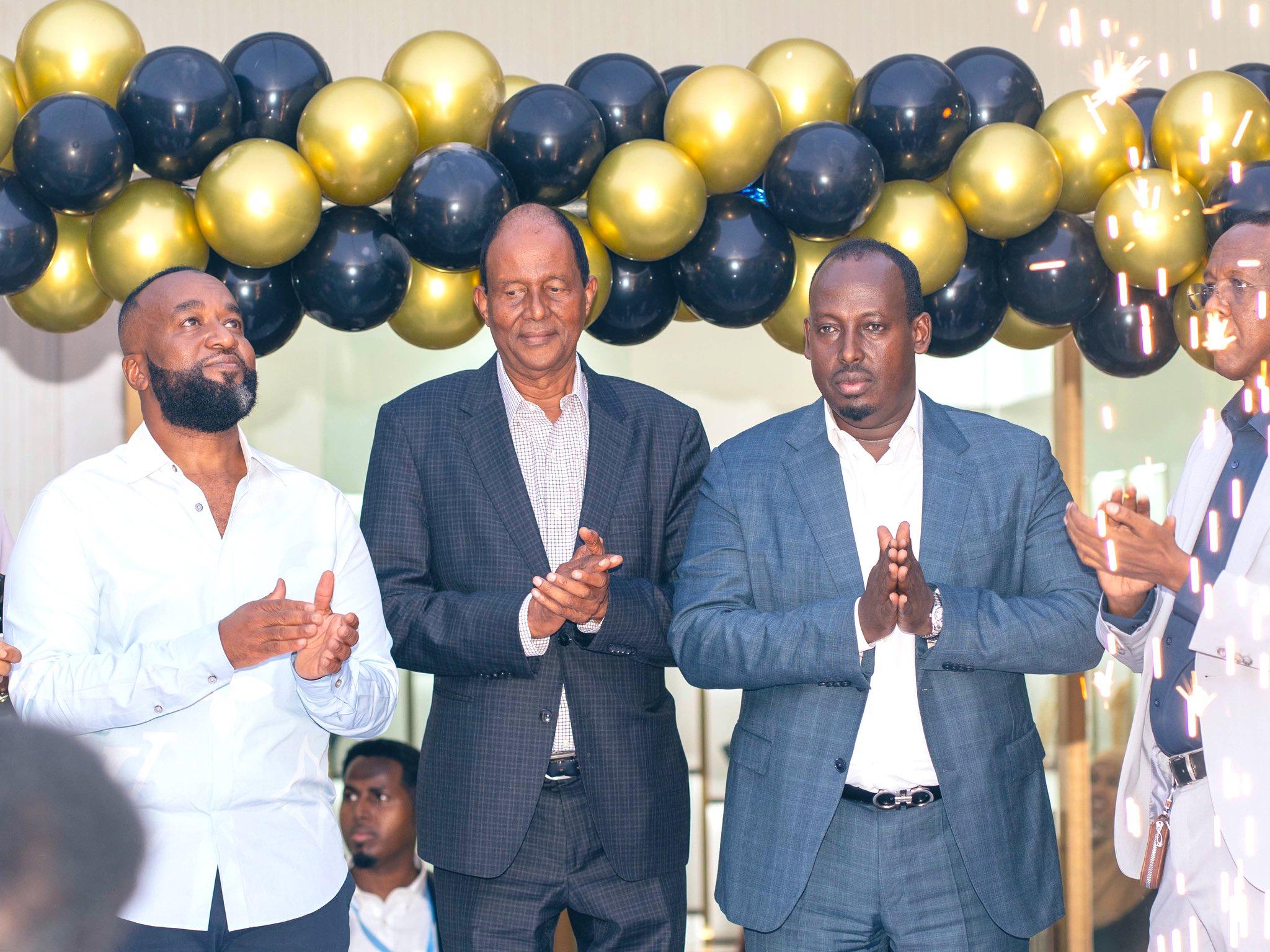
Abdiweli Mohamed Hassan sits at the intersection of Kenya’s most explosive business and political controversies in 2026, his name ricocheting between corruption allegations, international fraud schemes and multibillion-shilling procurement scandals that have thrust the Somali-Kenyan entrepreneur into unwanted national prominence.
The owner of Eastleigh’s iconic Business Bay Square Mall, once celebrated as a symbol of entrepreneurial success and urban transformation, now finds himself battling to salvage a reputation battered by claims that link his commercial empire to stolen disability funds from Minnesota, rice import cartels threatening Kenyan farmers, and shadowy medical equipment deals worth Sh200 billion.
It is a spectacular fall from grace for a man who, just two years ago, was feted by President William Ruto at the grand opening of what was billed as East and Central Africa’s largest shopping complex. Today, Hassan is the face of what critics describe as the dangerous nexus between political patronage, ethnic entrepreneurship and alleged corporate malfeasance in Kenya’s Wild West business environment.
THE MINNESOTA BOMBSHELL
The first blow came with devastating force on January 4, when former Deputy President Rigathi Gachagua, speaking from the pulpit of AIPCA Kiratina Church in Githunguri, made sensational claims that sent shockwaves through Kenya’s business community and diplomatic circles.
“That money was meant to help people living with disabilities. It was stolen, brought to Kenya and invested in land, houses, and the construction of a mall,” Gachagua thundered before a packed congregation. “There is a mall in Eastleigh that was built using that money, and the owner is a business partner of the President.”

The allegations were explosive. Gachagua was directly linking Hassan’s multibillion-shilling commercial empire to an international fraud scandal that has rocked Minnesota, where federal authorities have charged 92 people, with 62 already convicted, in connection with schemes that bilked US taxpayers out of hundreds of millions of dollars meant for disability services and child nutrition programs.
The most notorious case involved Feeding Our Future, a nonprofit that allegedly siphoned USD 250 million during the COVID-19 pandemic. FBI Director Kash Patel has called the Minnesota fraud “just the tip of a very large iceberg,” with losses potentially running into billions.
But Gachagua went further, urging US President Donald Trump to bypass Kenya’s legal system entirely and conduct a Venezuela-style military operation to seize suspects linked to the alleged fraud. “We are asking you Trump, don’t bother about the extradition process in Kenya, wewe fanya vile ulifanya Venezuela, because Ruto amesema jamaa asitolewe huku,” the former deputy president said in remarks that have triggered diplomatic concerns.
Hassan’s response was swift and uncompromising. On January 5, his lawyers at MMA Advocates filed a blistering 10-page petition with the National Cohesion and Integration Commission, accusing Gachagua of making reckless, inflammatory and ethnically charged statements that threaten to tear apart the social fabric of Eastleigh and destroy the livelihoods of thousands of innocent traders.
“These utterances have the effect of demonising an entire community and economic zone without factual or legal basis,” the petition states, arguing that Gachagua’s words amount to “collective punishment and ethnic stereotyping, which this country has suffered from in the past.”
The lawyers presented a detailed timeline that they say demolishes Gachagua’s allegations. According to court documents, the BBS Mall property was lawfully acquired in 2009 and initially housed Comesa Mall before being redeveloped between 2018 and 2022. The alleged Minnesota fraud, by contrast, occurred between 2022 and 2025, making it chronologically impossible for those funds to have financed a building already completed.
Eldas MP Adan Keynan rushed to Hassan’s defense, describing the mall’s proprietor as a respected businessman who has operated in Eastleigh for more than 25 years without ever being linked to criminal activity. “The property was later redeveloped into what is now the largest mall in East and Central Africa. Construction commenced in 2018 and was successfully completed in 2022,” Keynan said, demanding that Gachagua retract his claims and issue an unreserved public apology.
Yet the damage was done. Investors began getting cold feet. Tenants reconsidered expansion plans. Customers stayed away. The reputation of one of East Africa’s largest shopping complexes now hangs in the balance, all because of unsubstantiated allegations from a high-ranking political figure.
Hassan has not been formally charged in relation to the Minnesota allegations, and no court has made a determination on the claims. But in the court of public opinion, the verdict has already been rendered, at least in some quarters.
THE RICE IMPORT SCANDAL
If the Minnesota fraud allegations were not enough, Hassan found himself at the centre of another firestorm in August 2025, when Busia Senator Okiya Omtatah publicly accused him of leading a rice import cartel that threatens Kenyan farmers.
The accusations came after the government announced it would allow 500,000 tonnes of duty-free rice imports from India and Pakistan, a decision defended by Agriculture Cabinet Secretary Mutahi Kagwe as essential to avert a food crisis, given Kenya’s annual deficit of about one million metric tonnes.
But Omtatah was having none of it. During a Senate session on July 31, 2025, the outspoken lawmaker claimed that the import deal favored BBS Mall’s ownership, questioning the legality and transparency of the rice import allocation.
“I would like to seek a statement from the committee on the matter that is now a public concern,” Omtatah said on July 9, 2025. “This development has raised concerns about the impact of this decision on local rice farmers.”

The senator noted an apparent bypassing of established regulatory institutions such as the Agriculture Food Authority, which under the Crops Act is mandated to oversee decisions related to food crop imports. He claimed that the mall was given permission by the government to import 500,000 metric tonnes of rice, an allegation that has bewildered rice farmers in Mwea, Kirinyaga County, who reported unsold stocks amid the influx of imported rice.
Hassan’s legal team, led by prominent lawyer Ahmednasir Abdullahi, responded forcefully with a demand letter dated August 23, 2025, threatening legal action unless Omtatah retracted his Senate statements.
“For the record, we state expressly that our client was never allocated any quota to import rice,” the letter asserted, labeling Omtatah’s statements as baseless and misleading.
The standoff escalated into a broader political battle, with Omtatah declaring, “Parliamentary privilege is not for sale. I will not be gagged for demanding answers on the 500,000 tonnes of duty-free rice imports that threaten Kenyan farmers.”
Gachagua also waded into the rice controversy, linking Hassan to claims of rice importation deals. “I recently spoke about a mall in Eastleigh which was used to import rice at the expense of our farmers. I have seen people saying that I have attacked the mall. I never mentioned the mall,” Gachagua said in a quick rejoinder.
The rice scandal took on added urgency when the High Court in Mombasa threw a judicial spanner into a controversial rice importation deal, with Justice Jairus Ngaah issuing interim orders that exposed what appears to be a scandalous procurement process riddled with irregularities and potential fraud.
The ruling effectively froze the Agriculture and Food Authority’s attempt to reallocate a massive 250,000 metric tonnes rice import quota to four largely unknown private firms: Zyan Agencies, Ecoview Commodities, Njema Commodities, and Solid Commodities. These firms mysteriously emerged as beneficiaries despite not being among the original 60 companies initially considered for the contract.
Even more shocking, these firms edged out 16 legitimate bidders who had already been notified by the Kenya National Trading Corporation on September 9 that they were successful, only to be told the following day that the corporation had “chosen to go a different route.”
Corporate records raised immediate red flags. Solid Commodities, owned by Haroon Omar Bachoo, was incorporated as recently as October 2024, yet somehow secured a share of this multibillion-shilling deal. When journalists attempted to contact Zyan Agencies using officially registered information, they reached a woman who denied any knowledge of either the company or its listed owner, Ibrahim Murie Ibrahim.
With the government’s revised valuation of grade one white Pakistani rice at USD 460 per metric tonne, the total consignment is valued at approximately Sh14.8 billion. The import duty waiver makes this an even more attractive deal for the beneficiaries.
While Hassan’s legal team has categorically denied any involvement in rice importation, the controversy has placed the BBS Mall founder at the centre of a heated national debate about food security, farmer protection, and the influence of business cartels on government policy.
The accusations against Hassan came as local farmers in Mwea reported unsold stocks amid the influx of imported rice, fueling public suspicion that major business figures wield disproportionate influence over government commodity import decisions.
THE MEDICAL EQUIPMENT MYSTERY
As if the Minnesota fraud allegations and rice import scandal were not enough to tarnish Hassan’s reputation, his name has also been mentioned in connection with a Sh200 billion medical equipment supply deal reportedly awarded to Sunview Medipro International.
The contract, which has attracted scrutiny over its scale and procurement process, involves the National Equipment Service Program, a successor to the controversial Medical Equipment Service scheme that saw the Kenyan government spend Sh63 billion on dysfunctional medical equipment.
Sunview Medipro International, a little-known firm, was contracted to handle the medical equipment leasing deal under NESP by the Ministry of Health at a cost of Sh200 billion in collaboration with the Council of Governors, an arrangement that was controversially rejected by governors at its inception stage.
The pullout by governors came days after the National Treasury allocated more than Sh9 billion for the project in the 2023/24 budget, with shadowy contractors whose firms were kept away from public knowledge and scrutiny.
Under the current framework, Sunview Medipro International has been contracted to deploy an initial 98 Diagnostic Imaging CT Scan Machines, two Diagnostic Imaging Mammogram Machines, 400 Operating Theatres, and 400 Laboratories across the country under a Fee-for-Service model.
While appearing before the Senate Public Accounts Committee on December 3, 2024, Nyeri Governor Mutahi Kahiga, vice-chairperson of the Council of Governors, blew the lid off the new medical equipment leasing deal under NESP, terming it as shadowy.
He admitted that county governments were left with little choice but to sign the contracts, despite being kept in the dark about crucial details, including the identities of the suppliers.
“We had no option but to sign the deal. Counties do not have the funds to buy this equipment,” Kahiga told the committee. “We did not procure the machines, it’s the Ministry of Health that did the procurement. They even put out advertisements in the newspapers. We were not involved.”
Kahiga explained that counties were asked to select from 23 lots of equipment needed for local hospitals, but it was only after making these selections that they learned which companies would be providing the machines.
“But whoever selected them, that was a programme decided by the national government. We are just landlords,” he added.
Senators described the NESP as “opaque” and akin to the MES scandal. Busia Senator Okiya Omtatah demanded that Kahiga specify the legal clauses that allowed counties to sign the agreements. Isiolo Senator Fatuma Dullo accused the governors of not fully understanding the programme’s operations, suggesting that the deal could be worse than the MES scandal.
At least 37 counties have already signed agreements with the Ministry of Health to supply the medical gadgets, but the identities of the suppliers remain unclear. Hassan’s connection to this deal remains murky, with no formal confirmation of his involvement, yet his name continues to surface in public discourse around the controversial procurement.
When contacted for comment on the medical equipment deal, Hassan had not responded by the time of publication.
THE TATU CITY GAMBLE
Even as controversy swirled around him, Hassan moved forward with what may be the largest private real estate deal in Kenya’s history. On October 10, 2025, he signed a Sh65 billion agreement with Tatu City Special Economic Zone to develop a 60-acre mixed-use community spanning residential homes, retail spaces, offices, logistics facilities, and religious infrastructure.
The timing of this announcement carried particular significance. Hassan himself had been accused by Omtatah of being at the helm of a rice import cartel, though Hassan’s legal team had vehemently denied any involvement in rice importation deals.
“BBS Mall changed how people viewed Eastleigh, showing that thoughtful development can reshape neighborhoods and improve how people live and work,” Hassan explained during the signing ceremony. “Now, the future of development is moving beyond the city center, where there’s space to build holistic communities with everything people need: schools, offices, entertainment, shops, and recreation. Tatu City offers exactly that, a well-planned environment free from congestion and the hassles of commuting.”
Stephen Jennings, founder and CEO of Rendeavour, the developer behind Tatu City, framed Hassan’s investment as validation of Kenya’s appeal to serious transformative investors despite the country’s well-documented governance challenges.
“People today value a higher standard of living in well-governed, holistic communities,” Jennings noted. “It takes visionaries like Abdiweli Hassan to execute large-scale projects that improve the lives of tens of thousands of people. We are delighted that Hassan selected Tatu City for this record-setting investment in Kenya’s future.”
The Sh65 billion Tatu City investment represents patient capital committed to genuine value creation, with Hassan’s development timeline spanning a decade. This long-term orientation stands in stark contrast to the scramble for quick gains characterizing the rice import scandal, where politically connected firms materialized overnight to claim contracts worth billions.
Yet the irony is inescapable. Hassan’s Sh65 billion Tatu City investment announcement comes as he navigates accusations of benefiting from the very type of opaque government dealings that have plagued Kenya’s procurement system.

THE EASTLEIGH SUCCESS STORY
Hassan’s journey from transforming Eastleigh through the 130,000-square-meter Business Bay Square Mall to this record-setting investment at Tatu City represents what supporters call a masterclass in strategic development thinking.
Where others saw congestion and limited infrastructure, Hassan identified opportunity. His BBS Mall, housing over 1,000 shops and restaurants, did not just create commercial space but reimagined an entire neighborhood’s economic potential and fundamentally altered public perception of what Eastleigh could become.
The mall has become a symbol of the entrepreneurial success of Kenya’s Somali community, a testament to the economic transformation of a district once dismissed as chaotic and disorganized. It employs thousands of Kenyans and contributes hundreds of millions in tax revenue annually.
But this success has also made Hassan a lightning rod for criticism and suspicion. In a country where rapid wealth accumulation often triggers questions about its source, Hassan’s meteoric rise from trader to billionaire developer has invited scrutiny from politicians, senators and civil society activists.
Following Gachagua’s remarks, leaders from Northern Kenya rallied to Hassan’s defense, terming the accusations politically motivated and unfairly targeted. They argued that Eastleigh’s business success has often been mischaracterized and that allegations against Somali-Kenyan entrepreneurs are frequently amplified without due process.
“It is dangerous for a leader of Mr Gachagua’s stature to repeatedly suggest that businesses in Eastleigh are inherently criminal,” Hassan’s lawyers wrote in their NCIC petition. “Such statements amount to collective punishment and ethnic stereotyping, which this country has suffered from in the past.”
Trade Cabinet Secretary Lee Kinyanjui has hit back at Gachagua, accusing him of recklessness and warning that dragging foreign governments into Kenya’s internal disputes could have catastrophic consequences. “How can a leader seek to throw his own country into the deep end merely to score personal revenge?” Kinyanjui demanded.
THE DUAL REALITY
Hassan’s case captures Kenya’s development paradox. On one hand, he represents the promise of entrepreneurial capitalism, a self-made businessman who has transformed urban landscapes and created thousands of jobs. On the other hand, he stands accused, however contested those accusations may be, of benefiting from the very cartel dynamics that corrupt public procurement.
Can the same individual embody both Kenya’s developmental promise and its procurement pathologies? Or does the truth lie somewhere more nuanced, in the complex intersection of legitimate business ambition, political accusations, and a governance system so compromised that even legitimate entrepreneurs find themselves suspected of cartel involvement?
The BBS Mall petition lays out stark demands. It calls on the NCIC to investigate whether Gachagua’s remarks constitute hate speech or ethnic contempt under Kenyan law, issue formal censure if violations are found, and recommend prosecution where appropriate. The lawyers also want media houses cautioned against amplifying such inflammatory statements.
“The effect of these remarks is real, not hypothetical,” the petition warns. “They threaten the reputation and operations of lawful businesses, destabilize commercial relations, and can inflame ethnic animosity.”
As of press time, the NCIC had not publicly responded to the explosive complaint, leaving the nation to wonder whether Kenya’s foremost cohesion watchdog will act when confronted with one of its most significant tests in recent memory.
THE UNANSWERED QUESTIONS
What remains clear is that Abdiweli Mohamed Hassan has become the face of controversial Somali-Kenyan business success, whether he deserves that label or not. His name has become entangled in Kenya’s broader conversation about cartels, procurement integrity, and the influence of wealthy business interests on government policy.
Whether these allegations hold merit remains contested. Hassan’s lawyers insist he had no involvement in rice importation and that the Minnesota fraud timeline makes it impossible for those funds to have financed BBS Mall. Omtatah and Gachagua, however, maintain their accusations, protected by parliamentary privilege and political ambition.
What is undeniable is that Hassan’s trajectory from Eastleigh trader to billionaire developer has made him a symbol of both aspiration and suspicion in a country where success often invites scrutiny and ethnic entrepreneurship triggers political backlash.
As construction begins at Tatu City within the year, Hassan’s gamble will face its ultimate test not in tender documents or Senate debates but in concrete and steel, in schools filled with students and offices humming with commerce, in neighborhoods where families build lives rather than merely survive.
Whether Hassan’s name emerges from these controversies vindicated or tarnished will help define not just one developer’s legacy but Kenya’s capacity to distinguish between genuine value creation and extractive corruption, between building the nation’s future and merely exploiting its present dysfunction.
For now, Abdiweli Mohamed Hassan remains at the center of Kenya’s most explosive business and political storms, his reputation hanging in the balance as investigators, senators and courts pick through the allegations that threaten to define his legacy.
Kenya Insights sought comment from Hassan on all the allegations, but he had not responded by the time of going to press.

Comments