
Investigations
How Hacker Breached Fintech Firm Eclectics International‘s System And Stole Sh52 Million
Using remote access software, Albert Komen Kipkechem burrowed unseen into the payment platform of Eclectics International and a local bank, silently rerouting millions of shillings in transactions that never followed normal payment flows. Detectives who hunted him down found eight fraudulent identity cards, a Congolese passport in a false name, a money-counting machine, and ATM cards registered to other people


Sometime in early June 2025, a cursor moved silently across a computer screen inside a payment platform that processes hundreds of millions of shillings in daily transactions on behalf of banks, SACCOs, and government agencies across Kenya and beyond.
No alarm was triggered. No security protocol flagged the intrusion.
The person behind that cursor, investigators now allege, was not an authorised employee but a man who had burrowed deep into the company’s information systems using remote access software, and who would spend the next two weeks systematically redirecting transactions outside the normal payment flow, bleeding the firm dry of Sh52,549,798 before anyone noticed something had gone catastrophically wrong.
On Thursday, Albert Komen Kipkechem, also known as Jonathan Kiptum Barmasai, stood in the dock at the Milimani Law Courts in Nairobi and pleaded not guilty to charges of Access with Intent to Commit a Further Offence contrary to Section 15(1) and Computer Fraud contrary to Section 26(1)(b) as read with Section 2(a) of the Computer Misuse and Cybercrimes Act No. 5 of 2018.
He was subsequently remanded at Capitol Hill Police Station until March 12, 2026, when the court will give directions on his bail and bond terms.
The victim at the centre of the charge sheet is Eclectics International, a Nairobi-based fintech company that operates as a duly authorised payments aggregator and has built a continental footprint spanning Uganda, Rwanda, Zambia, and eight Francophone countries in West Africa.
The company has been celebrated for developing Africa’s first World Bank-recognised shared agency banking platform. But Eclectics was not the only casualty.
The DCI confirmed that the same suspect is also the principal figure in separate incidents targeting a local commercial bank and a SACCO, with the combined financial losses across all three institutions totalling over Sh52 million in June 2025 alone.
The modus operandi, according to the DCI, was chillingly consistent across both incidents. Kipkechem is alleged to have deployed remote access software to gain unauthorised entry into the payment platform and bank information systems, after which he effected transactions that deliberately bypassed the normal payment flow.
The irregularities were designed to be invisible to automated fraud-detection systems for as long as possible, and they very nearly were. It was only when the affected institutions eventually detected anomalies in their transaction logs that the scale of the breach became apparent.
Upon discovery, the institutions reported the matter to detectives from the Economic and Commercial Crimes Unit attached to the Cyber Fusion Unit at the Central Bank of Kenya.
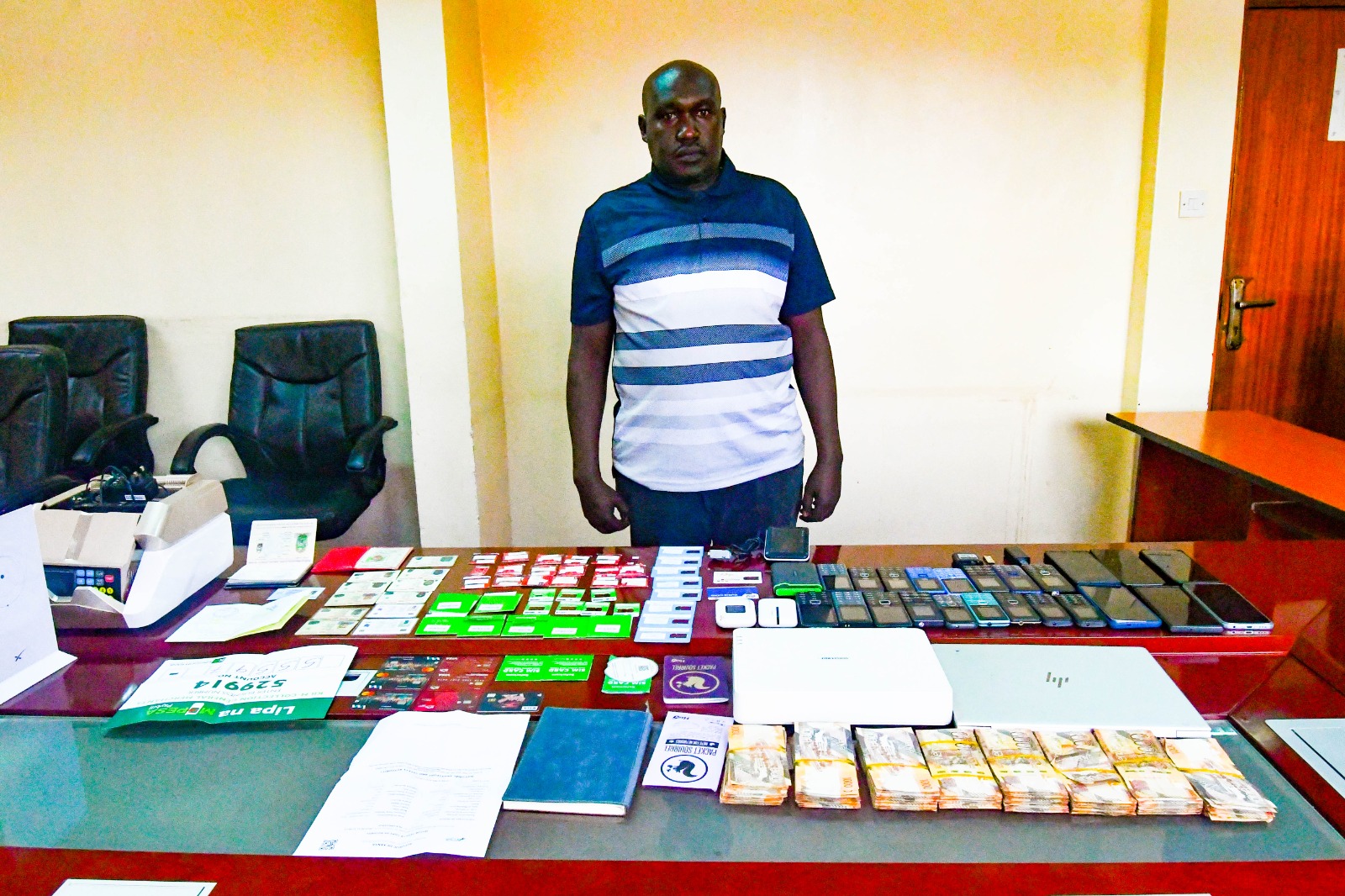
Investigators, working in close collaboration with experts from the National Forensic Laboratory (NFL) and the Crime Research and Intelligence Bureau (CRIB), dissected the digital footprints left behind in the compromised systems. After collecting relevant digital artefacts from the affected institutions and obtaining the necessary court orders and search warrants, detectives zeroed in on their suspect.
He was arrested in Thome, Nairobi, then escorted to his Nakuru home, where the full dimensions of an elaborate criminal enterprise began to emerge from cupboards, drawers, and electronic devices.
Among the recoveries at the Nakuru property were multiple electronic gadgets, assorted SIM cards from various telecommunications service providers, ATM cards registered under other people’s names, a money-counting machine, and cash in Kenyan currency. But it was the identity documents that told the most damning story of all.
Detectives recovered eight fraudulently registered national identity cards, each bearing Kipkechem’s photograph but displaying different names and nationalities, along with a Congolese passport carrying his photograph but registered under the name Katempa Ngoy Alexisa, and a Congolese national identity card bearing the same false name.
The sheer volume and variety of false identification documents found in a single suspect’s possession painted a portrait of a professional criminal who had invested significant time and resources in constructing multiple parallel identities.
Investigators told the court the documents raised a serious concern that Kipkechem could use one of the many false identities to flee the country before the case is concluded, particularly given that a DRC passport gives him a credible route across an international border.
The DCI further told the court that Kipkechem possesses advanced technical expertise that would enable him, if released, to remotely access, encrypt, or delete digital evidence critical to the investigation.
The prosecution also expressed concern that the accused could interfere with witnesses, some of whom are described as former associates or employees of the institutions that suffered the attacks, raising the spectre of witness tampering in a case still actively under construction.
Prosecutors told the court that investigations are continuing into other related cyber-fraud incidents and that the total losses linked to the wider suspected syndicate stand at approximately Sh100 million across several financial institutions.
The charges laid against Kipkechem thus far may represent only the opening chapter of a far longer and more complex criminal saga.
The case lands at a moment of acute anxiety for Kenya’s financial technology sector.
According to the Communications Authority’s National KE-CIRT/CC, Kenya recorded 842 million cyber threat events between July and September 2025 alone, with losses estimated at Ksh29.9 billion in that three-month window.
Mobile banking fraud cases surged by 87 per cent in the most recent annual reporting period, driven by SIM-swap attacks, credential theft, and social engineering.
Eclectics International ironically lists cyber risk management among its own service offerings, describing its team as providing comprehensive security solutions and insisting that cyber risk is multifaceted and not merely a technology concern.
That a firm with such stated capabilities could itself be penetrated so thoroughly, and for so long, raises uncomfortable questions about the adequacy of defences even among companies that trade on security expertise. The case returns to court on March 12, 2026.
Kenya Insights allows guest blogging, if you want to be published on Kenya’s most authoritative and accurate blog, have an expose, news TIPS, story angles, human interest stories, drop us an email on [email protected] or via Telegram


China Sets Lowest Growth Forecast Since 1991

How Kenya Airways Repatriation Flights Ensure Safe Return of Stranded Kenyans in Middle East

How Hacker Breached Fintech Firm Eclectics International‘s System And Stole Sh52 Million

Nowhere To Hide: Govt Begins Tracing Hustler Fund Defaulters Using National IDs To Recover Unpaid Sh12 Billion

Justice Department Posts FBI Interview Memos Related To Trump Sex Abuse Allegation

Gachagua’s Former Secretary Spills Beans On His Dark Past Linking Him To Alleged Murder Of Two Pregnant Girlfriends and Late Brother’s Wife

Trump Demands Say On Iran’s Next Leader As Mideast War Spirals

Vybz Kartel Denies Rumors of East African Tour and Concert In Kenya

OpenAI Says It Can’t Control How Pentagon Uses Its AI, Reports Say

Hamilton Names Kenya A Dream Home, Vows To Race In Africa Before F1 Retirement

Alleged Male Lover Claims His Life Is in Danger, Leaks Screenshots and Private Videos Linking SportPesa CEO Ronald Karauri

The General’s Fall: From Barracks To Bankruptcy As Illness Ravages Karangi’s Memory And Empire

Russian Man’s Secret Sex Recordings Ignite Fury as Questions Mount Over Consent and Easy Pick-Ups in Nairobi

THE FIRM IN THE DOCK: How Kaplan and Stratton Became the Most Scrutinised Law Firm in Kenya

Multi-Million Dollar Fraud: Three Kenyans Face US Extradition in Massive Cybercrime Conspiracy

Iran Demands Arrest, Prosecution Of Kenya’s Cup of Joe Director Director Over Sh2.6 Billion Tea Fraud

FBI Investigates Congresswoman Ilhan Omar’s Husband’s Sh3.8 Billion Businesses in Kenya, Somalia and Dubai

A UN Director Based in Nairobi Was Deep in an Intimate Friendship With Epstein — He Even Sent Her a Sex Toy

Epstein Files: Sultan bin Sulayem Bragged on His Closeness to President Uhuru Then His Firm DP World Controversially Won Port Construction in Kenya, Tanzania

A Farm in Kenya’s Rift Valley Ignites a National Reckoning With Israeli Investment
-
 Grapevine2 weeks ago
A UN Director Based in Nairobi Was Deep in an Intimate Friendship With Epstein — He Even Sent Her a Sex Toy
-

 Development4 days ago
Kenya Strips Dutch Climate Body of Diplomatic Immunity Amid Donor Fraud Scandal and Allegations of Executive Capture
-

 Investigations1 week ago
How Mexico Drug Lord’s Girlfriend Gave Him Away
-

 Business2 weeks ago
Safaricom Faces Avalanche of Lawsuits Over Data Privacy as Acquitted Student Demands Sh200mn Compensation in 48 Hours
-

 Investigations2 weeks ago
How Close Ruto Allies Make Billions From Affordable Housing Deals
-

 Entertainment2 weeks ago
KRA Comes for Kenyan Prince After He Casually Counted Millions on Camera
-

 Business1 week ago
American Investor Claims He Was Scammed Sh225 Million in 88 Nairobi Real Estate Deal
-

 Investigations2 weeks ago
Talanta Stadium Construction Cost Inflated By Sh11 Billion, Audit Reveals