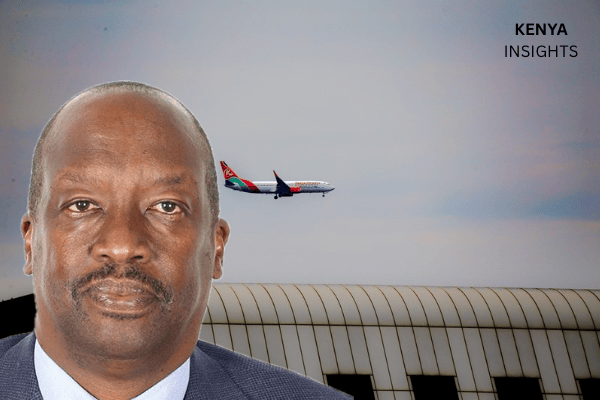
When Kenya Airways unveiled its new board on March 5, 2026, the announcement had the trappings of institutional renewal.
Four fresh faces, led by veteran businessman Kiprono Kittony as chairman, were presented as the architects of the airline’s long-awaited turnaround. The fanfare lasted about 48 hours.
By the weekend, Kenya’s financial and legal commentariat had torn into a detail the airline’s press release buried in its third paragraph: Kittony is also the sitting chairman of the Nairobi Securities Exchange, the very bourse on which KQ shares trade.
The question now circulating in boardrooms, on social media, and increasingly in the offices of regulators is blunt.
Can the man who chairs the exchange that lists and oversees Kenya Airways simultaneously chair Kenya Airways itself without compromising the structural independence that market integrity demands?
“One can’t sit in the board of NSE and be a board member of a listed company. There is complete conflict of interest. It is worse when the board member is a chairman in both places.” — Governance commentator Ike Ojuku
Corporate governance commentator Ike Ojuku was among the first to go on the record. Writing on X, Ojuku argued that the dual positions amounted to a complete conflict of interest and called on the Capital Markets Authority and the National Treasury to account for what he described as a failure of regulatory vigilance. “National Treasury and Capital Markets Authority are not doing their work,” Ojuku wrote in a post that was widely shared and cited in online governance discussions.
The concern is not theoretical. NSE, as a securities exchange, holds a quasi-regulatory function over its listed companies.
It enforces listing rules, monitors continuous disclosure obligations, reviews board composition changes, and can recommend or initiate enforcement action against listed companies in concert with the CMA.
Kittony, as NSE chairman, presides over that oversight function. As KQ chairman, he is now the primary custodian of one of the listed companies that the exchange regulates. The two roles, in their most literal sense, put him on both sides of the oversight relationship simultaneously.
The Standard reported that the KQ announcement did not address how Kittony intends to manage the two roles, an omission that governance observers found telling.
The Capital Markets (Public Offers, Listings and Disclosures) Regulations, 2023, which currently govern listed companies, require issuers to disclose conflicts of interest at the point of appointment.
KQ made the announcement pursuant to those very regulations but included no such disclosure.
Professor Winnie Nyamute, also newly appointed to the KQ board, simultaneously sits on the NSE board, compounding the structural overlap critics have identified.
The conflict has layers. Beyond Kittony, Standard Media reported that Professor Winnie Iminza Nyamute, one of the three other new independent non-executive directors appointed to the KQ board alongside him, also currently sits on the NSE board.
The two now share seats in both the exchange’s boardroom and Kenya Airways’. That dual boardroom overlap between the same pair of individuals at the regulator and a listed company would raise eyebrows in any jurisdiction with functioning governance enforcement.
Kenya’s legal architecture does not make the arrangement outright unlawful. The Companies Act, 2015 permits multiple directorships. Kenyan governance codes allow a person to chair up to two publicly listed companies provided conflicts are declared and managed.
The CMA’s Circular No.06/2024, issued to clarify the 2023 regulations, specifies that non-executive directors must not hold executive or employee positions in related entities, but does not prohibit non-executive board chairmanships across the exchange and a listed company.
Kittony’s defenders will note that the NSE chairmanship is itself a non-executive governance role, not an operational regulatory post, and that the NSE board’s day-to-day market oversight functions are executed by management, not the chairman.
But governance does not run on legal technicalities alone, particularly when a national carrier at the centre of a government privatisation drive is involved.
Kenya Airways has been navigating a bruising investor search after years of accumulated losses.
The government is actively scouting for a strategic investor to revive the airline, a process that involves valuations, disclosures, and market-sensitive negotiations, all of which flow through or past the NSE’s oversight apparatus.
The argument that Kittony’s NSE role creates at minimum an acute perception of conflict in that environment is one that even commentators sympathetic to his personal credentials have found difficult to dismiss.
Kittony’s credentials themselves are not in question.
He co-founded Betway Kenya and Radio Africa Group, chairs Mtech Limited and CreditInfo CRB Kenya, serves as vice chairman of the World Chambers Federation in Paris, and is widely credited with the rehabilitation of the Kenya National Chamber of Commerce and Industry during his tenure as its chairman.
He holds a Bachelor of Commerce and a Bachelor of Laws from the University of Nairobi and a Global Executive MBA from USIU and Columbia University. He was awarded the Elder of the Order of the Burning Spear in 2019 under former President Uhuru Kenyatta. The question his critics are raising is not about his competence. It is about institutional design.
The government is actively scouting for a strategic investor for KQ. That process involves valuations, disclosures, and market-sensitive negotiations. Kittony’s role atop the exchange that oversees that market creates structural questions no amount of personal credentials can paper over.
David Ndii’s appointment to the same board has attracted separate scrutiny of a political nature.
Ndii previously served as chairperson of President William Ruto’s Council of Economic Advisors, a role that was declared unconstitutional by the High Court in January 2026 after Justice Bahati Mwamuye found the Executive had bypassed the Public Service Commission and the Salaries and Remuneration Commission in creating and staffing the advisory positions.
The court barred the National Treasury from disbursing any further funds to the 21 former advisers. Ndii dismissed the ruling as a pyrrhic victory and indicated the advisory relationship with the presidency would continue informally.
His presence on the KQ board raises questions about the commercial and political independence of a board now navigating a sale process under the same government whose economic agenda Ndii has publicly championed.
Kenya Airways, through Company Secretary Habil Waswani, congratulated the new board members and expressed confidence in their ability to steer the company forward.
The airline did not respond to specific questions about how the structural conflicts identified by critics would be managed or whether CMA had been consulted prior to the announcement.
Neither the CMA nor the National Treasury had issued a public statement on the matter at the time of going to press. The silence is itself a form of answer.
In jurisdictions where governance enforcement is robust, an appointment of this nature would typically require pre-approval from the market regulator or, at minimum, a formal conflict declaration and recusal protocol lodged with the exchange before the announcement was made public.
That none of this appears to have happened is the detail that governance observers are finding most alarming.
For Kenya Airways, the governance controversy arrives at the worst possible moment. The airline’s recovery strategy depends on the credibility of its leadership to attract institutional investors willing to take a long-term stake in a loss-making carrier.
Institutional investors, particularly foreign ones, apply their own governance screens before committing capital.
A board chairman whose other hat belongs to the very institution regulating the company they are evaluating is exactly the kind of structural anomaly that triggers red flags in due diligence. Whatever Kittony’s personal standing, the arrangement hands prospective investors a ready-made excuse to negotiate harder or walk away entirely.
The CMA and National Treasury now face a choice. They can let the appointment stand and trust that Kittony will manage the inherent tensions through robust conflict declaration and recusal mechanisms, a workable outcome only if those mechanisms are visible, enforceable, and credible.
Or they can require KQ and Kittony to resolve the structural conflict by vacating one of the two roles, a course that would be disruptive but would restore the institutional clarity that market integrity requires.
The third option, continued silence, is the one neither the market nor investors can afford.





Comments