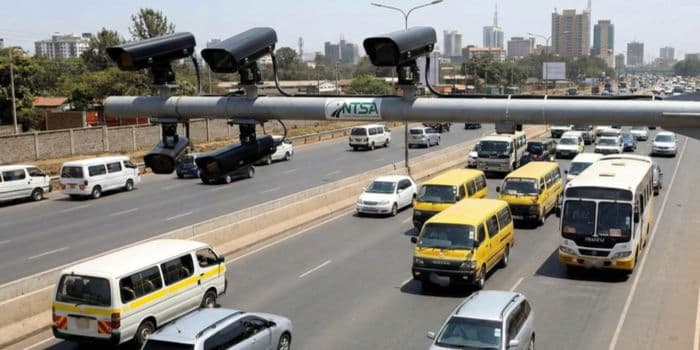
Kenya’s roads entered a new era on Monday when the National Transport and Safety Authority (NTSA) activated its Instant Fines Traffic Management System, a fully automated enforcement platform that silently watches every vehicle on Nairobi’s busiest corridors and dispatches SMS penalty notices to offenders within minutes of a detected violation.
By mid-morning on the system’s first day of operation, motorists across the city were already reporting fine alerts on their phones. One driver shared an Sh10,000 penalty notice he had received after travelling at 128 km/h on Thika Road, a stretch where the posted speed limit is 110 km/h. Others took to social media to complain that they had been fined before they had any idea the system was live, let alone what the rules were.
“This is extortion at this point,” the Thika Road motorist wrote on X. His frustration reflects a sentiment shared widely among Nairobi’s driving public: a technology-driven enforcement regime has arrived swiftly, with limited public education and lingering legal questions about its constitutionality.
NTSA insists the rollout is lawful, necessary and overdue. Road crashes killed more than 5,100 people in Kenya in 2025, imposing an estimated Sh450 billion in economic costs through medical expenses, lost productivity and property damage.
The authority attributes a large share of those deaths to weak enforcement driven by a shortage of cameras, corrupt roadside policing and low enrolment in the smart driving licence programme. The instant fines system, NTSA says, is the antidote.
THE CAMERAS: WHERE THEY ARE AND HOW THEY WORK

The enforcement infrastructure consists of more than 1,000 high-definition smart cameras deployed under a Sh42 billion public-private partnership between NTSA, KCB Bank Kenya and technology firm Pesa Print. The project, approved by Cabinet in December 2025, will run for 21 years, with the camera network ultimately transferred to state ownership at the end of the contract.
Of the 1,000 units, 700 are fixed cameras mounted at permanent positions along major highways and what NTSA describes as high-risk corridors. The remaining 300 are mobile units that enforcement teams will deploy at speeding hotspots and accident-prone zones on a rotating basis.
The cameras are linked to a National Command and Control Centre that monitors traffic in real time, detecting violations and automatically triggering the fine notification system without human intervention.
The system connects to NTSA’s smart driving licence database, which means every fine is tied directly to the individual driver’s profile rather than to the vehicle’s registered owner.
Once a violation is logged, the motorist receives an SMS notification containing the alleged offence, the location, and an image of the vehicle at the time of capture.
In practice, the cameras are concentrated along the roads that carry the highest volumes of traffic in Nairobi, routes where speeding and lane indiscipline have historically caused the greatest harm.
Thika Road, Mombasa Road, the Southern Bypass, the Northern Bypass, the Nairobi Expressway and Waiyaki Way are all under camera surveillance, with speed limits varying significantly from one section to another.
What has frustrated many motorists is that the camera positions are not publicly disclosed and, on many stretches, are not prominently signed.
Critics, including technology commentators and transport operators, argue this approach prioritises revenue collection over behavioural change.
Rwanda’s equivalent system, widely cited as a regional benchmark, marks every enforcement camera clearly so that drivers are warned in advance and have the opportunity to slow down. In Nairobi, the cameras are, for now, invisible.
SPEED LIMITS BY ROAD AND SECTION
Speed limits on Nairobi’s major roads are not uniform. They vary not only between roads but between sections of the same road, depending on the infrastructure, surrounding land use and historical accident data. The table below sets out the applicable limits on each major corridor currently under camera surveillance.
|
ROAD / SECTION |
LIMIT |
|
Thika Road — Safari Park to Thika Road |
110 km/h |
|
Thika Road — Roysambu / TRM |
80–100 km/h |
|
Thika Road — Jomoko to Thika Turnoff |
80 km/h |
|
Thika Road — Allsops / GSU HQ |
80 km/h |
|
Thika Road — Pangani / Muthaiga Interchange |
80 km/h |
|
Nairobi Expressway — Museum Hill to Westlands |
80 km/h |
|
Nairobi Expressway — After Nyayo Stadium |
80 km/h |
|
Mombasa Road — Mombasa Road to Nyayo Stadium |
80 km/h |
|
Mombasa Road — Sameer Business Park / GM |
80 km/h |
|
Southern Bypass — to Virtual Weighbridge |
80 km/h |
|
Southern Bypass — Ngong Road Interchange |
80 km/h |
|
Northern Bypass — After Gitaru |
80 km/h |
|
Northern Bypass — Ruaka / Wangige |
80 km/h |
|
Waiyaki Way — Kangemi / Uthiru |
60–80 km/h |
The most important figure for most Nairobi commuters is the 110 km/h limit on the section of Thika Road between Safari Park and the Thika Road exit. This is the highest posted speed limit on any Nairobi urban road and is the stretch where the first widely reported fine under the new system was issued. Below Safari Park, limits drop to 80 km/h or a variable 80 to 100 km/h range depending on the specific interchange.
The Nairobi Expressway, which carries significant cross-city traffic between Mlolongo and Westlands, is capped at 80 km/h throughout, including from Museum Hill to Westlands and after Nyayo Stadium. The Southern and Northern bypasses similarly sit at a flat 80 km/h limit. Waiyaki Way, which runs through heavier residential and commercial zones, applies the most conservative limits of 60 to 80 km/h depending on the section.
THE SPEEDING PENALTY SCALE
Speeding forms the backbone of NTSA’s enforcement model. The system applies a graduated penalty structure that becomes sharply more expensive as the excess speed increases. Crucially, the same scale applies regardless of the posted speed limit on the particular road: whether you exceed an 80 km/h or a 110 km/h limit, the bands and amounts are identical.
|
EXCESS SPEED BAND |
PENALTY |
|
1–5 km/h above limit |
Warning only |
|
6–10 km/h above limit |
Ksh 500 |
|
11–15 km/h above limit |
Ksh 3,000 |
|
16–20 km/h above limit |
Ksh 10,000 |
The graduated structure means that a motorist travelling at 91 km/h on a road posted at 80 km/h will face a Sh3,000 fine for exceeding the limit by 11 km/h. If the same motorist had been travelling at 101 km/h on the same stretch, the fine would jump fourfold to Sh10,000.
Legal experts note that the sudden escalation from Sh3,000 to Sh10,000 for just five additional kilometres per hour creates what amounts to a cliff-edge penalty with no intermediate step.
THE FULL FINES SCHEDULE: ALL 37 OFFENCES
Beyond speeding, the system is designed to detect and penalise a broad range of traffic violations. NTSA has published a schedule of 37 offences that fall within the instant fines framework. The complete schedule is reproduced below.
|
OFFENCE |
PENALTY |
|
No identification plates / improperly fixed plates |
Ksh 10,000 |
|
No valid vehicle inspection certificate |
Ksh 10,000 |
|
No licence endorsement for vehicle class |
Ksh 3,000 |
|
Failure to renew driving licence |
Ksh 1,000 |
|
Failure to produce driving licence |
Ksh 1,000 |
|
Unqualified PSV driver |
Ksh 5,000 |
|
Driving on pavement / pedestrian walkway |
Ksh 5,000 |
|
Ignoring police officer direction |
Ksh 3,000 |
|
Ignoring traffic sign |
Ksh 3,000 |
|
Failure to stop for police |
Ksh 5,000 |
|
Causing road obstruction |
Ksh 10,000 |
|
No reflective triangles / lifesavers |
Ksh 3,000 |
|
Driving on footpath |
Ksh 5,000 |
|
Driver using phone while driving |
Ksh 2,000 |
|
Body part outside moving vehicle |
Ksh 1,000 |
|
Unlicensed PSV driver or conductor |
Ksh 5,000 |
|
Employer hiring unlicensed PSV staff |
Ksh 10,000 |
|
Failure to refund fare (incomplete trip) |
Ksh 3,000 |
|
Touting |
Ksh 3,000 |
|
PSV driver / conductor without badge or uniform |
Ksh 2,000 |
|
Undesignated person driving PSV |
Ksh 3,000 |
|
PSV driver allowing unauthorised driver |
Ksh 3,000 |
|
PSV with tinted windows / windscreen |
Ksh 3,000 |
|
PSV without fire extinguisher / fire kit |
Ksh 2,000 |
|
PSV picking / dropping at unauthorised stop |
Ksh 3,000 |
|
No speed governor in PSV / commercial vehicle |
Ksh 10,000 |
|
PSV seat belts not maintained |
Ksh 500 |
|
Vehicle without seat belts |
Ksh 1,000 per seat |
|
Not wearing seat belt |
Ksh 500 |
|
Vehicle without reflective warning signs |
Ksh 2,000 |
|
Motorcycle rider without protective gear |
Ksh 1,000 |
|
Motorcycle with more than one pillion passenger |
Ksh 1,000 |
|
Learner without ‘L’ plates |
Ksh 1,000 |
|
Pedestrian obstructing vehicles |
Ksh 500 |
|
Passenger boarding / alighting at unauthorised stop |
Ksh 1,000 |
Among the most significant fines is the Sh10,000 penalty for causing a road obstruction, a common issue in Nairobi where matatus stop mid-road to pick up or drop off passengers. Operating a public service vehicle without a speed governor will also attract Sh10,000, as will employing an unlicensed PSV driver or conductor.
The Sh1,000-per-seat penalty for vehicles without seat belts is notable for its potential cumulative impact: a matatu found to be missing seat belts across its full complement of seats could face a fine of Ksh14,000 or more from a single stop. Drivers using their mobile phones while driving face a Sh2,000 penalty, while those who fail to wear their own seat belt will be charged Sh500.
HOW TO PAY AND WHAT HAPPENS IF YOU DON’T
All fines issued through the automated system must be paid through the branch network of KCB Group within seven days of the SMS notification.
The seven-day window is strict: failure to pay within the deadline will result in interest accruing on the outstanding amount, and the vehicle or driver record will be blocked from conducting any transaction on NTSA’s service platforms.
That includes licence renewals, vehicle inspections, transfers of ownership and any other government transport service.
Critics, have pointed out the awkward contradiction in this arrangement: NTSA is marketing a digital enforcement revolution yet directing motorists to a bank branch to settle fines, a manual bottleneck that sits at odds with the system’s stated ambitions.
NTSA has said a Mobile Driving Licence wallet is in development that will allow motorists to carry digital copies of their licences, access offence records and pay fines through mobile and USSD channels.
NTSA has not disclosed whether repeat offenders will face escalating penalties beyond the standard fine amounts, nor has it clarified how the system treats special-category vehicles such as those transporting perishable goods, whose operators have raised concerns about the practical implications of being held up by fine-related transaction freezes.
THE LEGAL CHALLENGE
The system’s most consequential question is not how much it will cost motorists but whether it is lawful. Advocate Marvin Onyango has argued publicly that NTSA may have overstepped its mandate by treating automated camera captures as proof of guilt.
“Traffic offences are criminal in nature,” Onyango said. “Automated enforcement raises questions because it presumes guilt without considering the right to a fair hearing under Article 50. They cannot simply declare someone guilty and impose a fine without a hearing and proper evaluation of evidence.”
Article 50 of the Constitution of Kenya guarantees the right to a fair hearing. In the criminal law context, that right includes the presumption of innocence, the right to be heard and the right to challenge evidence presented against you. An automated system that issues a fine on the basis of a camera image and sends payment demands with a seven-day deadline provides none of those procedural safeguards.
Onyango’s position echoes a concern raised by the Federation of Public Transport Sector (FPTS), which, while broadly welcoming the system, has called for clear guidelines on who bears liability when a commercial vehicle is fined: the registered owner, the SACCO managing the route, or the individual driver behind the wheel at the time of the violation. The federation has also called for a consultative meeting with NTSA, the Judiciary and the National Police Service to address these gaps before the system’s enforcement bites more deeply into the sector.
NTSA had not responded to requests for clarification on the outstanding legal questions as of the time of going to press.
THE POLITICAL PRESSURE THAT DROVE THE LAUNCH
The speed with which NTSA activated the system has raised eyebrows in transport circles. The instant fines programme had been in the pipeline for years before President William Ruto’s intervention on March 2, 2026, when he used a road safety meeting convened by the National Council on the Administration of Justice at State House to publicly rebuke the authority for its inaction.
“I have always wondered why we have taken forever. Why don’t we enforce the instant fines programme? Why haven’t we rolled out the cameras on our roads? Rolling out cameras is not rocket science. Let us roll out the cameras in the five or six major towns within one month,” the President said, directing Transport Cabinet Secretary Davis Chirchir to begin implementation immediately.
Within a week, NTSA had announced the system was live.
What the authority has not explained publicly is how 1,000 cameras were procured, installed, calibrated and connected to a functional enforcement back-end in that timeframe, unless the infrastructure was already substantially in place before the presidential directive was issued.
The Sh42 billion public-private partnership with KCB and Pesa Print had been approved by Cabinet in December 2025, suggesting months of preparation had already occurred.
What is clear is that political will has finally translated into operational deployment, and Nairobi’s motorists are now navigating a transformed enforcement landscape whether they were ready for it or not.
WHAT THIS MEANS FOR NAIROBI DRIVERS
For the average Nairobi motorist, the practical implications of the new system are significant. The most immediate risk is speeding on Thika Road, the single corridor where the first fine was already reported on day one of operations. The 110 km/h stretch between Safari Park and the Thika Road exit is where the risk of an Sh10,000 fine materialises fastest, particularly given Nairobi’s tendency for variable traffic flow that can tempt drivers to accelerate on open sections.
Matatu operators and their SACCOs face the broadest exposure across the full range of offences, from tinted windows and missing fire extinguishers to touting and fare refund failures. The industry has been warned. Commercial truck operators face particular risk from the speed governor requirement, a penalty of Sh10,000 that could land on fleets where vehicles have had governors tampered with or disabled.
For all motorists, the most important practical step is to verify their mobile number is correctly registered with NTSA, since the fine notification system operates entirely via SMS. A number that is outdated or unregistered will mean fines accrue unnoticed until a transaction block triggers an unpleasant discovery at a licensing office.







Comments