
News
DARFUR SULTAN CAUGHT ON TAPE: War-Linked Figure Runs Red Lights in Nairobi With Impunity
A viral video exposes Sudan’s RSF-aligned Sultan Ahmed Ali Dinar flouting Kenya’s traffic laws in a luxury Range Rover fitted with illegal emergency lights. As Kenyans fume at elite impunity on the roads, the incident shines a spotlight on the controversial figure’s deepening ties to a militia the United States has formally designated a perpetrator of genocide.

It began as another Nairobi road-rage clip. A dashcam video, thirty-three seconds long, filmed along a tree-lined Nairobi thoroughfare on Monday, March 17, and uploaded to X by motor assessor Wangai Mwaniki. The grey 2023 Range Rover Vogue in the clip, registration KDT 579P, cuts aggressively through gridlocked lanes, its dashboard blazing red and blue emergency lights, forcing matatus, sedans, trucks and boda-boda riders to scramble out of its path.
Overlaid text reads: “In Kenya when you have money traffic rules don’t exist.” Within hours, 290,000 views. By the time Nairobi woke up Tuesday morning, the clip had become something far more consequential than a viral rant.
The vehicle’s registered owner, confirmed through official National Transport and Safety Authority records circulated in the thread by a follow-up user, is Ahmed Hussein Ayoub Ali Dinar, the Sultan of the Fur tribe, Sudan’s largest ethnic community and the people over whom the Darfur conflict has been most catastrophically waged.
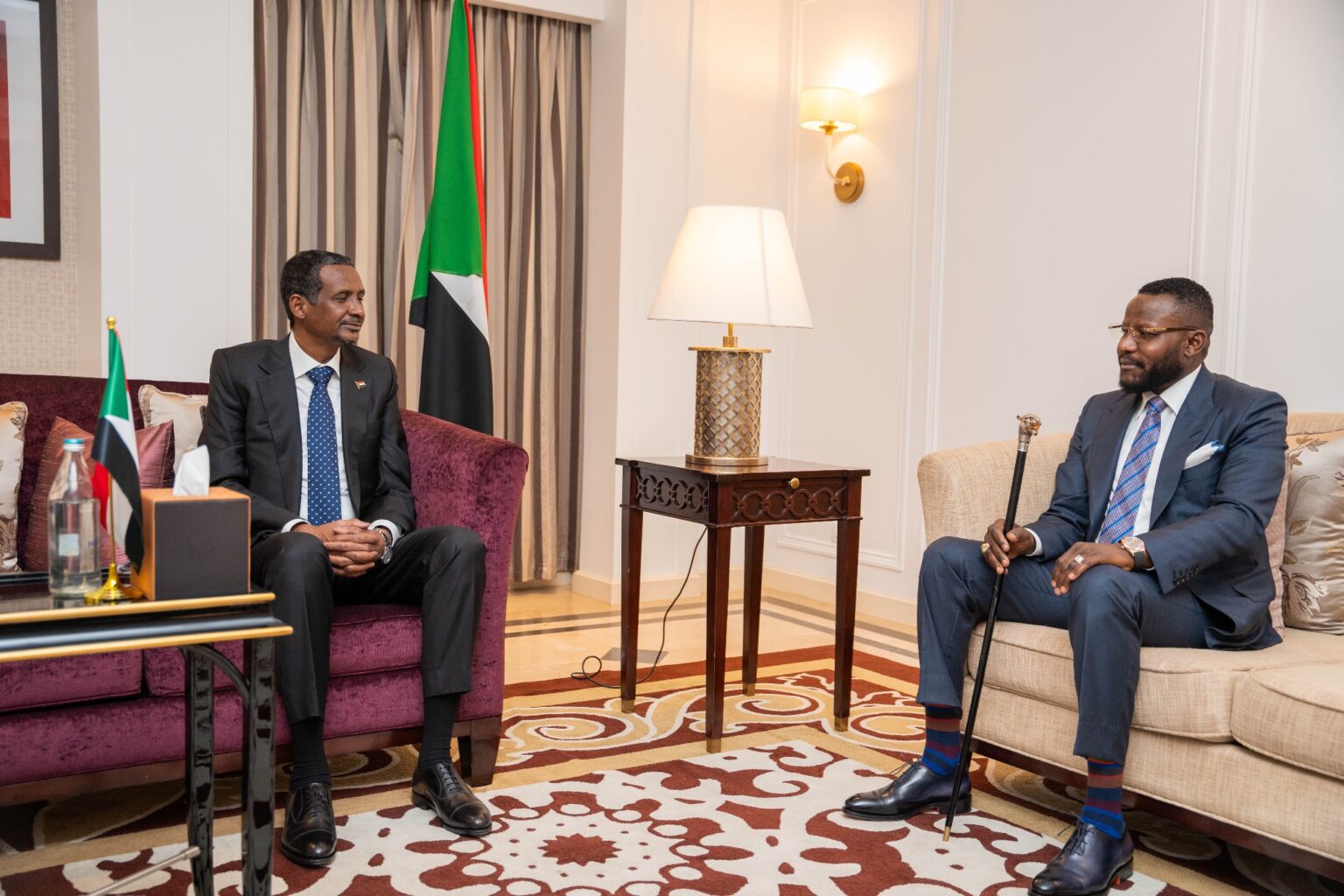
And in January 2024, that same Sultan sat across a table in a Nairobi hotel from Mohamed Hamdan Dagalo, known universally as Hemedti, the commander of Sudan’s Rapid Support Forces, a paramilitary militia that the United States government formally designated a perpetrator of genocide in January 2025.
The screenshot of that meeting, posted in the replies beneath the traffic video by user Shoba Gatimu with the caption “The plot thickens”, detonated a second wave of outrage. Nairobi was no longer discussing dangerous driving. It was discussing who, exactly, was behind the wheel and why he appeared to be moving through its streets entirely untouchable.
A NAME WEIGHTED WITH HISTORY
The name Ali Dinar is not merely a family surname in Sudan. It carries the freight of an entire civilisational epoch.
The original Sultan Ali Dinar ruled the independent Darfur Sultanate from 1898 until 1916, when British colonial forces killed him and annexed Darfur into the Anglo-Egyptian Sudan, ending more than two centuries of Keira dynasty sovereignty over a territory the size of France.
He is remembered across Darfur as a symbol of resistance, a man who proclaimed jihad against British occupation and whose capital, El Fasher, was a seat of Islamic scholarship, trade and culture connecting central Sudan to the whole of northern Africa.
It is precisely that symbolic weight that makes the modern Sultan’s political choices so contested. Ahmed Hussein Ayoub Ali Dinar was elected in June 2015 by the Fur tribe’s Shura and Notables’ councils as Sultan for the entire Fur people, renewing his family’s ceremonial claim to the seat his great-grandfather died defending.
He has presented himself publicly as a mediator, a voice for peace in Sudan’s devastating civil war, and a traditional leader committed to dialogue between all parties. Kenyan President William Ruto received him at State House, publicly engaging with him as the leader of the Fur in Darfur, alongside Sudan Liberation Movement figures.
Yet the RSF, the militia now fighting to dismember the Sudanese state and which the United Nations Fact-Finding Mission has documented committing genocide, war crimes and crimes against humanity against Darfur’s non-Arab communities, including the Fur, has invested heavily in the Sultan’s legitimacy. And by all available evidence, that investment appears mutual.
THE HEMEDTI MEETING IN NAIROBI
In January 2024, Hemedti arrived in Nairobi on what analysts described as a tour designed to legitimise the RSF as a governing force.
He met President Ruto at the Kenyan State House, receiving what multiple media accounts described as an elaborately warm reception, complete with traditional dancers and a full presidential pavilion welcome at JKIA that observers noted was notably more extravagant than that afforded to Sudanese Armed Forces Commander General Abdel Fattah al-Burhan. Khartoum recalled its ambassador in protest.
Hemedti also met Ahmed Ali Dinar in Nairobi. The RSF commander posted about the encounter on X, saying he appreciated what he described as the Sultan’s neutral stance in rejecting the war and devoting himself to supporting Darfurian communities.
Both men, according to the Sudan Times, pledged to coordinate efforts to alleviate suffering and achieve what they called sustainable peace and security.
To critics and to many Sudanese from Darfur, that characterisation of neutrality was grotesque. The RSF and its allied Arab militias were by that point already implicated in the massacre of up to 15,000 people in El Geneina, the capital of West Darfur, a slaughter the UN Panel of Experts documented in a January 2024 report.
The RSF’s predecessor formations, the Janjaweed, had been responsible for the ethnic killing, mass rape, and displacement of some 2.7 million people and the deaths of up to 300,000 in the original Darfur conflict beginning in 2003. A militia meeting with the paramount traditional leader of the Fur people and framing it as a peace gesture was, to Sudanese human rights organisations, a provocation dressed as diplomacy.
DARFUR’S WOUND THAT NEVER HEALED
To understand the stakes of any alignment between the modern Sultan and the RSF requires understanding Darfur’s history not as a series of events but as a continuous, unresolved trauma. When rebels from Darfur’s non-Arab communities launched an uprising against Khartoum in 2003, accusing the Arab-dominated government of systematic discrimination, then-President Omar al-Bashir responded by deploying the Arab tribal militias known as the Janjaweed.
The United States designated the resulting campaign as genocide in 2004. The UN Security Council referred the situation to the International Criminal Court in 2005, the first such referral in ICC history and the first involving allegations of the crime of genocide.
Al-Bashir formally reconstituted the Janjaweed into the RSF in 2013, giving the militia institutional form and placing it under Hemedti’s command.
Between 2013 and 2023, the RSF evolved from a counterinsurgency instrument into an autonomous economic and military power, controlling gold mines, border trade networks and a private army. When the RSF broke from the Sudanese Armed Forces in April 2023, the war that erupted was devastating in its speed and its savagery.
The RSF seized most of Khartoum and swept through Darfur. By late 2024 and into 2025, the RSF had laid siege to El Fasher, the last SAF stronghold in Darfur and the ancestral capital of the Darfur Sultanate that the historical Ali Dinar died defending, holding 1.5 million people under conditions the ICC’s deputy prosecutor described to the UN Security Council as a campaign of widespread mass criminality and collective torture.
The RSF, during this siege, also destroyed the Sultan Ali Dinar Palace in El Fasher in January 2025, a site African human rights organisations called a deliberate act of cultural erasure, an attempt to wipe out the symbols that give Darfur’s communities their collective identity. The same militia had been meeting with the historical sultan’s modern claimant in Nairobi hotel rooms.
In January 2025, the outgoing Biden administration formally declared that the RSF and allied militias had committed genocide in Sudan’s Darfur region, a determination that led to direct sanctions on Hemedti and several RSF-linked companies.
The European Union and United Kingdom followed with their own designations and sanctions on RSF commanders. The ICC’s deputy prosecutor signalled in early 2025 that arrest warrants for crimes committed since April 2023 in West Darfur were imminent.
KENYA AS RSF’S CONTINENTAL BASE
The Sultan’s comfortable presence in Nairobi, Range Rover and emergency lights included, does not exist in a vacuum. Kenya has become, whether by deliberate policy or geopolitical convenience, the RSF’s most important continental staging ground. President Ruto’s administration has extended to the RSF a degree of access and hospitality that has placed Kenya in direct diplomatic confrontation with Khartoum and drawn formal censure from rights organisations, civil society coalitions and, ultimately, the United States Senate.
In February 2025, RSF leadership and allied armed movements gathered at the Kenyatta International Convention Centre in Nairobi and signed a political charter creating what they called the Government of Peace and Unity, a parallel administration for RSF-controlled territories in Sudan.
The Kenyan government, through Prime Cabinet Secretary Musalia Mudavadi, admitted providing the RSF with the platform and defended it as an exercise in Kenya’s long tradition of conflict mediation.
Sudan declared it an act of hostility, recalled its ambassador and imposed a ban on Kenyan imports. Human rights organisations, including the International Commission of Jurists Kenya chapter and the Kenya Human Rights Commission, issued a joint statement describing Kenya as complicit in mass atrocities.
They noted the RSF killed more than 433 civilians, including women and children, in an assault in Southern White Nile State during the very days its leadership was gathered in Nairobi.
The Geneva-based Global Initiative Against Transnational Organised Crime, in a November 2025 report, documented Kenyan-registered aircraft landing in RSF-controlled Nyala and offloading supplies, and separately transporting wounded RSF fighters.
Bellingcat published an investigation in June 2025 revealing Kenyan military ammunition crates in an RSF depot near Khartoum. The Kenyan government denied arms supply to the RSF. In August 2025, the United States Senate opened a review of Kenya’s major non-NATO ally status, conferred in 2024, in part over the Kenya-RSF question.
In late 2023, Ruto had flown to Juba on the presidential jet alongside RSF Deputy Commander Abdulrahim Dagalo, Hemedti’s brother, who carries US sanctions for allegedly fuelling Sudan’s civil war.
Analysts and critics noted that the RSF had essentially treated Nairobi as a de facto capital for its international diplomacy, its political charter-signing ceremonies and, apparently, the residential arrangements of at least one prominent ally.
ILLEGAL LIGHTS AND A LEGAL FRAMEWORK THAT APPLIES TO EVERYONE ELSE
Under Section 34 of Kenya’s Traffic Act Cap 403 and Rule 83 of the Traffic Rules, red and blue flashing emergency lights and sirens are restricted to police vehicles, fire engines and ambulances. The Order of Precedence Act of 2014 extends the privilege of sirens to the President, Deputy President, Speakers of Parliament and the Chief Justice.
The law is explicit that no private vehicle may be fitted with flashing lights, LED light bars or strobe systems of any kind without NTSA authorisation, which is not granted to private citizens or foreign nationals living in Nairobi.
The NTSA issued a circular to all Regional Police Commanders as recently as May 2024 directing law enforcement to take legal action against any unauthorised use of strobe lights, light bars, sirens or lead-and-chase vehicles, citing complaints about harassment on Nairobi roads and highways by unauthorized persons.
Section 58 of the Traffic Act makes the offence punishable by a fine of up to Sh400,000, imprisonment of up to two years, or both.
The Range Rover Vogue in the video, registered to the Sultan in April 2025 according to NTSA records circulating in the viral thread, appears fitted with exactly the kind of emergency lighting the law prohibits for private vehicles. The vehicle’s Kenyan registration raises its own questions. The Sultan is Sudanese.
He is resident in Nairobi. His vehicle carries a 2025 registration. Whether he travels on a diplomatic passport, holds a residency permit or relies on some other protected status that Kenya’s authorities have extended to him remains, as of publication, a question that neither the NTSA, the Kenya Police nor the relevant ministries have addressed.
As of Thursday morning, the NTSA had issued no public statement on the incident. The Sultan’s office had not responded to requests for comment.
‘NTSA HAIWEZI GUZA YEYE’
Mwaniki’s original post tagged the NTSA with a knowing laugh: “@ntsa_kenya huyu arudi driving school pia?” Should this one go back to driving school too? The replies swelled with a mixture of outrage, dark humour and the particular resigned fatalism of Nairobi motorists who have watched high-powered vehicles move through the city as though the law existed for everyone else. “NTSA haiwezi guza yeye,” wrote one commenter. NTSA cannot touch him. “He is not even Kenyan!” wrote another. “Unless that fool is a police officer responding to an emergency, he has no right of way!!” a third commenter added.
What distinguishes this episode from the regular catalogue of Nairobi road impunity complaints is not merely the identity of the registered owner. It is what that identity represents in the context of Kenya’s increasingly fraught entanglement with Sudan’s civil war.
A man publicly photographed alongside the commander of a militia designated a perpetrator of genocide, whose formal traditional role as Sultan of the Fur people makes his RSF alignment all the more symbolically charged, appears to be moving through Nairobi roads with what the video depicts as the confidence of someone who knows no traffic officer will flag him down.
Kenya’s roads are among the most dangerous in Africa. The NTSA records thousands of road fatalities annually, with reckless driving, impunity and corruption at traffic enforcement level repeatedly identified as systemic causes. Each incident like this one feeds a public narrative that Kenyan road law is, in practice, a tiered system: merciless toward matatu drivers and boda-boda operators, invisible when the vehicle is expensive enough, the plates are the right kind, or the owner is connected to the people who make the rules.
QUESTIONS THAT REMAIN UNANSWERED
Several questions arising from this incident demand formal answers, and Kenya Insights has submitted enquiries to the NTSA, the Directorate of Immigration and the Ministry of Foreign Affairs. Under what immigration and residency status does Sultan Ahmed Ali Dinar reside in Kenya? Has he or any entity on his behalf applied for and received any form of diplomatic status in Kenya? Who authorised, if anyone, the installation of emergency-grade flashing lights on the vehicle registered to him? Has Kenya’s government, in extending hospitality to RSF-linked figures including the Sultan, conducted any due diligence on the implications given the US genocide designation against the RSF?
The broader question, which the Sudanese diaspora community in Nairobi and human rights organisations have been raising with increasing urgency since the February 2025 RSF parallel government ceremony at KICC, is whether Kenya’s political relationship with Hemedti and his allied civilian and traditional leaders has extended into a permissive environment in which those figures operate in Nairobi with privileges that Kenyan law does not formally recognise and that Kenyan institutions appear unwilling to examine.
The irony that the RSF, which in January 2025 dynamited the palace of the Sultan Ali Dinar in El Fasher, the very monument to the Fur people’s sovereignty and cultural identity that the historical sultan built and died defending, should simultaneously be cultivating his modern successor in Nairobi hotel rooms and Nairobi streets will not be lost on those Sudanese who have lived through the war.
The RSF erased the old sultan from the landscape of Darfur. In Nairobi, his descendant drives with emergency lights, and no one seems willing to ask who gave him permission.
Kenya Insights allows guest blogging, if you want to be published on Kenya’s most authoritative and accurate blog, have an expose, news TIPS, story angles, human interest stories, drop us an email on [email protected] or via Telegram









Caleb Amisi Says Linda Mwananchi Has Lost Direction, Announces Plans To Form A New Movement

Air Canada Pilot Flew Passengers For Years With A Fake Pilot’s License, Police Say

Itumbi Claims Kalonzo Has Settled on Sifuna as Running Mate

THE KURIA NETWORK TAKES THE BOARDROOM: How Moses Kuria’s Inner Circle Seized Control of Africa Mega Agricorp And the Paper Trail That Links It All

Who Is The Somali Referee Barred From Entering The US For The World Cup?

Inside NCBA’s Decline: How a Banking Giant Lost Its Strategic Edge

Shiquo wa Hii Style Counts Costly Lesson After Anti-Counterfeit Raid Wipes Out Shop Stock

“Are They Giving Kickbacks To Government Officials?” The Scandalous Record Behind Kenya’s Most Favoured Chinese Contractor

Two MPs Defrauded of Sh93.5 Million in Karen Land Scam

Gachagua Rejects Sh50 Million Court Compensation, Calls It An Insult

Cement, Cash and Courts: How the Hashu Dynasty Crushed the Ramji Brothers for Fourteen Years and Why the Walls Are Now Closing In

Inside The Urban Planning Cartel That Owns Nairobi

Why Ruto’s Favourite Candidate Adan Mohammed Could Be Locked Out of the KRA Top Job

LifeCare on the Brink: SHA Fraud, Stolen Wages, and the Rotten Empire Jayesh Saini Built

Este Medical Kenya Fights American’s Explosive Complaints

Betika Faces DCI Probe, Directors Arrest and License Revocation Over Massive 29.5 Million Safaricom Customers’ Data Breach

The Rot Inside Absa: How Bank Insiders Are Looting Nairobi’s Customers

Inside FAFSA Fraud: How Kenyan Cybercriminals Siphoned Millions from America’s Sh12 Billion Student Loan System

Fresh Move Launched to Remove Kenya Railways MD Mainga From Office After Awarding Sh817 Million Consultancy Contract

Court Confirms Safaricom Customers Data Was Sold To Betting Companies In Seven-Year Cover-Up
-
 Investigations6 days ago
Cement, Cash and Courts: How the Hashu Dynasty Crushed the Ramji Brothers for Fourteen Years and Why the Walls Are Now Closing In
-
 Investigations5 days ago
Inside The Urban Planning Cartel That Owns Nairobi
-
 Investigations1 week ago
Betika Faces DCI Probe, Directors Arrest and License Revocation Over Massive 29.5 Million Safaricom Customers’ Data Breach
-
 Investigations6 days ago
Fresh Move Launched to Remove Kenya Railways MD Mainga From Office After Awarding Sh817 Million Consultancy Contract
-
 News2 weeks ago
Eight Students Arrested In Kenya After Suspected Deadly School Arson Attack
-
 News2 weeks ago
How Uhuru’s Deal With Obama In 2015 Paved Way For America’s Ebola Plan In Kenya
-

 Business7 days ago
TRUST BETRAYED: How Senior DTB Bank Insiders Allegedly Looted Sh149 Million From a Customer’s Account Over Five Years
-

 Investigations4 days ago
Why Drivers Cheered Bolt’s Reported Exit: Inside the Slow Financial Strangulation of Thousands of Kenyan Drivers and Riders in Kenya