There is a category of transaction that does not exist in the formal architecture of development finance. It has no name in the regulatory manuals that govern lending institutions from Kampala to Nairobi, no clause in the standard form agreements that are drafted by international lawyers billing at three hundred dollars an hour, and no mention in the governance frameworks that development banks present to their shareholders at annual general meetings.
And yet it is the category into which, according to testimony that has surfaced across a decade of litigation, the most consequential portion of the loan that destroyed Raphael Tuju’s business empire quietly fell. It is called trust.
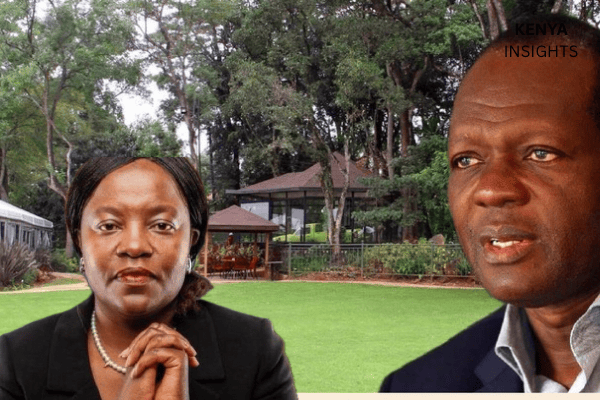
In the wreckage of what was once a billion-shilling development, as armed police stand at the gates of Dari Restaurant and receiver managers prepare inventories of assets that Tuju built over three decades, this is the detail that nobody in the mainstream coverage of the EADB-Tuju dispute has examined with sufficient rigour: the second tranche of the 2015 loan facility, a sum variously described in court documents as Sh270 million to Sh294 million, the tranche that was supposed to fund the construction of luxury housing units whose sale would have serviced the entire debt, does not appear to have been governed by the same contractual rigour as the first. And the only credible explanation for why a businessman of Tuju’s sophistication would proceed on that basis lies in the identity of the person who ran the East African Development Bank when the loan was made.
That person was Vivienne Yeda Apopo. She held the title of Director General for sixteen years and nine months, from January 15, 2009, until December 31, 2024, three months before police showed up at Tuju’s gates.
She was, by any measure, one of the most powerful bankers in the East African region during the period when Kenya’s political and business elite were building the empires that they now fight to preserve.
And the question that the courts, operating within the narrow procedural confines of foreign judgment enforcement, have never been required to answer is this: what was the precise nature of the relationship between Vivienne Yeda Apopo and Raphael Tuju, and did that relationship substitute for contractual certainty at the moment when certainty mattered most?
The written contract bound Tuju absolutely. The alleged verbal assurance about the second tranche bound nobody. That asymmetry is the architecture of destruction.
THE ARCHITECTURE OF A CONVENIENT DEAL
To understand what happened, it is necessary to understand what EADB is and who controls it. The bank was established in 1967 under the treaty of the original East African Community and was re-established under its own charter in 1980 after the collapse of that union.
Its founding members were Kenya, Tanzania, and Uganda. Rwanda joined as the fourth Class A member state in 2008. But the bank’s shareholding extends well beyond the four governments.
Class B institutional shareholders include the African Development Bank, the Netherlands Development Finance Company, the German Investment and Development Company, SBIC-Africa Holdings, Standard Chartered Bank in London, Barclays Bank in London, and, critically, the Commercial Bank of Africa.
That last name is not incidental. The Commercial Bank of Africa, known as CBA before its merger with NIC Group to form NCBA in 2019, was effectively the house bank of the Kenyatta family.
The Kenyattas, through an investment vehicle called Enke Investments Limited, controlled 24.91 percent of CBA, making them the single largest private shareholders. President Uhuru Kenyatta’s family was therefore a double shareholder in EADB at the time the Tuju loan was made: once as the Government of Kenya, which holds one of the four sovereign stakes in the bank, and again through CBA’s institutional Class B shareholding.
The former Finance Minister who presided over the period when Yeda Apopo was appointed Director General was none other than Uhuru Kenyatta himself, who held the Treasury portfolio from 2001 to 2005 and had been deeply embedded in the bank’s political oversight architecture when Yeda Apopo rose through its ranks.
Yeda Apopo had been at the EADB since at least 2006, serving as Director of Legal Affairs before being appointed to the top post in January 2009.
By the time Tuju approached the bank in 2015 for funding for his Karen project, she had been Director General for six years.
She sat on the board of the Central Bank of Kenya, had received the African Banker of the Year Award in May 2014, and had been named Business Leader of the Year by the Africa-America Institute in October 2014. She was, in the language of East African business, a woman of consequence.
And she was Kenyan, in a bank that her own staff would formally accuse, in 2016, of favouring Kenya to the disadvantage of its other member states.
A MAN WITH THE PRESIDENT’S EAR
Tuju, in 2015, was not merely a borrower. He was a Cabinet Secretary without portfolio in Uhuru Kenyatta’s administration, a position that placed him in the inner sanctum of executive power.
He was also Secretary-General of the Jubilee Party, the ruling coalition, which made him one of the most politically connected individuals in the country.
He had previously served as Minister for East African Community under President Kibaki, giving him a history of direct engagement with the regional institutions that operated under the East African Community framework, of which the EADB is one.
For a Director General seeking to maintain relevance in Nairobi, to secure the goodwill of the government that was simultaneously a sovereign shareholder and an indirect institutional shareholder through the Kenyatta family’s CBA stake, and to avoid the scrutiny that her own staff were beginning to direct at her management, Tuju was not a difficult case to approve.
He was, by the internal political logic of the institution, the right kind of borrower: powerful, connected, and capable of running interference against the kind of parliamentary and governmental oversight that was already beginning to shadow her tenure.
Staff within EADB had already begun to raise concerns about the manner in which Yeda Apopo was running the institution.
A formal petition, which would become public in 2016 when The East African newspaper obtained it, accused her of approving projects from her home country while sitting on applications from Uganda, Tanzania, and Rwanda.
The petition, copied to Kenya’s Treasury, demanded her immediate termination.
It described a director general who frustrated viable projects from other member states while ensuring that Kenyan applications moved smoothly through the system.
The Tuju loan, approved in April 2015, fits precisely that pattern. It was a Kenyan project, brought by a Kenyan political heavyweight, approved by a Kenyan director general, at a bank where Kenya was a double shareholder.
Whether any personal relationship existed between Tuju and Yeda Apopo, as has been speculated in social media posts dating back to at least November 2020 and revived with considerable intensity in March 2026 as the Karen property seizures unfolded, the structural conditions for preferential treatment were more than sufficient on their own.
Kenya was a double shareholder. The borrower was a cabinet minister. The lender was a Kenyan director general whose own staff accused her of running the bank as a Nairobi franchise. The political geometry was perfect.
THE TRANCHE THAT WAS NEVER WRITTEN DOWN
The loan agreement signed on April 10, 2015, between EADB and Dari Limited, Tuju’s company, was, on its face, a commercial document of reasonable sophistication.
It was governed by English law, with disputes to be resolved in London, a choice that would prove catastrophic for Tuju’s defence when enforcement proceedings eventually commenced.
It provided for a facility of $9.3 million, the disbursement of which was secured by charges over Tuju’s Entim Sidai property, his Tamarind Karen development, and the Dari Business Park, as well as personal guarantees from Tuju himself and his three children.
The first tranche, approximately Sh932.7 million, was disbursed on July 29, 2015, and used to purchase the 94-year-old Victorian bungalow built by Scottish missionary Albert Patterson, which would become the centrepiece of the Dari Restaurant and Wellness project.
The second tranche, approximately Sh294 million, was intended for the construction of high-end maisonettes on the property, the sale of which was the mechanism by which the loan was meant to repay itself.
Thirty three-bedroom units on one parcel, eight five-bedroom units on another. The mathematics were straightforward: sell the units, retire the debt.
But the second tranche, according to testimony that David Odongo, then EADB’s Kenya Country Manager, gave under cross-examination during Kenyan court proceedings, was structured differently from the first.
Tuju’s legal team has consistently argued, and Odongo’s testimony appeared to support, that the disbursement of the second tranche was governed not by the four corners of the written facility agreement but by representations made outside it.
The written agreement described conditions for disbursement.
But the understanding of how and when those conditions would be satisfied, and indeed of whether they were conditions at all or merely administrative formalities that would be resolved through the relationship between the parties, appears to have operated on a different plane entirely.
This is the missing link.
The written contract bound Tuju absolutely. The alleged verbal assurance about the second tranche bound nobody. That asymmetry is the architecture of destruction.
When Tuju’s team sought to introduce Odongo’s testimony as new evidence in 2024, seeking a review of the 2020 High Court decision that had adopted the UK judgment against him, the application was dismissed with a ruling that has become one of the most cited sentences in this litigation: the court said it would not permit a collateral attack on a final and valid foreign judgment already recognised and upheld on appeal.
The Supreme Court of Kenya, when Tuju took his case to the apex court, was equally unsparing.
Five justices, including the Deputy Chief Justice, found that the petitioners had not validated their averments with any proof.
The allegations were described as bare and unsubstantiated.
But the courts were not asked to evaluate whether the verbal representations were made. They were asked to evaluate whether those representations, even if made, could override a written contract governed by English law and already reduced to a London judgment. The answer to the second question is no. The first question was never properly examined.
THE GRAVITY OF INSTITUTIONAL ACCESS
To understand why a man of Tuju’s business experience would proceed on the basis of verbal assurances rather than written commitments, one must understand the gravitational pull of proximity to power in the Kenyan institutional environment.
In 2015, Tuju was not dealing with a commercial bank whose loan officers operated within clearly defined matrices of credit authority.
He was dealing with a regional development bank whose Director General had held her position for six years and whose decision-making, according to her own staff, had become increasingly concentrated at the apex of the institution.
The EADB’s governance structure places the Governing Council, comprising the finance ministers of the member states, at the apex, with the board below it and the Director General responsible for day-to-day management.
In practice, development banks of this size and complexity develop what practitioners call executive dominance, a tendency for the Director General’s personal judgement to substitute for collective institutional processes.
The 2016 staff petition against Yeda Apopo described precisely this phenomenon: projects approved by senior management were stopped by the Director General without documented justification, while other projects she favoured moved through the system regardless of what the management recommendation said.
If, in this environment, the Director General indicated to a borrower, through whatever channel, that the second tranche would be forthcoming once the first was deployed and the project had begun to take shape, a borrower operating in the Kenyan political economy would have had every reason to treat that indication as binding.
Not because it was legally binding, but because in Nairobi in 2015, the word of a person of Yeda Apopo’s institutional stature, given to a person of Tuju’s political stature, carried a weight that no written contract needed to replicate.
This is not a defence of Tuju’s financial management.
The loan went into default in the second quarter of 2016, barely a year after disbursement. Only one interest payment was made, in October 2015.
The grace period expired, the demand letters were ignored, and the international arbitration that followed produced a judgment that Kenyan courts have consistently upheld.
Whatever verbal assurances were made, the written obligations were not met.
But the question of why the obligations were not met, why the project that was supposed to generate the cash flow to service the loan never got off the ground, cannot be answered without examining the second tranche.
And the second tranche cannot be examined without confronting the circumstances under which it was structured.
THE OTHER DEALS THAT DIED THE SAME DEATH
The Tuju case is not the only EADB lending relationship during Yeda Apopo’s tenure that followed this pattern.
The 2020 reporting on the dispute by Kahawatungu identified at least three other projects that suffered what it described as the same fate: Quality Health Limited of Tanzania, where funds were allegedly disbursed for purposes other than those approved; the Kwale International Sugar Company, where a Sh2 billion agreement was signed but funds withheld after new conditions were introduced mid-stream; and the Infinity Industrial Park in Kenya, where $10 million was approved and offer letters executed before disbursement was declined following the imposition of new conditions.
The pattern is consistent.
An initial approval, sufficient to secure the borrower’s commitment and, in several cases, the pledging of security.
A subsequent refusal to disburse on the basis of conditions that either were not in the original agreement or were introduced after the borrower had already committed to the project.
The effect, in each case, is to leave the borrower exposed: the security is pledged, the project is underway or anticipated, but the funding that would make the project viable has been withheld.
Whether this pattern was deliberate, systemic, or the product of individual lending decisions that simply went wrong is a question that falls outside the scope of this article.
What it does establish is that the Tuju situation was not anomalous. It was one of several cases in which the gap between what was approved and what was disbursed became the site of the borrower’s destruction.
Yeda Apopo had reduced the bank’s non-performing loan ratio from 26 percent in 2009 to 0.88 percent in 2024. The instrument of that reduction was aggressive recovery. The fuel for that recovery was the gap between approval and disbursement.
THE BANKER WHO LEFT BEFORE THE RECKONING
Vivienne Yeda Apopo retired on December 31, 2024. Three months later, armed police sealed the Dari Business Park.
The timing is not conclusive of anything, but it is suggestive of the manner in which institutional accountability operates in the East African regional architecture.
Her departure was announced with the language of celebration. The EADB described it as the conclusion of an outstanding 17-year career.
Her successor in the interim was Benard Mono, the bank’s head of finance, pending a recruitment process.
The bank she left behind was, by the metrics she had championed, a success: non-performing loans at 0.88 percent, down from 26 percent when she took over in 2009.
That reduction was the signature achievement of her tenure.
It was also, in the view of Tuju and at least three other borrowers, the product of recovery strategies that prioritised the bank’s balance sheet over the borrowers’ ability to complete the projects for which they had borrowed.
She had survived multiple challenges during her tenure. The 2016 staff petition was investigated by Ernst and Young on the board’s recommendation.
Its findings were not made public. In May 2023, then Treasury Cabinet Secretary Njuguna Ndung’u convened a meeting to deliberate on her term, raising questions in Nairobi’s financial circles about whether her position was finally under threat.
She survived that too, remaining in post until the voluntary retirement that the bank characterised as entirely on her own terms.
In November 2022, MP Joseph Makilap of Baringo North had risen in Parliament to table a pointed question: was there not a conflict of interest in the circumstance that the Director General of the bank that had provided the loan to finance the Lake Turkana Wind Power project was simultaneously serving as chairperson of the board of Kenya Power, the entity that was a party to the power purchase agreement arising from that loan? The question was never satisfactorily answered in parliament.
Yeda Apopo was eventually pushed out of the Kenya Power chairmanship by the incoming Kenya Kwanza administration in 2022, but she retained the EADB directorship until her retirement.
By the time she left, the EADB had spent $4.4 million in legal fees between 2016 and 2024 while declaring zero dividends to its shareholder governments, according to testimony presented to the East African Legislative Assembly by a civil society petition in September 2025.
The largest single recovery action that consumed those legal fees was the Tuju case, pursued through London arbitration, the UK High Court, the Kenya High Court, the Kenya Court of Appeal, and eventually the Supreme Court of Kenya.
Yeda Apopo’s departure meant she would not be present to answer for any of it.
WHAT THE SILENCE CONCEALS
Neither Tuju nor Yeda Apopo has made any public statement addressing the nature of their personal relationship.
The social media posts that alleged a romantic connection between them, circulating from at least November 2020 and resurging in March 2026 as the property seizures became front-page news, remain unverified by any official record.
Tuju’s court filings describe the second tranche’s non-disbursement as the cause of his default.
They do not, in the filings that are part of the public record, attribute the initial loan to any personal relationship.
What the filings do establish, read in conjunction with the testimony that Tuju sought to introduce as new evidence, is that there were representations made outside the written agreement that Tuju believed would be honoured.
What they also establish is that a former EADB country manager, in sworn testimony, appears to have confirmed that the loan was structured in two phases in a manner that was not fully reflected in the contractual documentation.
The courts declined to examine those representations because the procedural pathway to doing so was closed.
The UK judgment came first.
The Kenyan recognition of that judgment came second.
Every subsequent attempt to introduce evidence that might have qualified or changed the outcome of those proceedings was dismissed as an attempt to relitigate matters already determined. That is not a failure of justice in the technical legal sense. But it is a failure of the full truth to emerge.
And in that gap between legal process and full truth sits the relationship between Tuju and Yeda Apopo. Whatever its precise character, it was a relationship between two Kenyans at the apex of their respective spheres of influence, operating in an institution whose governance was already compromised by the kind of concentrated personal authority that makes verbal assurances feel as solid as signed documents.
It was a relationship that, by the internal logic of EADB’s decision-making during Yeda Apopo’s tenure, made the Tuju loan possible on terms that a more arms-length process might not have produced.
That relationship, whatever its character, appears to have been the invisible third party to the 2015 transaction.
It is what substituted for the contractual certainty of the second tranche. It is what made a Sh294 million commitment feel real without ever being reduced to paper.
And when it ended, or when its protections ceased to operate, what remained was a written security package that gave EADB everything it needed to enforce, and a borrower whose only defence depended on oral representations that no court was willing to evaluate.
On March 14, 2026, three months and fourteen days after Vivienne Yeda Apopo retired from the East African Development Bank, armed police and uniformed officers arrived at Dari Restaurant and Business Park on the Ngong Road in Karen.
They sealed the compound, changed the locks, and handed possession to the receiver managers appointed by EADB. Raphael Tuju stood outside the gates he could no longer enter and spoke directly to the cameras in the language of a man who understands public narrative.
He described what was happening as a political assault. He invoked the constitution and the rule of law. He called the seizure an act of state-directed violence against a businessman who had tried to build something worth building in a country that should want more of the same. He was eloquent and composed, and he was, by any measure, a man watching the product of decades of work disappear behind a padlock that bore another institution’s name.
Whether the story he told that night was the full story is the question that this investigation has sought to examine.
The loan was real. The default was real. The judgment was real. The enforcement was legal. All of that is beyond dispute. But between the loan and the default, between the signing and the seizure, there was a phase of this transaction that has never been fully examined, a phase governed not by paper but by the assurances of a powerful woman to a powerful man in an institution where power was concentrated enough to make such assurances feel sufficient.
That phase, and the relationship that made it possible, is the untold story of how Raphael Tuju lost Dari.
NOTE
This investigation is based on sworn court filings from proceedings in England and Kenya, testimony recorded during cross-examination of EADB witnesses, a formal staff petition submitted to the EADB Board of Governors and widely published in 2016, parliamentary records including the Hansard of the National Assembly of Kenya dated November 23, 2022, the EADB’s official shareholding disclosures, public records of the Commercial Bank of Africa’s ownership structure, and reports of proceedings before the East African Legislative Assembly. No court has found as a matter of fact that any personal relationship, romantic or otherwise, existed between Raphael Tuju and Vivienne Yeda Apopo, and neither party has confirmed or denied such a relationship on the record. The allegations of a personal relationship circulating in social media are presented here as unverified. Nairobi Law Monthly makes no finding on this question. EADB has not responded to queries specific to this investigation at the time of publication. Vivienne Yeda Apopo could not be reached for comment.






Comments