
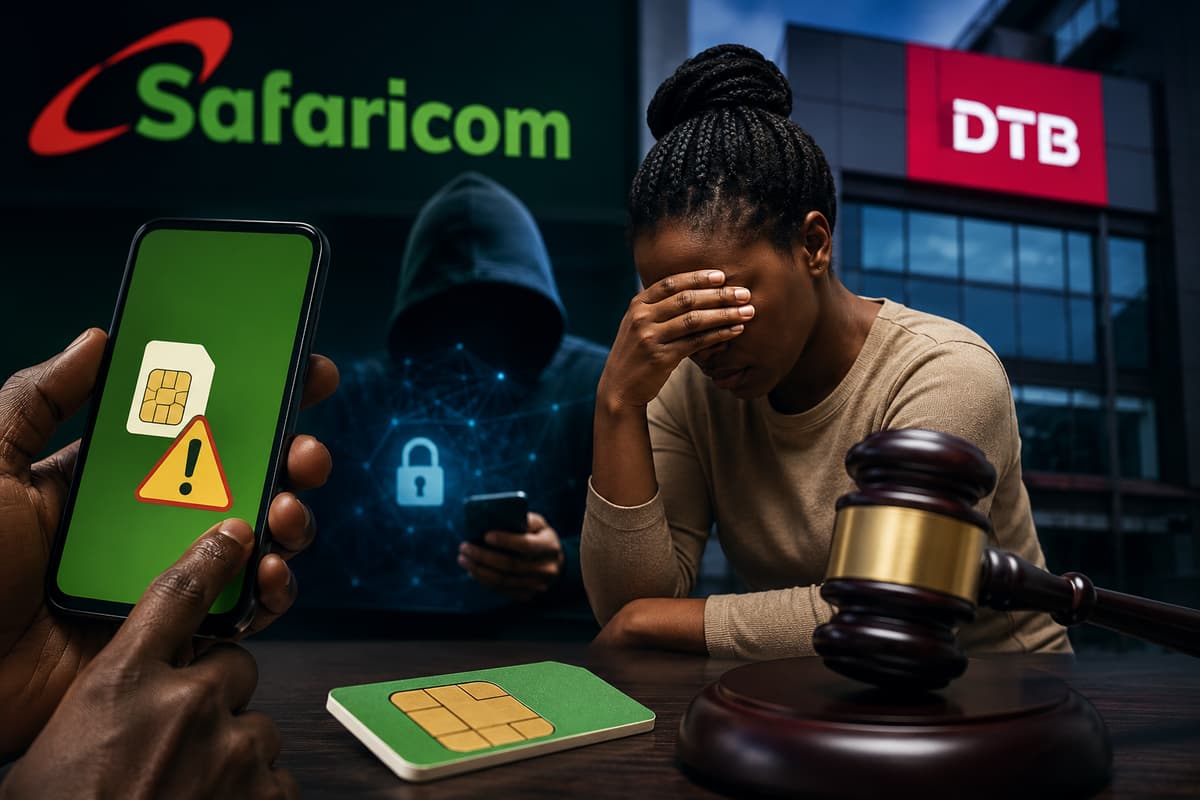
NAIROBI, Kenya — Firebrand lawyer Danstan Omari has fired the opening salvo of what could become the most consequential legal battle in Kenya’s telecommunications history, threatening to drag Safaricom into a Sh1 trillion class action lawsuit on behalf of millions of Kenyans whose private data he claims the company has been routinely handing over to the Directorate of Criminal Investigations without court orders.
The explosive threat comes hours after the Milimani Chief Magistrate’s Court acquitted university student David Mokaya on Thursday in a ruling that tore through the prosecution’s case and landed squarely on the doorstep of Kenya’s most profitable corporation.
Omari, never one to speak in whispers, went straight for the jugular.
“Safaricom must send us a cheque of 200 million shillings by Monday for giving David Mokaya’s location to DCI,” the lawyer declared. “Failure to do so will lead to the biggest lawsuit of the century, that will see them pay over 1 trillion shillings to all Kenyans whom they have leaked their data.”
The warning landed like a thunderclap across the country’s corporate and legal landscape. If Omari makes good on his promise, Safaricom, which serves over 42 million subscribers and commands a market capitalisation that makes it the largest company on the Nairobi Securities Exchange, could find itself defending not one aggrieved client but an entire nation.
The ruling that started it all
Principal Magistrate Carolyne Nyaguthii Mugo acquitted Mokaya under Section 215 of the Criminal Procedure Code after finding that prosecutors had failed to prove their case against him in Criminal Case No. MCCR/E1161/2024.
Mokaya had been charged under Section 22(1) of the Computer Misuse and Cybercrimes Act following his alleged publication of an image depicting a funeral procession with a casket draped in the Kenyan flag on November 13, 2024, captioned “President William Ruto’s body leaves Lee Funeral Home.”
But it was not the content of the post that undid the prosecution. It was the manner in which investigators went about their work. Magistrate Mugo found that Mokaya’s electronic devices were seized unlawfully and subjected to forensic examination without judicial authorisation.
The court went further, emphasising that electronic devices attract heightened constitutional protection given the volume of personal data they contain, and that cybercrime investigations must strictly comply with legal procedure.
The prosecution, the court held, had also failed to conclusively link Mokaya to the social media post. He walked free.
Safaricom in the crosshairs
Omari’s attention then turned from the state to the telecoms giant, and his language left little room for diplomatic interpretation.
He argued that Safaricom violated Article 31 of the Constitution, which guarantees every person the right to privacy, including the right not to have their personal data collected or shared without consent or a valid court order.
“For the police to obtain your location or personal data from Safaricom, they must first obtain a court order. Without that order, any disclosure is unconstitutional,” Omari said.
He further invoked Article 28, the constitutional provision protecting human dignity, arguing that personal data, private communications, contacts and location information are inseparable from a person’s dignity.
“Your personal data, your messages, your contacts, and your location are part of your dignity and privacy. These rights were violated,” he said.
Omari told The Star that his legal team has already issued a formal demand letter to Safaricom seeking the initial Sh200 million in compensation for Mokaya’s case alone. He said if the company does not respond satisfactorily before Monday morning, his team will be at the High Court’s Constitutional and Human Rights Division at 10 a.m. to file the constitutional petition.
And from there, he warned, the case expands dramatically. Every Kenyan whose data Safaricom has disclosed to law enforcement without a court order, he argued, has a justiciable claim.
A system under scrutiny
Legal observers say the Mokaya ruling has cracked open a conversation that Kenya’s security establishment has long preferred to keep behind closed doors. The relationship between telecommunications companies and law enforcement in Kenya has operated in a grey zone, with the DCI regularly accessing call records, location data and subscriber information in the course of investigations. The mechanics of how that access is granted, and whether court orders are routinely obtained, has rarely faced this level of judicial scrutiny.
The Data Protection Act of 2019 is explicit in its requirements around consent and lawful basis for processing personal data. Critics have long argued that implementation has lagged, particularly where national security or criminal investigations are invoked as justification.
Omari is betting that the Mokaya ruling gives him precisely the judicial foundation he needs to challenge that system.
“The David Mokaya case is a landmark decision that is going to bring sanity to the telecommunications sector,” he said.
The stakes
Safaricom has not publicly responded to the threats as of the time of publication. The company, which processes billions of transactions daily and sits at the centre of Kenya’s digital economy through its M-Pesa mobile money platform, has in the past cooperated closely with investigative agencies.
Whether Omari’s trillion-shilling threat is legal theatre or the beginning of a genuine class action that reshapes the relationship between big telecom and Kenyan citizens will become clearer on Monday. What is certain is that Magistrate Mugo’s judgment has set something in motion that neither Safaricom nor the DCI had anticipated when they built their case against a university student over a social media post.
David Mokaya went to court facing prosecution. He left it holding a potential weapon. And his lawyer has pointed it at one of the most powerful corporations in East Africa.






Comments