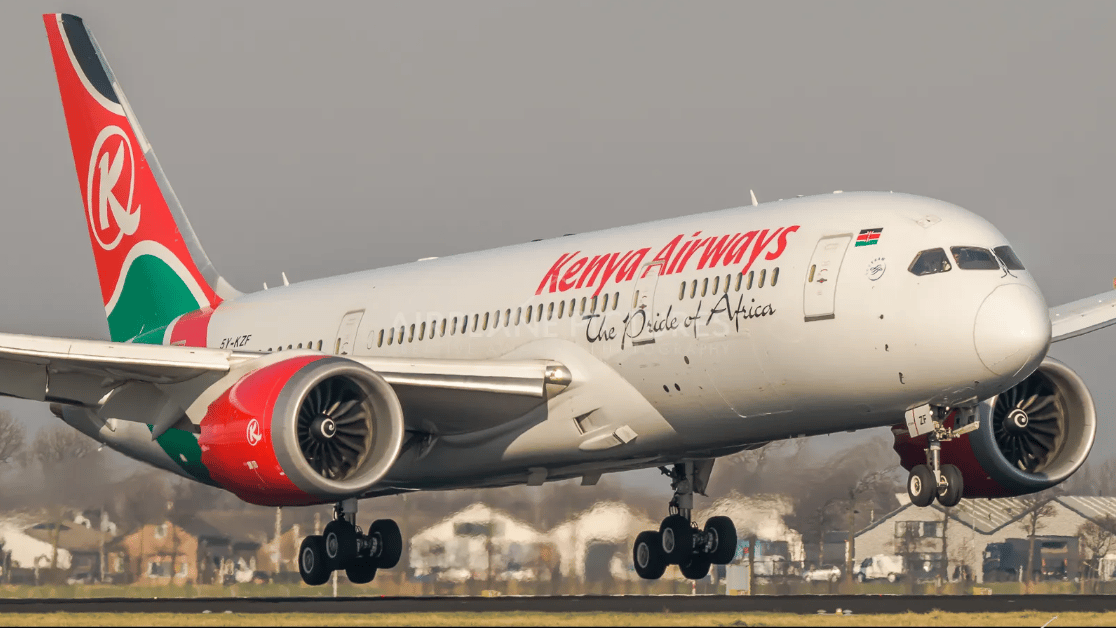
Kenya’s government has launched an urgent international search for a strategic investor willing to inject up to $2bn into the debt-stricken national airline, marking the most dramatic intervention yet in a carrier that has drained state coffers for more than a decade.
Treasury Cabinet Secretary John Mbadi announced on Wednesday that an expression of interest would be floated imminently to attract foreign capital of between Sh154.8bn ($1.2bn) and Sh258bn ($2bn), with the government prepared to sweeten the deal by bundling additional assets alongside the financially crippled airline.
The move comes as Kenya Airways teeters on the edge of insolvency, with liabilities of Sh309.9bn dwarfing assets of just Sh180.3bn as of June 2025, producing a negative equity position of Sh129.5bn that has worsened from Sh118.2bn just six months earlier. The carrier’s balance sheet deterioration underscores the urgency of Nairobi’s search for a white knight investor capable of reversing years of mismanagement and undercapitalisation.
“The new investor is expected to inject a minimum of $1.2bn and up to $2bn into the business,” Mbadi told reporters, adding that the government had already absorbed Sh63.1bn of the airline’s debt, which would be converted to equity once a strategic partner was secured. “This is not about a partner who merely injects money, but one who can run a successful airline.”
The rescue effort has triggered fierce competition between state-backed investors from Singapore and Qatar, according to industry sources. Temasek Holdings, Singapore’s sovereign wealth fund and majority owner of Singapore Airlines, has reportedly proposed acquiring a 90 per cent stake through fresh capital injections, though the firm has publicly denied the reports. Qatar Airways, meanwhile, is said to be pursuing a comprehensive management agreement that could include operational control of Jomo Kenyatta International Airport alongside its investment in the airline.
The interest from Gulf and Asian state investors reflects the strategic value of Kenya Airways’ hub position in East Africa, even as the carrier’s financial performance remains dismal. The airline slumped to a half-year loss of Sh12.15bn in the six months to June 2025, a sharp reversal from the Sh634m profit posted in the same period the previous year and ending a brief return to profitability that had lasted barely 12 months.
Speculation about an imminent deal has sent Kenya Airways shares soaring 69.7 per cent in eight trading days in January, pushing the stock to Sh5.04 and giving the carrier a market capitalisation of Sh28.6bn, despite the gaping hole in its balance sheet. The rally reflects investor hopes that a deep-pocketed strategic partner could transform the airline’s prospects, though sceptics question whether any investor would willingly shoulder such extensive liabilities.
The rescue package represents the latest chapter in a tortured history of state intervention. In 2017, the government and 11 commercial banks, including KCB, Equity and Cooperative Bank, converted billions in debt to equity in a failed turnaround attempt. That swap increased the government’s stake to 48.9 per cent from 29.8 per cent while banks acquired 38.1 per cent through a special purpose vehicle, diluting Air France-KLM’s holding to just 7.8 per cent from 26.7 per cent.
The government’s willingness to bundle other assets, possibly including airport terminals or ground handling operations, to attract investors highlights the desperation to offload an airline that has become a chronic drain on public finances. Analysts warn, however, that potential investors will demand not just equity rather than debt to avoid further balance sheet stress, but also operational autonomy that could prove politically contentious.
“The proposal is reasonable, but the challenge will be getting an investor to commit funds and realise a return on investment,” said Eric Musau, head of research at Standard Investment Bank. “The government can add something to go along with the deal such as offering Kenya Airways airport terminals to the investor.”
The Treasury’s search takes place against a backdrop of mounting pressure from the International Monetary Fund, which made finding a strategic investor for Kenya Airways a condition of its lending programme with Nairobi. The government’s failure to secure a partner has left this IMF conditionality unmet, adding urgency to the current effort even as the airline’s operating performance shows few signs of sustainable improvement.
The carrier’s recent losses stemmed partly from the grounding of three Boeing 787-8 Dreamliners for maintenance, representing a third of its wide-body fleet and forcing route cancellations that decimated revenues and passenger numbers. The grounding exposed the airline’s vulnerability to fleet disruptions and raised questions about management competence.
Leadership instability has further complicated the search for investors. Chief executive Allan Kilavuka departed in November after six years at the helm, months before his contract was due to expire in April 2026, while chairman Michael Joseph retired in June without being replaced. The dual leadership vacuum prompted Mbadi to acknowledge that governance fixes were now the priority before securing strategic investment.
The government insists Kenya Airways will retain its national carrier status and preserve its JKIA hub advantage even under foreign ownership, though regulatory constraints limit foreign stakes to a maximum 49 per cent. Whether that proposition proves attractive to investors eyeing a carrier with decades of losses, a deteriorating balance sheet and persistent operational challenges remains the critical question facing Nairobi’s rescue effort.
Industry observers note that Kenya Airways’ predicament mirrors broader struggles across African aviation, where carriers face high fuel costs, regulatory fragmentation, limited infrastructure and intense competition from Gulf airlines that have steadily eroded African carriers’ market share on intercontinental routes.
The Treasury’s determination to find a solution before the airline’s financial position worsens further suggests that privatisation, long resisted on nationalist grounds, has become the only viable path forward. Yet the risk remains that even a multibillion-dollar injection may prove insufficient without fundamental operational reforms that previous rescue efforts have failed to deliver.





Comments