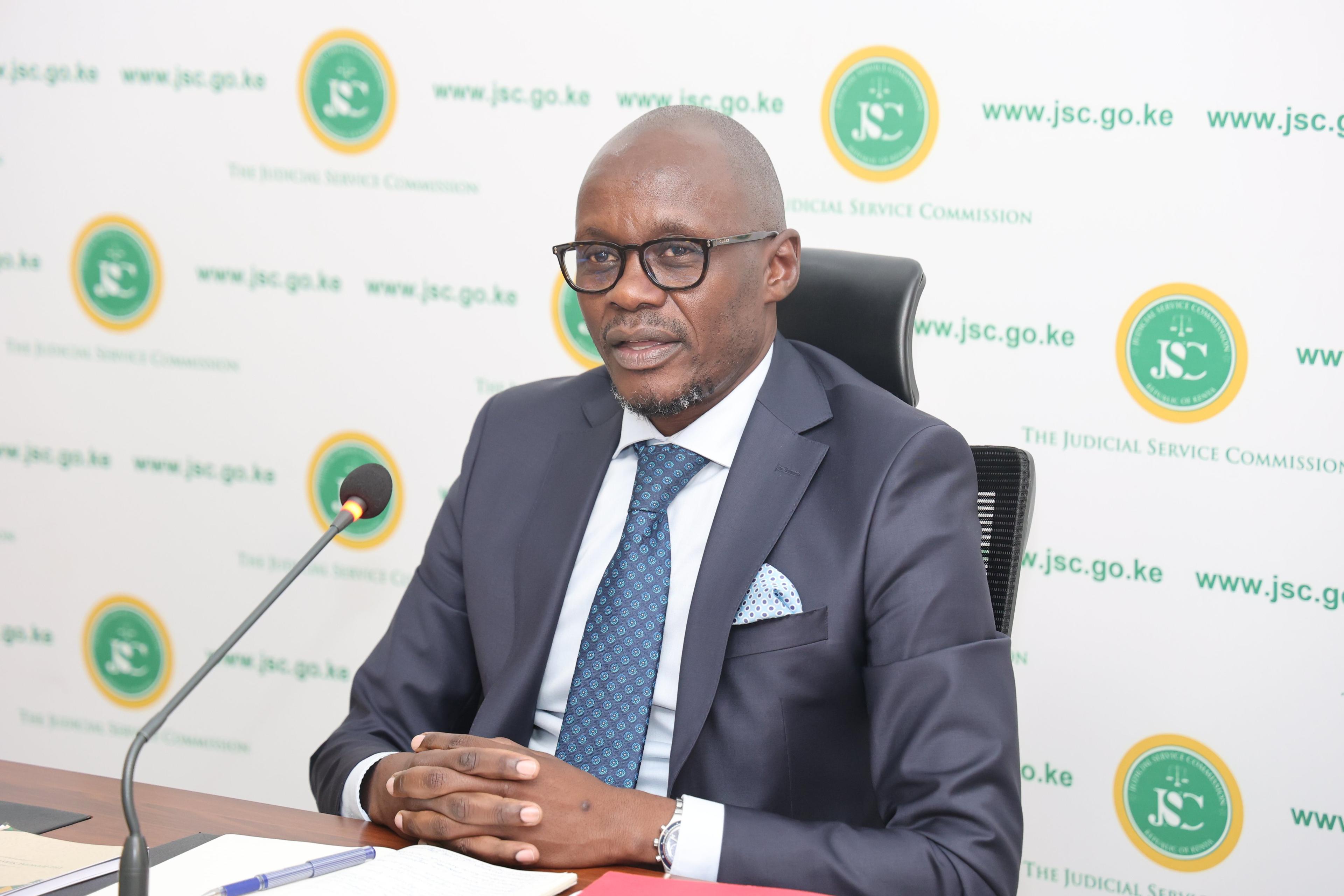
In the annals of Kenya’s judicial recruitment, few spectacles have been as simultaneously riveting and instructive as what unfolded on the morning of January 12, 2026, inside the JSC boardroom at CBK Pension Towers on Harambee Avenue.
Prof Migai Akech, constitutional law scholar, University of Nairobi lecturer, PhD holder from New York University, author of over 80 academic publications and the man widely regarded as one of the sharpest legal minds this country has produced, sat before the Judicial Service Commission. And within minutes, the panel wanted to talk about his tweets.
Akech had been selected as the very first candidate to face the JSC in the race for 15 Court of Appeal positions, chosen from a pool of 35 shortlisted applicants drawn from 95 who had applied by the July 2025 deadline.
That selection gave him pride of place in what Chief Justice Martha Koome’s commission had billed as a transparency-driven, publicly streamed process. What it also gave him was no warning of the ambush to come.
JSC public representative Caroline Nzilani told Akech during the interview that submissions from members of the public had flagged concerns about his conduct on social media platform X.
He was described as being “very vocal” on the platform, prone to “altercations with advocates” who disagreed with him, and condescending toward colleagues. The Chief Justice herself demanded to know how he would handle litigants and lawyers in court, given what she described as his “very strong expressions” online.
“In law and in administrative law, there’s something called the right to notice. It should never be an ambush.” — Prof Migai Akech
BLINDSIDED
Akech’s defence before the commission was that of a man who champions democracy through robust engagement, and who deploys humour as a tool of public discourse.
He told the commission he is an “active citizen” who believes democratic participation requires vigorous public conversation.
He acknowledged a single serious altercation with a fellow legal professional, an advocate who had once been his teacher, adding that he personally visited the man, apologised, and considered the matter closed.
He even offered a concession that in hindsight reads as almost poignant: he told the panel he would stop posting on X altogether if appointed to the bench. It was a promise of silence from a man who had built his public intellectual identity on loudness.

What stung him more deeply, he later revealed in an interview with Daily Nation’s on March 3, was that he had been given no prior notice of the specific posts that formed the basis of the commissioners’ concerns. “In law and in administrative law, there’s something called the right to notice.
It should never be an ambush,” he told the publication. “You should tell me in advance that, ‘The post that we have an issue with is this one. Please come prepared to talk to us about it.’ They didn’t do that.”
He also raised a separate grievance: that he was interrogated over the contents of a private email he had sent, which a recipient had leaked onto social media. “One of the people that received that e-mail made it public,” he said. “How do you side with the person that has done that? Then how do you then claim that is my social media post? I’m not responsible for it.”
THE ‘HOT AIR’ MOMENT
If the social media questions threatened to sink him, Akech did himself no particular favours with what became the most-quoted moment of an interview that was broadcast live on YouTube and Facebook.
Introducing himself to the panel, he declared that his academic record made him supremely qualified to serve on an appellate court that deals primarily with documents, adding that “words like hot air” would not find their way into his judgments.
The dig was unmistakeable. In the landmark 2022 Supreme Court presidential election ruling, Chief Justice Koome, sitting at the head of the very commission now interviewing him, had famously described opposition allegations of portal manipulation as “no more than hot air” for lack of credible evidence.
The remark drew laughter in the boardroom, including from Koome herself. But beyond the boardroom, it generated a storm of commentary online, much of it treating the quip as evidence of the very temperament problems that had already been raised.
Akech later dismissed the furore as a failure of national humour. “It was a joke,” he told Daily Nation.
“Kenyans don’t have a sense of humour at all. I was actually very surprised by the response to that remark, because it was just a joke. I’ve known the CJ for a very long time, and I respect her tremendously. It was not meant to be offensive in any way. It was just a light moment.”
He offered to stop posting on X altogether if appointed. It was a promise of silence from a man who had built his public intellectual identity on loudness.
THE VERDICT
He did not make the final cut. When the JSC released the names of 15 recommended Court of Appeal judges, Akech’s was not among them. Justices Issack Hassan, Katwa Kigen, Byram Ongaya, Hedwig Ong’udi and Chacha Mwita were among those picked and subsequently sworn in.
No reasons were published for any of the selections or rejections, a fact Akech found constitutionally objectionable.
He returned to X, the very platform that had partially undone him, to say so. Citing Article 47 of the Constitution, which requires the JSC to give reasons for its decisions, he argued that the entire process remained opaque and subjective behind a facade of public accountability. “The JSC gives the public a veneer of accountability, not real accountability,” he posted on February 26.
The irony is difficult to escape. A process that invited the public to submit “information of interest” about candidates effectively turned Akech’s digital footprint into an exhibit against him, wielded anonymously and without prior disclosure.
A man who built a career examining the relationship between law, democracy and power found himself on the receiving end of a process he now argues violates the very administrative law principles he has spent decades teaching.
THE SCHOLAR BEHIND THE SCREEN
Prof Akech is 54, Homa Bay-born, Starehe Boys-educated, and Cambridge and NYU-trained. He graduated from the University of Nairobi’s Faculty of Law in 1995 as one of only three students in his class to achieve a first class honours under the 8-4-4 system.
He was admitted to the bar in 1998 and went on to complete a second master’s at New York University before earning his PhD there in 2004. He was appointed a full professor in 2023 and delivered his inaugural lecture in April 2024, becoming only the third person to do so in the Faculty of Law’s history since 1970.
He has taught an estimated 8,000 students over his career, among them Law Society of Kenya president-elect Charles Kanjama and former LSK president Nelson Havi.
He has 80 published works to his name, has consulted for governments across Africa including advising on Lesotho’s constitutional amendment process in 2022, and submitted the basic structure doctrine analysis that the Supreme Court accepted in the BBI case in 2021.
He chairs the Football Kenya Federation’s appeals committee and once ran its disciplinary committee. Four framed degrees hang on the wall of his law firm in Hurlingham, alongside two football trophies.
None of that, it turned out, was immune to the intervention of an anonymous public submission about his conduct on social media.
Akech insists the characterisation is unfair. “I think I’m very measured in my social media,” he told Daily Nation. “Which posts are these they were talking about?” He remains unrepentant and unsilenced. The tweets continue. The scholarship continues. And the question he has now raised in full public view, whether the JSC’s opaque selection criteria meet the constitutional standard, is one that he, of all people, is well-equipped to litigate.



Comments