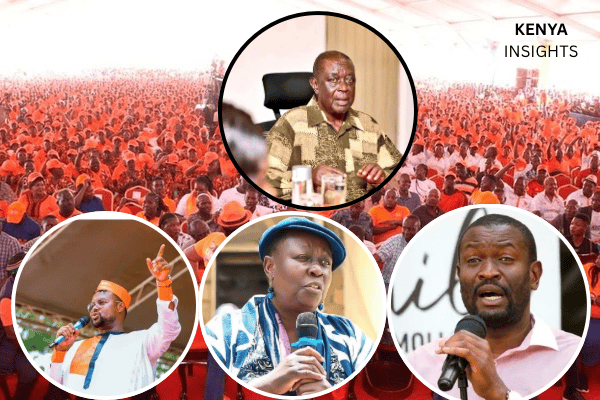
The Orange Democratic Movement, Kenya’s most storied opposition party, is hemorrhaging from within over questions nobody wants to answer: who controls the money, where are the millions coming from, and who truly speaks for the party that Raila Odinga built over two decades?
Three months after the death of its founding pillar, ODM finds itself in a brutal civil war between two camps, each claiming the mantle of legitimacy, each mobilizing parallel grassroots rallies, and each accusing the other of betraying the very soul of the orange revolution.
At the heart of this spectacular disintegration lies one stubborn truth that party insiders whisper but dare not say publicly: control of ODM means control of billions in political funding, patronage networks, and the keys to State House itself in 2027.
The party’s Secretary-General Edwin Sifuna lit the match that has now consumed the party when he went on national television and made a claim so explosive it sent shockwaves through the political establishment.
The ongoing Linda Ground rallies, he declared, are not being financed from ODM coffers.
As a signatory to the party’s bank accounts alongside National Treasurer Timothy Bosire, Sifuna stated categorically that no money has left official party accounts since the 20th anniversary celebrations in Mombasa last November.
“I can state authoritatively that the resources you see being spent in ODM rallies, the so-called Linda Ground forums, are not coming from ODM headquarters,” Sifuna told Citizen TV, his words measured but lethal. “There is parallel funding for activities clothed in ODM colours.”
The implications of this statement cannot be overstated.
Someone, somewhere, is bankrolling a multi-million shilling political operation under the ODM brand without going through official party channels.
The rallies have featured helicopters ferrying party bigwigs across counties, massive tents accommodating thousands, freshly printed ODM-branded T-shirts and caps, and logistics that suggest access to deep pockets.
Sifuna’s revelation raises the question that has now split the party down the middle: if not from party accounts, then where is the money coming from?
Kisumu Woman Representative Ruth Odinga, sister to the late Raila Odinga and niece to current party leader Oburu Oginga, has offered the most incendiary answer.
In a blistering statement defending Sifuna, she accused the government of President William Ruto of directly funding the Linda Ground rallies as a mechanism of control.
“The money flying in choppers, being used to procure big tents and to mobilize and brand crowds in ODM colours, yet the same money cannot be sent to the ODM Party bank accounts, only means one thing: control,” Ruth declared. “The government has the option of releasing the funds to the party, but when that happens, they will lack control. So, they must be the ones controlling the show, where they decide who is invited to the Linda Ground tents, and what they say once they get there.”
Her questions cut to the bone of ODM’s current predicament. Are governors funding the campaigns from county coffers? Are MPs diverting Constituency Development Fund money? Did a mysterious philanthropist suddenly develop an interest in keeping ODM afloat? And crucially, what does this shadowy benefactor want in return?
The Linda Ground faction, led by party leader Oburu Oginga, National Chairperson Gladys Wanga, deputy party leaders Simba Arati and Abdulswamad Nassir, and National Assembly Minority Leader Junet Mohammed, has remained conspicuously silent on the funding question. Instead, they have pivoted to attacking Sifuna’s legitimacy and questioning his loyalty.
Oburu, in a sharply worded statement, accused his Secretary-General of confusing party members by conflating personal opinions with official party policy. “The Secretary General has occasionally struggled to distinguish between his personal opinions and official party policy as determined by our constitutionally mandated organs,” Oburu said, in what many read as a thinly veiled threat. “This has, understandably, created confusion among members and supporters.”
But Oburu’s counterattack has done little to address the elephant in the room. The Linda Ground rallies have now visited Kakamega, Busia, Kisumu, Kisii, and Nyamira counties, with speakers consistently pushing for a pre-election coalition with President Ruto’s United Democratic Alliance. The optics are damning: a supposedly independent opposition party conducting expensive mobilization drives while its Secretary-General publicly states the party itself is not paying for them.
Mombasa Governor Abdulswamad Nassir attempted damage control by suggesting the rallies are funded by individual leaders out of goodwill, invoking the spirit of how Raila Odinga’s past campaigns were financed. “When we were moving around the country with former Prime Minister Raila Odinga, was the party financing those activities?” Nassir asked. “This party has many people who support it and do not necessarily focus on finances.”
The explanation has been met with skepticism. ODM, according to Sifuna, is owed a staggering Sh12 billion by the National Treasury in unremitted Political Parties Fund allocations. The Treasury is legally required to provide at least 0.3 percent of national government revenue to the fund, with 80 percent distributed based on votes in the last election. Yet ODM cannot access these funds even as millions flow into parallel structures bearing its name.
“As we speak, ODM is owed a total of Sh12 billion by the Treasury, yet we are being told that my former chairperson is the Cabinet Secretary for the Treasury,” Sifuna said, referencing John Mbadi, the ODM treasurer who now serves in Ruto’s government. The irony is not lost on anyone: ODM’s own appointees now control the very ministries that owe the party billions.
The factional warfare has now spawned competing grassroots tours. While Oburu’s Linda Ground rallies preach accommodation with Ruto’s government, Sifuna’s faction has launched Linda Mwananchi rallies, starting in Busia on February 8, to counter what they see as the sellout of ODM’s founding principles. Deputy Party Leader Godfrey Osotsi, Siaya Governor James Orengo, Embakasi East MP Babu Owino, Kisii Senator Richard Onyonka, and Saboti MP Caleb Amisi have thrown their weight behind the Sifuna camp, arguing that ODM must field its own presidential candidate in 2027 rather than back Ruto.
“We have an opportunity of a lifetime here because of how the votes were split in 2022,” Sifuna argued. “Our candidate lost by a margin of 200,000 votes. In my estimation, if we just kept the constituencies that voted for Raila Odinga, we don’t need to do anything else because the person who has lost the biggest chunk of votes is Ruto, and so we would actually win.”
Orengo has been more blunt, warning of a plot to “auction” ODM to President Ruto and vowing to protect the party’s identity. His language suggests the battle is existential: either ODM remains an independent force capable of challenging the government, or it becomes a client organization subsumed into the very power structures it was created to oppose.
The leadership crisis is compounded by questions over Oburu’s own installation as party leader. Sifuna has publicly challenged the process, arguing it violated party constitution. According to Sifuna, who was in Mumbai, India, helping repatriate Raila’s body when the decision was made, ODM’s constitution required that one of the deputy party leaders act temporarily pending a special National Delegates Convention. Instead, the National Governing Council directly installed Oburu without the constitutionally mandated NDC approval.
“The installation of Oburu Oginga as interim party leader was not procedural in accordance with the provisions of the Constitution,” Sifuna stated. “What I would have advised had I been in that meeting is to allow one of the deputies to act for one month, and in three months’ time, call for a special NDC and do it procedurally and properly.”
Oburu has fired back with equal force, pointing out that Sifuna himself was elected Secretary-General by the same National Governing Council in February 2018 and only later endorsed by the NDC in 2022. “One cannot selectively invalidate the very processes that conferred legitimacy upon oneself,” Oburu said, in what many read as a checkmate argument.
The spectacle reached its nadir on February 6 when businessman Oketch Salah, who styled himself as Raila’s adopted son, organized an event at the Kenyatta International Convention Centre featuring ODM-branded merchandise bearing President Ruto’s portrait. Attendees wore orange T-shirts and caps emblazoned with the face of the man Raila spent decades opposing. The imagery was jarring, almost obscene to party loyalists who remember the battles of 2007, 2013, 2017, and 2022.
ODM moved swiftly to distance itself. In a statement signed by National Chairperson Gladys Wanga, the party declared that Salah’s activities are carried out strictly in his personal capacity and do not represent or bind ODM. But the damage was done. The sight of ODM colors fused with Ruto’s image crystallized the fears of the Sifuna faction: that powerful forces within and outside the party are working to deliver ODM wholesale to the government.
Saboti MP Caleb Amisi captured the visceral reaction when he demanded to know: “When did ODM NDC meet and approve that our t-shirts and caps be printed with Ruto’s image?”
Salah has complicated matters further by claiming to possess knowledge of Raila’s final political wishes. According to Salah, Raila wanted a strengthened ODM to eventually endorse Ruto for re-election in 2027. He has also alleged that Raila suspected Sifuna of being someone’s mole, claims that have been furiously rejected by Raila’s biological children. East African Legislative Assembly MP Winnie Odinga dismissed Salah’s accounts as fabrications, stating she was at her father’s side in his final moments, not Salah. Raila Odinga Junior backed his sister, calling Salah’s assertions “nonsense.”
Yet Salah’s claims have found traction within the Oburu camp, which has been careful not to disavow them even as they publicly distance from Salah’s methods. This ambiguity feeds suspicion that Salah is expressing openly what powerful figures within ODM prefer to keep veiled.
The money trail tells its own story. ODM’s official bank accounts have been dormant for months even as lavish political theater unfolds across the country under its banner. The party is owed billions by a government that includes its own members in cabinet positions. Parallel funding structures operate outside party oversight. And all of this is happening as ODM prepares for what should be the most consequential election of its existence, coming off a loss to Ruto by just 200,000 votes.
Political analyst Professor Macharia Munene has warned that ODM may not survive the competing interests tearing it apart. “Even Raila knew that Sifuna was popular,” Munene noted, suggesting the current leadership underestimates the Secretary-General’s support base at its peril.
Ida Odinga, widow of the founding leader, has urged rival factions to embrace dialogue to avert a split. Speaking to Nairobi legislators, she warned that sustained infighting could undermine two decades of political legacy. “It is my wish that we preserve the party in Baba’s honour as a service to our country,” she said, her voice carrying the weight of a woman who has watched her husband’s life work threatened by the very people he elevated.
But dialogue seems increasingly unlikely. The Sifuna faction has boycotted Central Management Committee meetings, arguing the leadership under Oburu lacks procedural legitimacy. Oburu, for his part, has challenged critics to face him at the NDC, insisting he does not fear anyone. The party now operates with parallel structures, parallel tours, parallel narratives, and most damningly, parallel sources of funding.
The stakes could not be higher. Control of ODM means control of the largest opposition party in Kenya. It means control of parliamentary minority leadership positions. It means control of billions in political party funding. It means the power to decide whether Kenya has a viable opposition in 2027 or whether the political space consolidates entirely under Ruto’s presidency.
For the Oburu faction, cooperation with government is pragmatic politics that ensures ODM members are not left out of national development and decision-making. It is the difference between power and irrelevance. For the Sifuna faction, the same cooperation represents a catastrophic betrayal of ODM’s founding mission to provide an alternative to establishment power.
Between these irreconcilable positions lies the corpse of consensus. The party that Raila built as a vehicle for democratic reform now teeters on the edge of civil war, its leaders too busy fighting over control to notice the ground shifting beneath them. The orange revolution that inspired millions is now reduced to competing rallies funded by sources nobody will name, advancing agendas nobody will explicitly state, all while the party that claims to represent them bleeds out in public.
As 2027 approaches, only one certainty remains: whatever ODM becomes after this civil war, it will not be the party Raila left behind. The only question is whether it will be recognizable at all.


Comments