
Grapevine
Inside Pax Manor: Kenya’s Most Reclusive Betting Billionaire, His Premium Socialites, and the Night Amber Rose Came to Dinner
A colonial manor in Muthaiga. A Hollywood socialite in a convoy of black SUVs. An invisible Kenyan tycoon with a billion-shilling empire built in the shadows. The story Andrew Akwesera Aligula prayed you would never read.

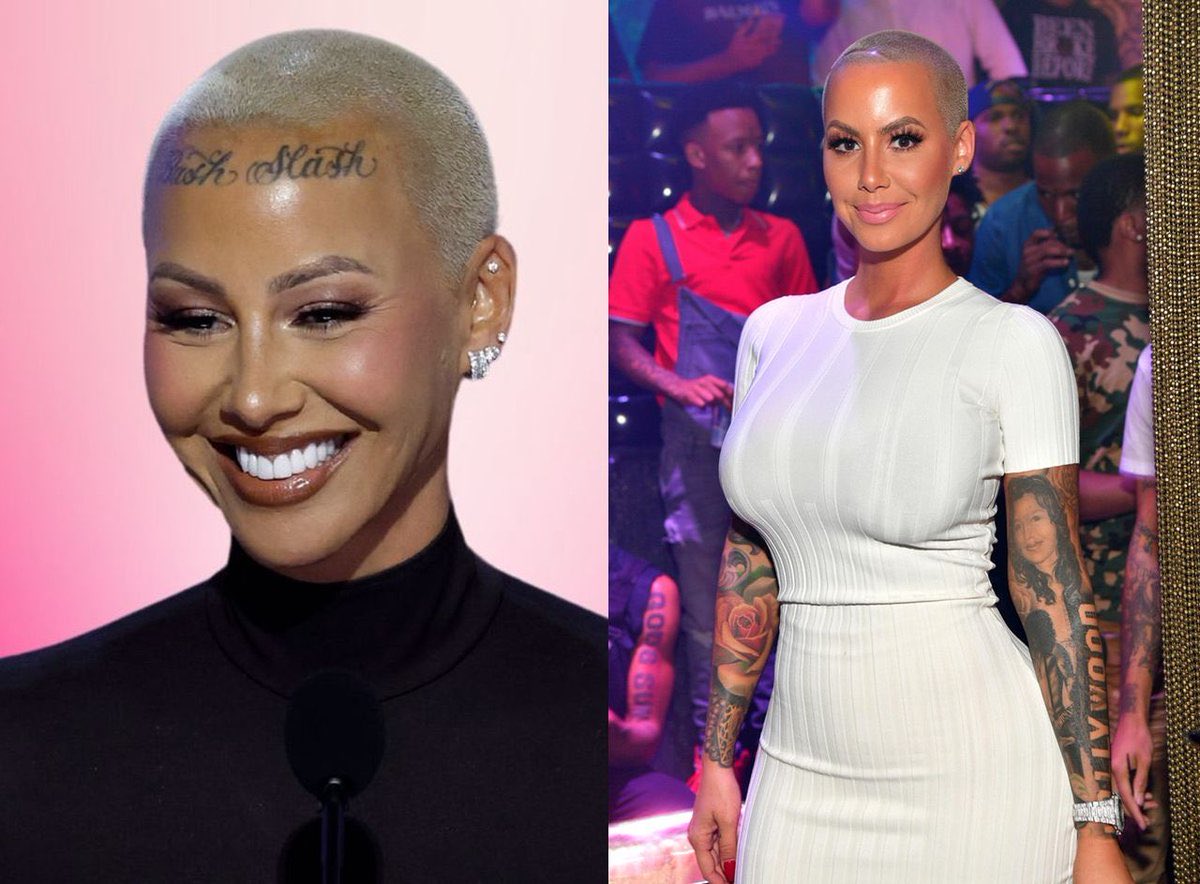
There is a part of Nairobi that does not belong to ordinary people. It sits behind tall hedgerows on Muthaiga Road, where the jacaranda trees form a corridor of purple and the air carries none of the city’s noise.
You cannot stumble onto it. You arrive there the way powerful people always arrive at their pleasures — by being summoned. Pax Manor, at number 58, is the kind of address that exists to make the outside world forget it exists at all. Its 26 rooms blend colonial grandeur with the kind of contemporary appointments that cost more than most Kenyans earn in a year.
The Royal 58 restaurant, named with the quiet arrogance of a man who considers himself above round numbers, operates on the principle that the finest meals are the ones eaten far from public view. The infinity pool gazes out at Karura Forest. The candles burn low.
And the staff — perfectly trained, impeccably dressed, surgically discreet — understand, with an instinct that cannot be taught in any hospitality school, that the most important service they provide is not the food or the wine or the thread count of the sheets. It is the silence.
Into this silence, at intervals known only to a very small number of people, steps a man most Kenyans have never heard of. He does not announce arrivals. He does not seek coverage. When he is in Nairobi, he is visible only to those he has chosen to see, in rooms he has chosen to occupy, in a manner entirely of his own design.
His name is Andrew Akwesera Aligula. He is, by every credible account this investigation has encountered, one of the richest men in Kenya. He is also, without any doubt, the most invisible.
“When Amber Rose was in Nairobi, the party did not happen where the cameras were. It happened where they are never allowed.” — Source close to Aligula
Muva Lands in Nairobi. The Real Story Was Not in Kibera.
The world saw one version of Amber Rose’s Kenya visit. In late April 2025, the American model, actress and cultural provocateur — 23 million Instagram followers, ex-wife of Wiz Khalifa, friend of Kanye, certified Hollywood royalty — touched down in Nairobi for the ‘Baddies Africa’ tour, a reality television project for the Zeus Network.
She arrived in a convoy of blacked-out SUVs that Nairobi noticed immediately. She posted to her Instagram stories: Nairobi traffic, a Maasai elder in full regalia, and a heartwarming visit to a children’s home in Kibera where dozens of children sang her a poem that made the internet weep for forty-eight hours.
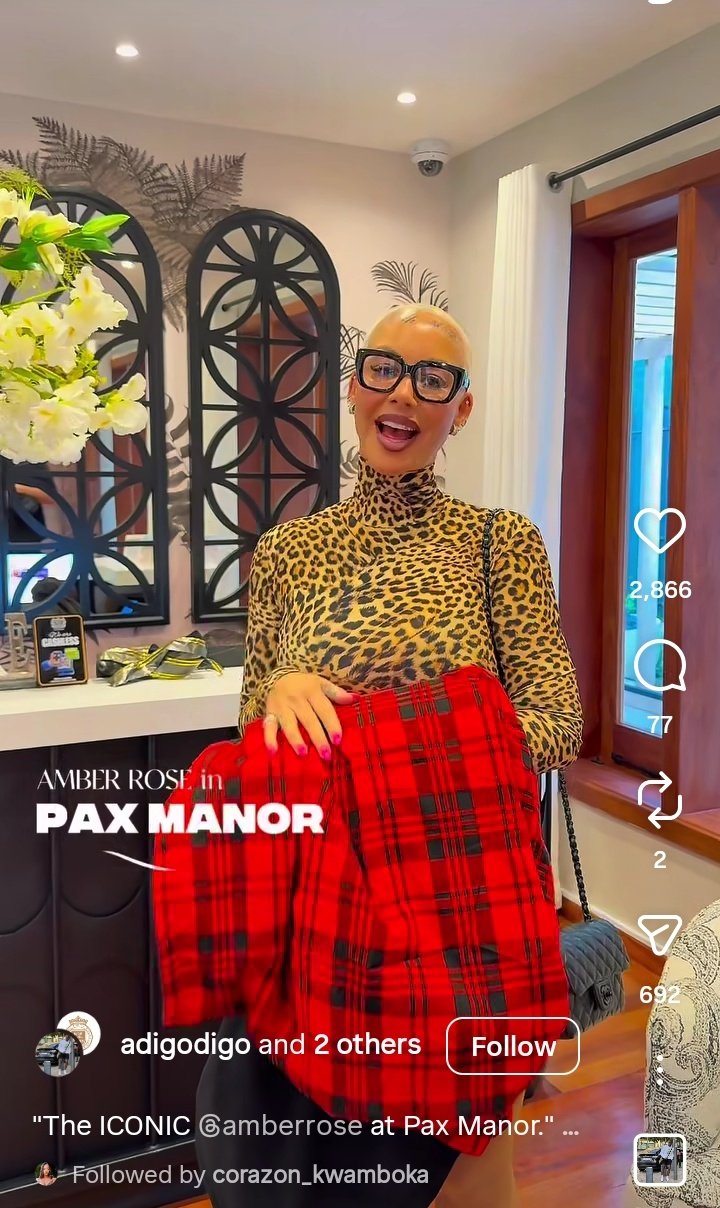
add24a0f8ae9ed6a518247a8057d41bb860c860b
The photographs were exquisite. The narrative was wholesome. Amber Rose, the woman who once wore a MAGA hat and then told her critics to kiss something unprintable, was giving back to Africa. It was the kind of press that money cannot buy.
But Nairobi’s grapevine, which has survived far more determined attempts at narrative management than a social media strategy dreamed up in a Los Angeles production office, tells a different story about at least one of those Nairobi evenings.
According to sources whose discretion in these matters has been tested and found reliable, the convoy of black SUVs that Amber Rose’s people were so pleased to have documented on Instagram was not, on every occasion, heading towards a children’s home.
On at least one evening — the kind of evening that does not get posted to Instagram, that no Zeus Network executive tagged, that not a single member of the Baddies Africa production crew ever mentioned in a press release — the convoy is said to have made its way up Muthaiga Road.
To a manor. Number 58. Where a Luhya tycoon from London had, by all accounts, laid on a welcome befitting someone who considers hospitality a form of power.
The details, as our sources relay them, are the kind that would make even Pax Manor’s most impassive staff member steal a glance. A private wing. A table at Royal 58 dressed for a party that the restaurant’s own booking system never officially recorded.
Rare champagne — the kind whose labels most Nairobi residents see only in lifestyle magazines. And at the head of the table, the man himself: Andrew Aligula, who reportedly spent what multiple sources describe as north of Sh1.5 million on an evening that, by every publicly available record, never took place. ‘He had been told Amber was coming to Nairobi,’ one well-placed source confided, with the measured tone of someone recounting a fact rather than a rumour. ‘He does not miss that kind of opportunity. He rarely misses any kind of opportunity. That is how he built what he built.’
“He had been told Amber was coming. He does not miss that kind of opportunity. That is how he built what he built.”
The Man Behind the Betting Machine Nobody Knew He Owned
To understand why an evening with a Hollywood celebrity at an undisclosed Muthaiga address matters, you first need to understand who Andrew Aligula is and precisely how hard he has worked to ensure that you do not know.
For years, Kenya’s betting public believed that OdiBets — the green-and-yellow colossus that has hoovered up billions of shillings from Kenyan households since its launch in 2018 — belonged, in all the ways that mattered, to Jimmy Kibaki. This was a masterpiece of misdirection. Jimmy is the son of the late President Mwai Kibaki. He is convivial, widely known in Nairobi social circuits, and possessed of an appetite that has become part of the city’s mythology. Tycoon Jimmy Wanjigi is said to have once quipped, with what we imagine was equal parts affection and disbelief, that young Kibaki could account for an entire chicken and an accompanying mountain of chips in a single sitting. He is, in every sense, a man who takes up space in a room. Which made him the perfect frontman for someone who had very specific reasons never to take up space in a room.
The actual architect of OdiBets is Andrew Akwesera Aligula, a Kenyan-born Luhya believed to be in his mid-thirties, London-based, and possessed of a ruthlessness in business that sources describe with something between admiration and alarm. ‘Jimmy was the face,’ an industry source put it with characteristic Nairobi directness. ‘Andrew was the bank, the strategy, and the get-out-of-trouble department. Jimmy smiled for the cameras. Andrew made sure the cameras never found him.’
The Political Architecture of a Protected Empire
OdiBets launched in 2018 under Kereco Holdings Limited, entering a market already churning with competitors. What happened next to those competitors is, in retrospect, a remarkable piece of industrial history. The Uhuru Kenyatta administration, citing admirable concerns about the social cost of gambling, launched a regulatory assault on Kenya’s betting industry.
SportPesa — then the market leader, with the sponsorships and the celebrity endorsements and the international ambitions — found itself in a bruising standoff with the Kenya Revenue Authority over a tax dispute that ultimately proved fatal to its Kenyan operations. Betin lost its licence. Foreign operators retreated. The market landscape, which had been crowded and competitive, was suddenly wide open.
OdiBets did not merely survive this purge. It flourished in the space vacated by the fallen. This does not happen by accident in Kenya. Industry veterans, speaking with the careful circumspection of people who understand what they are implying, attribute OdiBets’ charmed regulatory existence during the Kenyatta years to Aligula’s understanding of how business is actually done in this country. The Kenyatta family’s own entanglement in the betting sector — through Peter Muiruri, a presidential cousin who held a stake in SportPesa — adds a layer of irony to SportPesa’s eventual destruction that this newspaper notes without any further comment.
Under President William Ruto, sources say, Aligula has moved with the efficiency of a man who understands that political cover is a perishable asset requiring regular renewal.
The names most frequently attached to Aligula’s alleged Ruto-era relationships are not insignificant: personal presidential aide Farouk Kibet, Head of Public Service Felix Koskei, and Cabinet Secretary Kipchumba Murkomen. Kibet, in particular, is the subject of persistent industry whispers — robustly contested and as yet unsubstantiated by documentary evidence — that he holds an interest in OdiBets. The rumour is old enough and consistent enough across enough credible mouths that its persistence itself becomes a data point.
Aligula, according to sources, does not merely cultivate these relationships. He boasts of them. ‘He drops names the way other people drop cutlery,’ one source remarked, ‘casually, constantly, and always to make a point.’
These alleged connections have had practical consequences. The removal of Aggrey Sayi, Jimmy Kibaki’s trusted marketing director, from OdiBets is described by sources as an exercise in applied political pressure — a demonstration that when Aligula wanted someone out, the levers available to him extended well beyond the boardroom.
Sayi, who is understood to have co-founded rival platform MayBets with other former OdiBets staff, now runs a company that sources describe as operating under sustained, externally applied distress.
An accountant named Kwamboka, who also left OdiBets under circumstances sources describe as uncomfortable, ended up at MayBets. The firm is struggling. Insiders say it is not struggling by accident.
London Offices, Bangalore Accounts, and the Question Nobody Has Officially Asked
Whatever Aligula’s political connections have secured him domestically, his corporate architecture suggests a man who prefers not to keep all of his money in any single jurisdiction.
Corporate filings document his directorship in Money Transfer International Ltd, registered at 107-111 Fleet Street in London — the same square mile that has served as a discreet home for the offshore structures of the world’s financial adventurers since the age of empire.
The company, co-directed with Mike Macharia Mwenje and Nelson Mwaura Kigome, has reported turnovers exceeding one million dollars. Its purpose, in the context of a man running a multi-country betting operation generating billions of shillings annually, is a question that no regulator has yet found it urgent to answer publicly.
Techplan Limited, incorporated in Bangalore, India, in November 2022, adds a further layer. Aligula, Kigome, and an Indian national named Baijinder Singh are listed as directors.
Techplan’s most recent balance sheet, dated March 2023, has raised eyebrows among financial analysts who have examined the documents, with sources describing the accounts as carrying ‘the kind of irregularities that would concern anyone whose job it was to look.’ OdiBets operates across Kenya, Zambia, Ghana, Zimbabwe, Tanzania, and Uganda.
The combination of a high-volume, multi-jurisdictional cash-generating operation with a suite of offshore holding structures is not, in isolation, evidence of anything unlawful. But it does constitute precisely the configuration that anti-money laundering frameworks are designed to scrutinise. Kenya’s regulators, during the years when Aligula’s alleged political relationships were most robust, do not appear to have scrutinised it with any urgency.
“The accounts carry the kind of irregularities that would concern anyone whose job it was to look.” — Financial analyst
What Happens Inside OdiBets Stays Inside — Until It Doesn’t
Within OdiBets itself, the picture that has emerged from this investigation is of a company where institutional process is secondary to personal loyalty, and where the personal behaviour of senior figures has, on multiple accounts, crossed lines that employment law and basic professional standards are supposed to mark clearly.
General Manager Dedan Mungai, the company’s most publicly visible operational face, is the subject of allegations from multiple sources within the organisation.
These include claims of inappropriate relationships with female staff members, and separate allegations that Mungai has exploited administrative access — including the use of system credentials — to redirect company funds following KRA tax deductions. Mungai has not been provided an opportunity to respond to these specific allegations in the course of this reporting, and they should be understood in that context. What is notable is not merely the allegations themselves but the consistency with which they are repeated by sources who have no obvious reason to coordinate.
Gregory Amoshe, the Vice President of Marketing, is described across multiple sources as the operational expression of Aligula’s will — the person who translates the owner’s instructions into company reality, regardless of their character.
Around these two figures, a management layer comprising Benedict Murithi in digital media, Ann Wanjiru in customer care, Robert Muraya as brand ambassador, and Angela Mathenge in social media maintains the brand’s cheerful public face while the internal politics play out behind glass office doors that, inside OdiBets, are reportedly never quite as opaque as they appear.
The Law, the Grey List, and the Walls That Are Closing
For much of the past decade, the regulatory framework around Kenya’s betting industry was widely understood, by those who operated within it, as a set of rules enforced with a flexibility directly proportional to the seniority of the people involved. That era is encountering serious structural pressure from several directions simultaneously.
The Gambling Control Act, signed into law by President Ruto in August 2025, abolished the Betting Control and Licensing Board and replaced it with a new Gambling Regulatory Authority carrying substantially enhanced investigative and enforcement powers.
The minimum gambling age was raised to 21. Celebrity endorsements were prohibited. Every existing licence holder, including OdiBets, must reapply under the new authority’s framework. These are, on paper, the most significant reforms Kenya’s gambling sector has ever faced.
They arrived in a context of unusual external urgency. Kenya’s placement on the Financial Action Task Force grey list — the international watchdog’s register of jurisdictions whose anti-money laundering frameworks are considered deficient — forced a legislative sprint.
The Anti-Money Laundering and Combating of Terrorism Financing Laws Amendment Bill, passed in early 2025, was explicitly framed as an emergency measure to prevent Kenya’s economic isolation from international financial systems. Betting platforms were among the sectors specifically identified as vehicles for the unregulated financial flows that attracted the grey listing in the first place.
Whether the new authority will enforce its mandate with genuine independence, or whether it will replicate the regulatory culture that appears to have characterised its predecessor, is the question on which Andrew Aligula’s future most directly hangs. ‘He is not worried,’ one source said. ‘He has been through regulatory crackdowns before. He knows how to navigate them.’ Another source, from a different part of the same orbit, was less confident. ‘The FATF grey list is different. The pressure is coming from outside. You cannot phone the IMF and make it go away the way you phone a regulator.’
The Morning the Manor Cannot Contain

Pax Manor.
Pax Manor will not confirm or deny anything about its guests. That is, emphatically, the point of Pax Manor. The staff who prepared the private wing, who uncorked the champagne, who served at the table where a Kenyan billionaire entertained one of Hollywood’s most recognisable faces on an evening that no official record will ever reflect — those staff members have made a professional art form of not having seen anything. They are, by every account, extraordinarily good at their jobs.
But silence, even Muthaiga silence, has a radius. The corporate filings are public documents. The directorship records are filed in London and Bangalore and are accessible to anyone with the patience to look.
The pattern of a betting company that prospered precisely as its competitors were being regulated out of existence is documented in market data. The offshore entities are registered.
The political relationships, however strenuously denied at any given moment, are discussed in terms too specific and too consistent across too many independent sources to be entirely attributed to confabulation. The new law is real.
The FATF pressure is real. And the Amber Rose photographs, the ones that made the internet swoon, were taken in a city where a separate and considerably less photogenic evening also took place — the kind that says rather more about who Andrew Aligula actually is, and how he actually operates, than any Kibera children’s home ever could.
He has spent the better part of a decade being the most important man in a room that no one knew he was in. He has cultivated the political relationships that convert regulatory exposure into immunity.
He has built a corporate architecture that makes his money difficult to follow across multiple jurisdictions. He has entertained Nairobi’s finest, and now — on at least one account — Hollywood’s boldest, in the most discreet luxury the city can provide.
All of that may have been sufficient in the era that has just ended. In the era that is beginning — with international watchdogs, new laws with actual teeth, and a press with a considerably better map of the terrain — the question is simply whether the invisible man can stay invisible. Pax Manor’s walls, as it turns out, are not quite soundproof enough.
Our sources are still very much listening.
Kenya Insights allows guest blogging, if you want to be published on Kenya’s most authoritative and accurate blog, have an expose, news TIPS, story angles, human interest stories, drop us an email on [email protected] or via Telegram


Win For Bloggers As Court Strikes Down Cybercrime Act Criminalizing Publication of False Information

City Tycoons, MD Under Probe Over Multibillion Kenya Power Tender Scam

Zani-Led Committee Gives Ruto 85pc Score On 10-Point Agenda As Coalition Clock Ticks

Kenya Has No Capacity to Save Its Over 500,000 Citizens Stuck in the Middle East Fire, Ministry of Foreign Affairs Appears to Say

Israel and Iran Ambassadors Face Off in Kenya As War Escalates

Withheld Epstein Files With Accusations Against Trump Released By Justice Department

Russia Has Provided Iran With Information That Can Help Tehran Strike US Military

Govt Advices Over 500,000 Kenyans Stranded in Middle East Conflict To Leave At Own Cost, State Won’t Pay

‘Operation Epic Fury’ Burns An Estimated $5.82 Billion In Just 100 Hours

Trump Signals Cuba Focus After Iran

Alleged Male Lover Claims His Life Is in Danger, Leaks Screenshots and Private Videos Linking SportPesa CEO Ronald Karauri

The General’s Fall: From Barracks To Bankruptcy As Illness Ravages Karangi’s Memory And Empire

Russian Man’s Secret Sex Recordings Ignite Fury as Questions Mount Over Consent and Easy Pick-Ups in Nairobi

THE FIRM IN THE DOCK: How Kaplan and Stratton Became the Most Scrutinised Law Firm in Kenya

Multi-Million Dollar Fraud: Three Kenyans Face US Extradition in Massive Cybercrime Conspiracy

Iran Demands Arrest, Prosecution Of Kenya’s Cup of Joe Director Director Over Sh2.6 Billion Tea Fraud

FBI Investigates Congresswoman Ilhan Omar’s Husband’s Sh3.8 Billion Businesses in Kenya, Somalia and Dubai

A UN Director Based in Nairobi Was Deep in an Intimate Friendship With Epstein — He Even Sent Her a Sex Toy

A Farm in Kenya’s Rift Valley Ignites a National Reckoning With Israeli Investment

Epstein’s Girlfriend Ghislaine Maxwell Frequently Visited Kenya As Files Reveal Local Secret Links With The Underage Sex Trafficking Ring
-
 Grapevine2 weeks ago
A UN Director Based in Nairobi Was Deep in an Intimate Friendship With Epstein — He Even Sent Her a Sex Toy
-
 Development5 days ago
Kenya Strips Dutch Climate Body of Diplomatic Immunity Amid Donor Fraud Scandal and Allegations of Executive Capture
-

 Investigations2 weeks ago
How Mexico Drug Lord’s Girlfriend Gave Him Away
-
 Investigations2 weeks ago
How Close Ruto Allies Make Billions From Affordable Housing Deals
-

 Entertainment2 weeks ago
KRA Comes for Kenyan Prince After He Casually Counted Millions on Camera
-

 Business2 weeks ago
American Investor Claims He Was Scammed Sh225 Million in 88 Nairobi Real Estate Deal
-
 Investigations2 weeks ago
Talanta Stadium Construction Cost Inflated By Sh11 Billion, Audit Reveals
-
 Investigations2 weeks ago
GOLD RUSH TO GOLD DUST: How a Nairobi Forex Trader Scammed a Lawyer of Sh32 Million in a Phantom Gold Scheme