
Business
Kenya Now Demands ID Cards, Phone Numbers and Postal Addresses From Starlink Users
Digital rights advocates have pushed back against the registration drive, arguing it serves as a tool for state surveillance rather than purely a cybersecurity measure.


Kenyan authorities have moved to bring satellite internet users under the same stringent identification framework that governs mobile phone subscribers, ordering Elon Musk’s Starlink to collect and submit national identity cards, postal addresses and phone numbers of all its customers in the country or risk having their services cut off.
The Communications Authority of Kenya (CA) says the requirement stems from revised regulations introduced by ICT Cabinet Secretary William Kabogo, which expand subscriber registration rules beyond SIM cards to cover all internet communication services, including satellite-based connectivity.
Starlink has since written to its Kenyan customers informing them that they must submit their name, date of birth, gender, a government-issued identification document and a passport-sized photograph through their online accounts.
They must then visit an authorised Starlink retailer in person to complete identity verification. Customers who fail to comply by April 30, 2026, will have their service suspended.
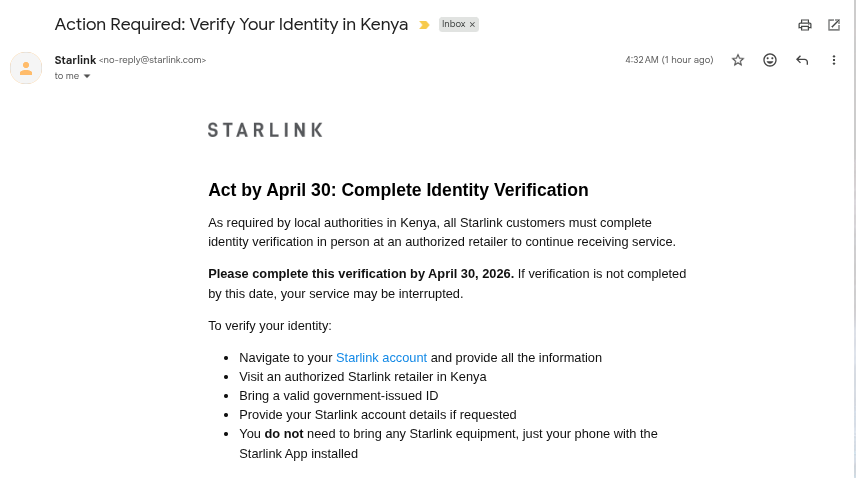
“As required by local authorities in Kenya, all Starlink customers must complete identity verification in person at an authorised retailer,” the company told subscribers in an email. “If verification is not completed by this date, your service may be interrupted.”
The CA confirmed to reporters that the new framework repeals the Kenya Information and Communications (Registration of SIM Cards) Regulations 2015, which had been narrowly focused on mobile phone lines. “The new regulations require all subscribers to ICT services to be registered, and their details authenticated in the National Integrated Population Registration System,” the regulator said.
Telecoms companies are additionally required to capture biometric data and ensure that subscribers complete a Form 1 that records multiple personal details.
The CA has, however, sought to calm concerns by clarifying that referencing biometric data in the regulations does not amount to an instruction to collect such data from subscribers.
Digital rights advocates have pushed back against the registration drive, arguing it serves as a tool for state surveillance rather than purely a cybersecurity measure.
Their concerns carry weight in a country where internet access has become central to commerce, employment and civic participation.
Joseph Khago, a Nairobi-based IT specialist, explained the practical implications for state oversight. “Without this information, it would be harder for authorities to identify the person behind the online activity of an IP address. The regulators would have to go through Starlink to request that data. The new push essentially gives the government more control,” he told the Business Daily.
Tying subscriber accounts to verified physical identities gives authorities direct visibility into who is online and from where, removing a layer of procedural distance that previously existed with satellite internet providers.
Starlink entered the Kenyan market in July 2024 and has grown rapidly, particularly in rural and underserved areas where traditional terrestrial internet infrastructure remains thin.
Data from the CA shows subscriptions reached 19,470 by September 2025, more than double the 8,063 recorded in December 2024.
Despite this growth, Starlink holds just 0.8 percent of Kenya’s fixed data market, a segment dominated by Safaricom at 35.6 percent, followed by Jamii Telecommunications at 20.4 percent and Wananchi Group at 11.8 percent.
Safaricom had earlier lobbied against Starlink’s direct market entry, arguing that satellite operators should be required to partner with existing providers rather than operate independently. The giant telco contended that standalone satellite operations posed a risk to the quality of mobile telephony networks.
The registration push arrives as the Kenyan government simultaneously considers more expansive biometric collection for new SIM card subscribers, including fingerprinting, blood typing and DNA samples, proposals that drew widespread public opposition.
The CA has maintained that the inclusion of biometric language in the regulations does not signal imminent collection of such data.
Under the revised rules, operators are empowered to suspend services where subscribers submit false information or repeatedly ignore registration requirements, including cases where a person who turns 18 fails to update their registration details within 90 days.
Before any disconnection, operators are required to issue prior notice through print and broadcast media.
The deadline facing Starlink users underscores how Kenya is steadily extending its regulatory reach into newer forms of internet delivery as the country’s online economy deepens and the government seeks tighter accountability over who is accessing the internet and how.
Kenya Insights allows guest blogging, if you want to be published on Kenya’s most authoritative and accurate blog, have an expose, news TIPS, story angles, human interest stories, drop us an email on [email protected] or via Telegram




Karua Detained at Entebbe as Uganda Blocks Besigye Lawyer From Entering Country

How KCB and Airtel Turned Kenya’s Unbanked Into a Data Goldmine Behind a ‘Financial Inclusion’ Deal

The Chivayo Network: How a Convicted Fraudster Won Access to Presidents, Passports and Billion-Dollar Deals Across Africa

BURRIED TWICE: The Victoria Bank CEO Yogesh Pattni Files

Court Stops Transfer Of EABL Shares To Asahi By Diageo In A Fresh Snag

Death Before Justice: Stephen Ngei, Victim of Sh180 Million Laptop Tender Scam Linked to Allan Chesang, Killed in Highway Crash

Court Brands Sh1.1 Billion Fee Demand by Lawyer Victor Swanya “Excessive and Exorbitant,” Exposes How City Hall Lets Public Money Bleed Through Legal Bills

Trump Unveils New Air Force One

MR. NO SHOW: Finance Bill 2026 Exposes Ndindi Nyoro’s Political Conmanship

Billionaire Eric Muli Rebukes Musalia Mudavadi Over Nairobi Capital Relocation Debate

Businessman Philip Waithaka Kinuthia’s Minor Son Allegedly Drove Drunk, Killed Two Peponi Students in Ngong Road Horror Crash as Claims of Cover-Up Intensify

Inside NCBA’s Decline: How a Banking Giant Lost Its Strategic Edge

Cement, Cash and Courts: How the Hashu Dynasty Crushed the Ramji Brothers for Fourteen Years and Why the Walls Are Now Closing In

Standard Chartered Ghosts Haunt Joshua Oigara At Stanbic As Whistleblower Spills Beans

South Sudan: Adut Salva Kiir’s Shadow Treasury Exposed

Inside The Urban Planning Cartel That Owns Nairobi

THE VULTURE AND THE SCHEME How Nairobi West Hospital Became the Most Dangerous Institution in Kenya’s SHA Ecosystem and Why the Books Must Be Audited Now

How Adil Popat Saved His Empire On The Eve Of Imperial Bank Collapse and Why Kenya’s Mainstream Media Buried The Story

The President’s Daughter and The Missing Witness: How Adut Salva Kiir’s Shadow Treasury Silenced Its Most Dangerous Critic

Why John Ngumi Is Running From the EACC and Why the Sh415 Million Payday May Be the Least of His Worries
-
 News1 week ago
Businessman Philip Waithaka Kinuthia’s Minor Son Allegedly Drove Drunk, Killed Two Peponi Students in Ngong Road Horror Crash as Claims of Cover-Up Intensify
-
 Business2 weeks ago
Inside NCBA’s Decline: How a Banking Giant Lost Its Strategic Edge
-
 Business2 weeks ago
Standard Chartered Ghosts Haunt Joshua Oigara At Stanbic As Whistleblower Spills Beans
-
 Africa1 week ago
South Sudan: Adut Salva Kiir’s Shadow Treasury Exposed
-
 Investigations4 days ago
THE VULTURE AND THE SCHEME How Nairobi West Hospital Became the Most Dangerous Institution in Kenya’s SHA Ecosystem and Why the Books Must Be Audited Now
-
 Business1 week ago
How Adil Popat Saved His Empire On The Eve Of Imperial Bank Collapse and Why Kenya’s Mainstream Media Buried The Story
-
 Africa2 weeks ago
The President’s Daughter and The Missing Witness: How Adut Salva Kiir’s Shadow Treasury Silenced Its Most Dangerous Critic
-
 Business2 weeks ago
Why John Ngumi Is Running From the EACC and Why the Sh415 Million Payday May Be the Least of His Worries