
Development
Blood and Gold: The Battle for Kakamega’s Buried Treasure
Shanta Gold’s environmental impact assessment, submitted to NEMA, reveals that the combined Isulu and Bushiangala sites contain 1.27 million ounces of high-grade gold.

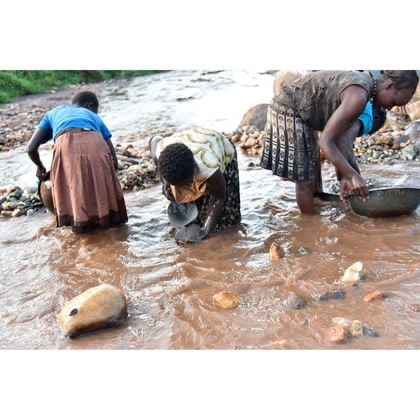
Three Dead, Families Displaced as Sh683 Billion Mining Deal Ignites Deadly Confrontation
The blood of three men now stains the red earth of Ikolomani, a grim marker of what happens when foreign corporate interests collide with the desperate survival of Kenya’s poorest citizens. On Thursday morning, as government officials gathered at Isulu market to discuss the future of Kakamega’s gold-rich soil, the fragile peace that had held for weeks finally shattered.
Armed police opened fire. Bodies fell. And the question that has haunted Western Kenya for months crystallized in the chaos: Who truly owns the gold beneath Kakamega’s soil, and who will profit from its extraction?
Western Regional Police Commander Issa Mahmoud confirmed that three people died in the violence, with six others hospitalized including two police officers.
Among the injured were journalists covering the confrontation, their cameras and phones smashed or stolen by angry miners who had lost all faith in the system meant to protect them.
The carnage erupted during what was supposed to be a routine public participation forum organized by the National Environment Management Authority.
Instead, witnesses described scenes of pandemonium as youths armed with wooden batons arrived in four Nissan matatus, storming the meeting and beating attendees indiscriminately.
When police intervened with gunfire, the death toll began to mount.
But this was no spontaneous eruption of violence.
This was the inevitable explosion of tensions that have been building since a British mining firm called Shanta Gold announced plans to extract what may be Kenya’s largest gold deposit, a glittering prize valued at Sh683 billion that lies beneath the homes and farms of Ikolomani residents.
The Prize Beneath Their Feet
The numbers are staggering.
Shanta Gold’s environmental impact assessment, submitted to NEMA, reveals that the combined Isulu and Bushiangala sites contain 1.27 million ounces of high-grade gold.
At current market prices, this represents a fortune that dwarfs the entire annual budget of Kakamega County.
The mining operation, projected to run for eight years, would produce an estimated 36,000 kilograms of gold. The company plans to invest Sh27 billion in capital expenditure, with annual operating costs of Sh2.5 billion. Underground mining techniques would be deployed across 337 acres, requiring the construction of processing plants, tailings storage facilities, waste rock dumps, and a 12-megawatt power station.
It sounds like development. It looks like opportunity. But to the more than 10,000 households facing displacement, it feels like theft dressed in the language of progress.
The Shadows Behind Shanta Gold
Shanta Gold was acquired in May 2024 by ETC Holdings, a Mauritian conglomerate controlled by the Patel family, Indian investors with extensive business interests across Africa.
What began as a British-listed mining company has transformed into something far more complex, with ownership traced back to three brothers operating an industrial empire spanning agriculture, logistics, metals, and energy.
The acquisition itself raised eyebrows.
The takeover, valued at approximately £142 million, received rapid approval from Kenyan authorities in April 2024, with the Cabinet Secretary for Mining giving the green light with remarkable speed.
Allegations have surfaced, impossible to fully verify but persistent nonetheless, that powerful forces within State House have been advocating for the company.
Sources within government circles have revealed that Felix Koskei, the influential Head of Public Service and Chief of Staff to President William Ruto, has been actively lobbying on behalf of the mining operation, according to reports circulating in political circles.
Whether these claims hold water or not, the speed of regulatory approvals and the forcefulness with which the government has pushed the project forward have convinced many locals that the fix is in.
A Raw Deal for Kenya
What makes the resistance particularly fierce is the mathematics of extraction. While Shanta Gold stands to pull Sh683 billion worth of gold from Kakamega’s soil over eight years, the financial returns for Kenya are modest at best.
The Kenyan government is expected to earn between Sh555 million and Sh607 million in annual royalties, plus Sh193.8 million for the Mineral Development Levy. Under current revenue-sharing frameworks, the National Treasury will claim 70 percent of mining royalties, county governments receive 20 percent, and communities get just 10 percent.
For Kakamega County, this translates to roughly Sh11 million annually. For the communities being displaced, their share amounts to approximately Sh5.53 million per year. Divided among the 800 households facing relocation, this works out to less than Sh7,000 per household annually from a Sh683 billion operation happening on their ancestral land.
Kakamega Deputy Governor Ayub Savula has been blunt in his assessment. He claimed that if the British firm is allowed to conduct mining in Ikolomani, it will rob the region of its wealth and take the deposits to neighbouring regions, questioning how locals would benefit when royalties flow to Siaya. The county government has announced plans for its own Sh1.2 billion gold mining factory to support artisanal miners, positioning itself as a defender of local interests against foreign extraction.
Senator Boni Khalwale has been equally defiant, dismissing eviction plans and vowing not to allow what he terms greedy leaders to take advantage of Ikolomani people.
The Artisanal Miners: Victims of Their Own Desperation
For decades, artisanal mining has sustained thousands of families across Western Kenya. Recent estimates suggest that Kenya is home to more than 250,000 artisanal miners, with more than one million people depending on gold mining for their livelihoods.
These are not wealthy prospectors. These are men and women who earn as little as Sh500 per day, digging in dangerous conditions with rudimentary tools, their survival dependent on whatever flecks of gold they can extract from the earth.
Nicholas Gambo, a resident, expressed distrust of the investor, claiming Shanta Gold has been exploiting locals for years. Lucy Mugala accused NEMA of colluding with the company to force relocations, pointing out that gold was discovered in Ikolomani in 1965 without triggering mass evictions.
Their resistance is not merely about losing land. It is about losing the only livelihood they know, the informal economy that has kept their families fed when formal employment remained a distant dream.
But artisanal mining carries its own deadly toll. Mercury is widely used by artisanal miners because it is cheap, accessible, and effective at extracting gold from ore, yet this convenience comes at a horrific cost. The amalgamation process, where crushed ore is mixed with liquid mercury, produces toxic vapors that settle in households, exposing families, particularly children and pregnant women, to neurological damage, kidney problems, and respiratory diseases.
In a study conducted in 2017, 71 percent of sampled women miners from mining sites had very high levels of mercury in their hair. The contamination extends beyond miners themselves, poisoning water sources, killing fish populations, and devastating the ecological systems that surrounding communities depend upon.
Kenya ratified the Minamata Convention on Mercury in 2017, committing to reduce mercury use and emissions. Yet implementation has been painfully slow. A 2022 Auditor General’s report found that the Ministry of Petroleum and Mining had failed to map or formally designate artisanal mining zones in key counties, leaving miners in a regulatory limbo where they remain technically illegal but practically tolerated.
Consultation or Charade?
Central to the fury that exploded on Thursday is the community’s conviction that consultation has been a sham. Residents say issues raised in an earlier petition submitted in July 2025 have not been fully addressed, citing gaps in public participation including the absence of translated materials and limited engagement with women, elders, and people with disabilities.
A community survey conducted across 18 villages showed that many households had not reviewed the EIA report, and residents are requesting that all documents be made available in Kiswahili, Luhya, and accessible formats.
NEMA had previously cancelled a scheduled public hearing on November 12 at Bushiangala Technical Training Institute, citing what it described as unavoidable circumstances that would have hindered free, fair participation. The cancellation only deepened suspicions that authorities were avoiding genuine community engagement.
When NEMA attempted to convene another forum on Thursday, the community’s patience had run out. The meeting descended into violence almost immediately, with protesters torching school property including a public address system, destroying hundreds of plastic chairs, and vandalizing the administration block of Imusali Secondary School.
The Environmental Reckoning
Beyond displacement and revenue disputes, residents have raised serious concerns about environmental devastation. Community members say more clarity is needed on how the mine would manage waste, protect water sources such as the Yala, Luyeku, Mukongolo, and Itechedi rivers, and address dust, fumes, and other emissions associated with mining.
These are not abstract concerns. Artisanal mining has already demonstrated the ecological toll of gold extraction. Analysis of soil, sediment, and water samples from 19 ASGM villages in Kakamega and Vihiga counties found that 96 percent of soil samples from mining and ore processing sites had arsenic concentrations up to 7,937 times higher than EPA standards for residential soils.
Chromium, mercury, and nickel concentrations in a majority of samples exceeded safety standards, with significant portions of these toxins remaining bioaccessible, meaning they can be absorbed by the human body.
Shanta Gold’s EIA outlines mitigation measures including lined tailings dams, water quality monitoring, controlled blasting, and progressive land rehabilitation. But communities that have watched artisanal operations poison their water sources for decades remain deeply skeptical that a foreign company extracting billions of shillings in gold will prioritize their health and environment.
The Siaya Parallel
Kakamega is not alone in its resistance. A similar confrontation is unfolding in Siaya County, where residents of seven villages affected by the Ramula-Mwibona gold mine project have rejected Shanta Gold’s operations despite the government issuing a mining license.
A report from Siaya County stated the community remained dissatisfied with unresolved issues raised during the April 2025 NEMA public hearing, stemming from unclear land compensation information, an incomplete Resettlement Action Plan, and concerns regarding environmental risks including air, water, noise, and land pollution.
The Ramula-Mwibona project will cover approximately 1,154 acres and require the relocation of an estimated 1,560 households, roughly 5,500 people, from seven villages in Siaya and two in Vihiga. While Siaya residents strongly oppose the project, their counterparts in Vihiga have welcomed it, creating a stark divide in public opinion that reflects differing calculations of cost and benefit.
On Wednesday, the Ministry of Mining confirmed that Shanta Gold had been granted approval to begin mining in Siaya and Vihiga. Principal Secretary Harry Kimtai announced the formation of a joint county project committee to oversee compensation and coordinate the venture, instructing Shanta Gold to ensure all affected families are compensated before mining begins in June 2026.
Kimtai stated that as government, both at the national and county levels, they have a responsibility to provide a good enabling environment for investors, promising that compensation would be done adequately. But no members of the affected communities attended the stakeholders’ workshop in Kisumu where these assurances were delivered, a telling absence that speaks to the chasm between government pronouncements and community trust.
A Pattern of Plunder
The fury in Kakamega and Siaya reflects a deeper historical pattern. Kenya’s mineral wealth has long been extracted with minimal benefit to the communities sitting atop those resources. From limestone quarries to titanium deposits, the story repeats: foreign companies arrive with promises of jobs and development, governments issue licenses with remarkable speed, and local populations find themselves displaced, poisoned, or impoverished while wealth flows elsewhere.
The colonial history of Kenya’s mining sector casts a long shadow. The Kakamega gold belt has a history dating back to the 1930s, when colonial-era miners established some of Kenya’s earliest commercial mines. That gold enriched the British Empire while leaving local communities with environmental devastation and minimal economic gain. Now, nearly a century later, residents see history preparing to repeat itself, with a new set of foreign owners extracting the same resources under a new flag of corporate respectability.
What residents demand is not opposition to mining itself. What they demand is a fair share of the wealth beneath their feet, genuine consultation on projects that will transform their lives, enforceable environmental protections, and the right to remain on land their families have occupied for generations.
The Week Ahead
NEMA has indicated that another public participation forum is scheduled as part of the certification process. Whether this forum will proceed, and whether it will be any different from the disaster that unfolded on Thursday, remains uncertain.
The government maintains that the Kakamega license is still under review, but the parallel approval granted for Siaya and Vihiga suggests the trajectory is already set. Shanta Gold expects to begin full mining operations in January 2026, just weeks away.
For the residents of Ikolomani, time is running out. Three of their neighbors are dead. Hundreds of families face eviction. A foreign company backed by powerful political connections is positioning to extract Sh683 billion in gold while offering them a pittance in compensation.
And the fundamental question remains unanswered: In whose interest is Kenya’s government truly governing, the people whose soil contains this wealth, or the foreign investors positioned to profit from its extraction?
As the bodies from Thursday’s violence are laid to rest, that question hangs heavy over Kakamega’s gold-bearing earth, a challenge that demands an answer before more blood is shed in the scramble for Kenya’s buried treasure.
Kenya Insights allows guest blogging, if you want to be published on Kenya’s most authoritative and accurate blog, have an expose, news TIPS, story angles, human interest stories, drop us an email on [email protected] or via Telegram




Popular Luo TikToker MC Adek Tatu Arrested Over Tribal Remarks Following Utumishi Girls Tragedy

Italy Bans Kanye West, Travis Scott Concerts Over Security Concerns

OdiBets Faces Investigation After 29.5 Million Safaricom Customers’ Data Breach, Risks Losing License

Omtatah Seeks Removal of Three Appeal Judges Over Kenya-US Health Deal Ruling

Blue Origin Rocket Explodes On Launchpad In A Setback For Bid To Catch Musk’s SpaceX

Two Teachers Knew Of Planned Utumishi Girls Dormitory Fire But Failed To Act

Eight Students Arrested In Kenya After Suspected Deadly School Arson Attack

Kenyan Court Orders Suspension Of US Plan For Ebola Quarantine Facility

Mohan Galot’s Empire Faces Collapse As Court Reinstates Sh3 Billion Demand

From Hunger Cartel To Oil Docket: The Troubling Rehabilitation Of Kello Harsama

Why Ruto’s Favourite Candidate Adan Mohammed Could Be Locked Out of the KRA Top Job

Green Gold, Rotten Roots: How Kenya’s Biggest Avocado Firms Hijacked a Sh5.8 Billion Harvest Ban

Safaricom’s Sh1.4 Billion Reckoning: How Kenya’s Most Profitable Company Stole a Man’s Idea and Got Caught

The Rot Inside Absa: How Bank Insiders Are Looting Nairobi’s Customers

DENTIST IN DISGUISE: How Este Medical Kenya’s Co-Founder Allegedly Prescribed Medicines Outside Her Scope, Lied to Police, and Weaponised the Law Against a Foreign Patient

The $24 Million Heist at the End of the World

Denial Under Duress: The Untold Collapse Threatening David Lagat’s DL Group’s Empire

THE INSURER THAT TOOK YOUR PREMIUM AND FORGOT YOUR NAME: How ICEA Lion Left a Client Begging for Sh7.8 Million Across Four Months

LifeCare on the Brink: SHA Fraud, Stolen Wages, and the Rotten Empire Jayesh Saini Built

The President’s Helicopter: How Ruto’s Aviation Empire Lands a Historic Airbus Milestone While His Government Writes the Tax Code
-
 News2 weeks ago
Why Ruto’s Favourite Candidate Adan Mohammed Could Be Locked Out of the KRA Top Job
-
 News6 days ago
DENTIST IN DISGUISE: How Este Medical Kenya’s Co-Founder Allegedly Prescribed Medicines Outside Her Scope, Lied to Police, and Weaponised the Law Against a Foreign Patient
-
 Investigations5 days ago
LifeCare on the Brink: SHA Fraud, Stolen Wages, and the Rotten Empire Jayesh Saini Built
-

 Business2 weeks ago
Court Confirms Safaricom Customers Data Was Sold To Betting Companies In Seven-Year Cover-Up
-

 Americas5 days ago
Inside FAFSA Fraud: How Kenyan Cybercriminals Siphoned Millions from America’s Sh12 Billion Student Loan System
-
 Investigations1 day ago
Mohan Galot’s Empire Faces Collapse As Court Reinstates Sh3 Billion Demand
-
 Business2 weeks ago
Blocked: How Mombasa Tycoon Ashok Doshi Has Stopped Imperial Bank Depositors From Getting Their Money
-

 Investigations6 days ago
LSK On The Spot For Renewing Rogue Lawyer Dennis Onyango’s Licence Despite Mounting Evidence He Held Foreign Investors’ Millions Hostage