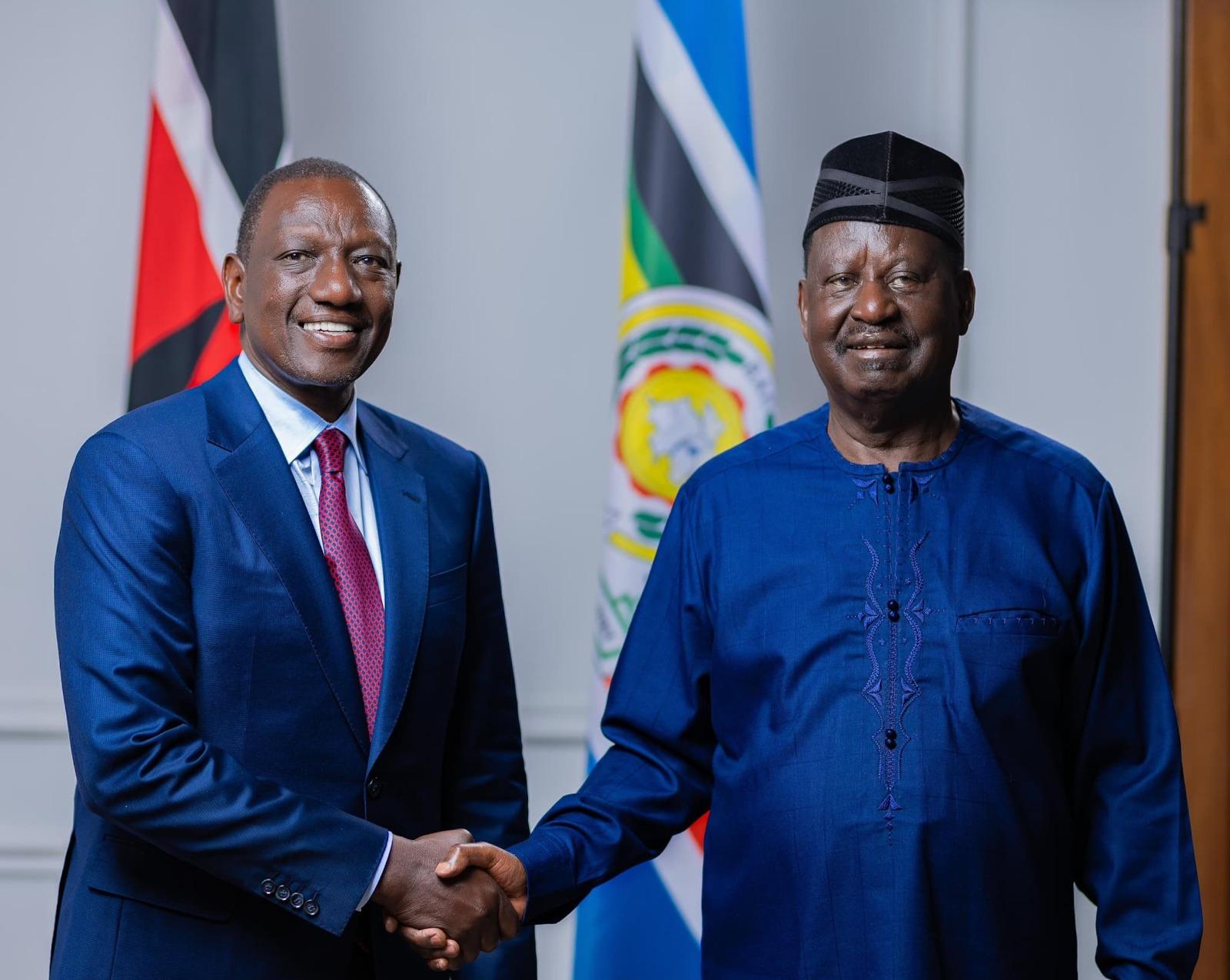
The committee overseeing the implementation of the 10-point agreement between President William Ruto and the late ODM leader Raila Odinga has awarded the broad-based government an implementation score of more than 85 per cent one year after the deal was struck, clearing the way for formal coalition talks ahead of the 2027 General Election.
The score, contained in a draft report to be presented to President Ruto and new ODM leader Oburu Oginga on Saturday, the first anniversary of the March 7, 2025, Memorandum of Understanding signed at the Kenyatta International Convention Centre, is expected to accelerate the politically fraught process of cementing the UDA-ODM alliance ahead of the next polls.
Javas Bigambo, vice-chairperson of the Committee on the Oversight of the Implementation of the Ten-Point Agenda and the NADCO Report, known as COIN-10, told reporters that the panel had completed extensive audits and stakeholder consultations to arrive at the figure.
“I can authoritatively say that after extensive engagements, audit and consultations with implementing agencies, the lay of the land and panoramic view of the 10-point agenda’s implementation reveals that the status of implementation is 85 per cent or more.”
Bigambo said the milestone was significant not only as a measure of delivery but as a political lever. “The more than 85 per cent implementation status of the ten-point agenda is a door opener for confident coalition negotiations and will easily accelerate the process,” he said. “This implementation will dampen the spirit of naysayers and the opposition.”
The five-member COIN-10 team, chaired by former Nominated Senator and political scientist Dr Agnes Zani, was constituted in August 2025 jointly by Ruto and the late Raila Odinga shortly before Odinga’s death.
The panel was mandated to submit bi-monthly reports to the two principals and a final comprehensive public report on March 7, 2026, coinciding exactly with the MoU’s one-year anniversary. Members of the committee include Fatuma Ibrahim, Kevin Kiarie, Gabriel Oguda and Bigambo, with its operations funded entirely by UDA and ODM rather than the national Treasury.

ANATOMY OF THE DEAL
The MoU emerged from a period of acute national tension. Youth-led protests in 2024, building on Azimio la Umoja demonstrations the previous year, had shaken the Ruto administration and exposed deep fissures over the cost of living, tax policy and governance credibility. The agreement, co-anchored in the recommendations of the National Dialogue Committee, NADCO, which was co-chaired by National Assembly Majority Leader Kimani Ichung’wah and Wiper leader Stephen Kalonzo Musyoka, outlined ten reform areas covering governance, economic inclusion, electoral credibility and institutional accountability.
Among the most tangible outcomes cited in the draft report is the reconstitution of the Independent Electoral and Boundaries Commission. Parliament passed the IEBC Amendment Act, 2024, which overhauled the commission’s appointment process. A new set of commissioners was sworn in last July, and the reconstituted IEBC has since supervised by-elections and is now preparing for mass voter registration ahead of 2027. The Conflict of Interest Act, 2025, has also been signed into law, and the Social Health Authority has been rolled out to expand healthcare coverage under the SHA scheme that replaced the National Hospital Insurance Fund.
Bigambo had previously placed the implementation score at 55 per cent in November last year before rising it again to 60 per cent in February. The latest figure of over 85 per cent, he said, reflects the accelerated pace of implementation driven by the March 7 deadline pressure. He had earlier cited milestones including passage and operationalisation of the IEBC legislation, stabilisation of production costs and commodity prices, assent to the Persons with Disabilities Act, 2025, roll-out of youth empowerment programmes including NYOTA and Climate WorX, and progress on national debt restructuring.
The draft report, however, acknowledges that challenges persist. The two-thirds gender rule, enshrined in the 2010 Constitution for more than a decade but never fully enforced in Parliament, remains unimplemented. Police independence from the executive remains a concern, and the committee flags what it describes as unconstitutional legislative attempts including the National Government Constituency Development Fund Act. Compensation for victims of the 2023 and 2024 protest killings has also stalled after a court order temporarily halted the process, with ODM’s Central Management Committee in January resolving to channel payments through the Kenya National Commission on Human Rights instead.
COALITION COUNTDOWN
The report comes as the two parties move toward formalising their 2027 electoral arrangement. ODM’s Central Management Committee, chaired by Oburu Oginga, gave the party leader a mandate in January to begin coalition talks with UDA. Oginga himself has insisted that full implementation of the MoU must precede any electoral deal. “We are in the broad-based government where we have the ten-point agenda, which we want to see implemented fully before the 2027 elections,” he told journalists this week. ODM Chairperson Gladys Wanga went further, rejecting the notion of a deadline altogether. “The ten-point agenda is moving this nation forward the way it was discussed. It cannot have an end date,” she said.
A joint UDA-ODM parliamentary group meeting scheduled for Tuesday is expected to review progress on the MoU. The gathering is regarded internally as a staging ground for the formal coalition announcement, with UDA Secretary General Hassan Omar having previously declared that the broad-based government model was “what Kenyans want.”
THE DISSENTERS
Not everyone is prepared to accept the committee’s scorecard at face value. Embattled ODM Secretary-General Edwin Sifuna, who is locked in a bitter power struggle with the Oburu Oginga-led party hierarchy, has been the sharpest internal critic of the deal. In February, Sifuna accused COIN-10 of producing “absolutely zero” meaningful work in six months and gave it a 30-day ultimatum to publish a final report. He has demanded concrete delivery, not prolonged consultations. “On Saturday, we are expecting a framework of implementation, not stories,” he said on Friday.

Sifuna’s ally, Siaya Governor James Orengo, was equally pointed. Orengo said his Linda Mwananchi group, which draws from ODM’s reform wing and allied stakeholders, had conducted its own independent assessment of MoU delivery and would present it at a rival rally at Jacaranda Grounds in Nairobi on Sunday. “We are having a meeting of chairmen of ODM across the country to look at and review the MoU and come up with a document,” Orengo said. ODM Co-Deputy Party Leader Godfrey Osotsi went further, accusing the Kenya Kwanza administration of orchestrating a deliberate cover-up of non-delivery. “The propaganda depicts Kenya Kwanza to be satisfactorily implementing the 10-point agenda reform package,” Osotsi said. “Repetitive falsehoods are designed to dissuade citizens not to read the March 7, 2025, MoU.”
Political commentator Tony Gachoka was more blunt. “The MoU signed between President Ruto and Raila Odinga was just a political gimmick devised to deceive the ODM electorate into accepting a political partnership. In my opinion, the ten-point agenda is buried in Bondo with Raila,” he said.
Kalonzo Musyoka, who co-chaired NADCO, joined the chorus of sceptics in late February. “Now we are almost in March, and the 10-point agenda signed by Raila and Ruto, nothing has happened,” the Wiper leader told congregants at a Sunday service in Utawala, Nairobi. He said he had it on the authority of Sifuna that items drawn directly from the NADCO report remained unaddressed.
ZANI’S DEFENCE
Dr Zani, in a television interview in February, defended the committee’s pace and scope of work. “We have already engaged stakeholders, some in person and others through submitted memoranda. All this is being processed,” she said. She noted that the committee had been conducting public participation forums across the country, including in county governments, civil society and religious institutions, as well as at national level. The panel had also briefed the Head of Public Service, Felix Koskei, at his Harambee House office to align ministries and state departments with the reform agenda. Zani said the committee was on track to deliver its mandate and cautioned politicians against misrepresenting its work. Bigambo echoed her, warning that the political class remained a structural threat to reform. “The political class remains a threat to full implementation because of selfish interests,” he said.
President Ruto received the committee at State House on January 21, reaffirming his personal commitment to the agenda and pledging full government support. “This process is designed to unite Kenyans through inclusive national dialogue and restore trust in public institutions by fostering transparency and accountability,” the President said. “It will translate consensus into practical reforms that strengthen democracy, improve daily life, and create opportunities for all.”
Whether a score of 85 per cent is enough to satisfy a divided ODM, a sceptical civil society and a Kenyan public that lived through the protests which necessitated the MoU in the first place, will be tested in the days ahead. The rally at Jacaranda on Sunday may offer a sharper verdict than any committee report.


Comments