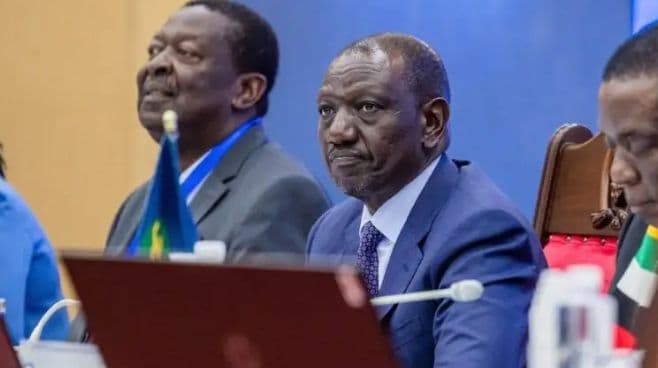
Kenya has responded to threats issued by Sudan’s military junta, which warned of “unknown consequences” for allowing the Rapid Support Forces (RSF) to hold a convention in Nairobi.
In a diplomatically nuanced statement issued on Wednesday, Kenya clarified its role in the Sudan peace talks, emphasizing its history of conflict mediation and reaffirming its commitment to providing a neutral platform for all parties involved.
Prime Cabinet Secretary Musalia Mudavadi stated that Kenya remains dedicated to collaborating with regional bodies, including the African Union (AU) and the Intergovernmental Authority on Development (IGAD), to support Sudanese-led efforts toward stability.
“Kenya has a long history of providing platforms for peace negotiations without taking sides,” said Mudavadi. “We strongly believe the crisis in Sudan can only be resolved through dialogue, not military force.”
Kenya also reaffirmed its alignment with the AU Charter on the Unconstitutional Change of Government, supporting the AU’s October 2021 decision to suspend Sudan from its activities.
The government highlighted that Sudanese groups have previously sought solutions through regional partners, including a January 2024 meeting in a neighboring country where stakeholders discussed the return to civilian rule.
Mudavadi noted that the recent presentation of a roadmap by the RSF and Sudanese civilian groups in Nairobi aligns with Kenya’s role in facilitating dialogue.
“We continue to offer a non-partisan space for conflicting parties to find common ground,” Mudavadi said. “Kenya stands in solidarity with the Sudanese people as they determine their future governance through inclusive discussions.”
He urged all stakeholders to engage in constructive dialogue to safeguard Sudan’s security and regional stability, adding that Kenya remains ready, both individually and through regional mechanisms, to support any agreed-upon efforts to restore peace.
Sudan’s Accusations Against Kenya
On Wednesday, February 19, Sudan condemned Kenya for allowing opposition forces to gather at the Kenyatta International Convention Centre (KICC) in Nairobi to discuss forming a parallel government. This came hours after RSF deputy leader Major General Abdul Rahim Hamdan Dagalo postponed plans to establish a “peace government” until Friday.
In a strongly worded statement, Sudan’s Ministry of Foreign Affairs accused Kenya of dishonoring agreements and supporting the RSF’s alleged war crimes and human rights violations.
“Hosting leaders of the terrorist RSF militia and allowing them to conduct political and propaganda activities—while they continue to perpetrate genocide, massacre civilians on an ethnic basis, attack IDP camps, and commit acts of rape—constitutes an endorsement of and complicity in these heinous crimes,” the ministry said.

Burhan
The Sudanese government further accused Kenya of violating regional diplomatic principles and breaching pledges made at the highest levels to prevent hostile activities against Sudan on Kenyan soil.
“This act by the Kenyan government is not only a violation of good neighborliness but also amounts to hostility against the Sudanese people,” the ministry added.
Sudan also accused Kenya of undermining African state sovereignty and interfering in its internal affairs. It urged the international community to condemn Kenya’s actions and vowed to take necessary measures to “redress the balance.”
RSF Meeting in Nairobi
On Wednesday, RSF supporters gathered at the KICC in Nairobi, singing, dancing, and chanting slogans in praise of their leaders. RSF leader Mohamed Dagalo, also known as “Hemedti,” was absent, but his brother and deputy attended. The meeting, intended to establish a parallel government, was postponed to Friday for the second time.
This development comes weeks after Sudanese Foreign Minister Ali al-Sadiq visited Kenya in January, claiming that Nairobi had revised its stance on the Sudan conflict.
“Nairobi has reconsidered its position towards Sudan based on new developments in the war. The idea of the RSF taking power in the country is over,” al-Sadiq said at the time.
Strained Diplomatic Ties
Since Sudan’s 2021 coup, diplomatic relations between the two East African nations have been tense. In 2023, Sudan’s military leader, General Abdel Fattah al-Burhan, rejected the nomination of Kenyan President William Ruto as a peace mediator, instead favoring South Sudan’s President Salva Kiir. Burhan has accused Nairobi of sympathizing with the RSF.






Comments