
Economy
KRA Crackdown On Taxpayers Who Filed Nil Returns But Have Income
From April 2026, the authority will apply automated checks to nil filings for 2025 to prevent false zero declarations.

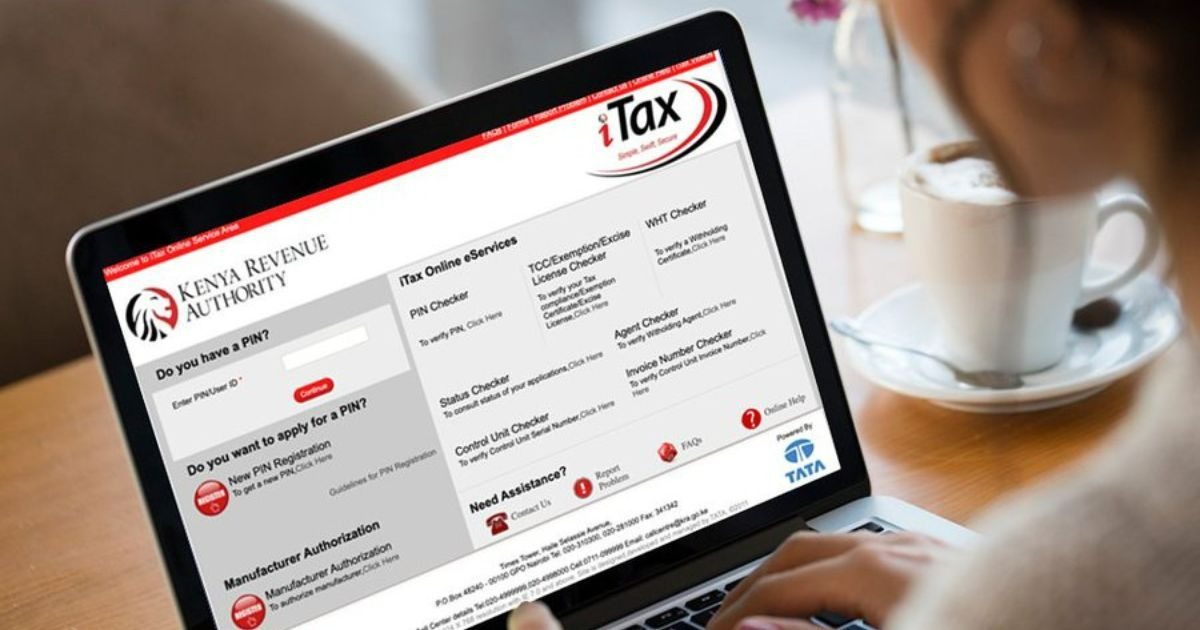
The Kenya Revenue Authority (KRA) has stepped up its scrutiny of taxpayers who filed nil income tax returns but appear to have earned income.
The authority has began sending SMS messages to individuals and companies, informing them that its systems detected income linked to their PINs. The messages notify recipients that their 2025 income tax returns have already been prepopulated on the iTax portal and are ready for review and submission.
Reports show that KRA flagged more than 392,000 taxpayers in this category. Internal reviews identified 392,162 companies and individuals who declared zero income in 2024 despite records showing financial activity. In many cases, the activity appeared through withholding tax records or transactions transmitted through the Electronic Tax Invoice Management System (eTIMS).
The SMS sent to affected taxpayers reads:
“Records indicate that while you filed a Nil Income Tax Return for 2024, you earned income in 2025 as evidenced by your eTIMS transmissions. Consequently, your pre-populated 2025 Income Tax Return is ready for filing. Please log in to iTax to file your return and pay any tax due.”
The message directs taxpayers to log into their iTax accounts to review the prefilled information. The system pulls data from eTIMS invoices, withholding tax records and customs imports. If the records show income that was not declared previously, KRA expects the taxpayer to account for it and settle any outstanding tax.
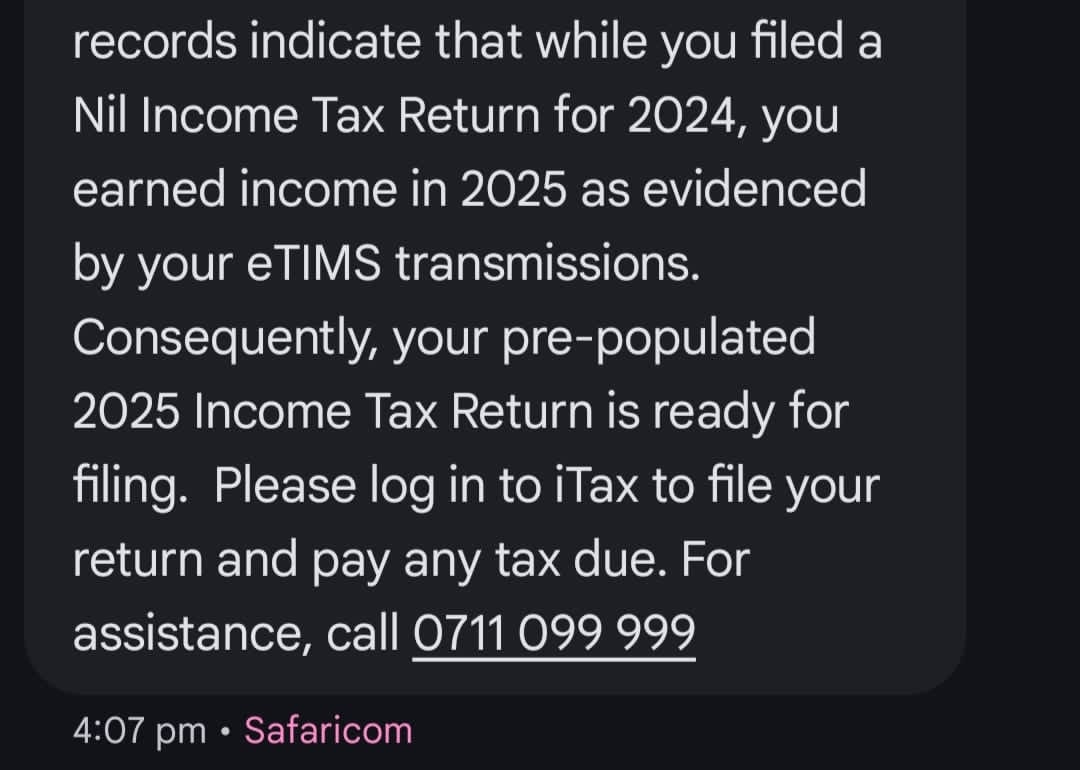
Part of the SMS sent by KRA notifying taxpayers. Screenshot
This enforcement drive forms part of wider reforms aimed at tightening compliance. On November 10, 2025, KRA issued a public notice outlining new validation rules. The notice stated:
“Effective 1st January 2026, it will begin validating income and expenses declared in both individual and non-individual income tax returns against the following data sources: 1) TIMS/eTIMS 2) Withholding Income Tax gross 3) Import records from Customs.”
Real-time checks introduced
Under this approach, validation takes place at the point of filing. When a taxpayer submits a 2025 return, the system checks declared income and expenses against the available electronic records. All income and deductible expenses must be supported by valid eTIMS invoices transmitted correctly, including the buyer’s PIN where required.
KRA has made clear that it will compare declared figures with data in its systems and rely on the higher verified amount when assessing undeclared income. Expenses that lack matching eTIMS documentation face automatic disallowance unless they fall under recognised exemptions.
Some exemptions exist under Section 23A of the Tax Procedures Act and the 2024 Electronic Tax Invoice Regulations. These cover items such as salaries, imports, interest income, investment allowances, airline tickets and income subject to final withholding tax. Outside these areas, taxpayers must ensure that invoices and records match what they declare.
The crackdown affects a broad range of taxpayers. Salaried employees who run side businesses must declare all income in a single return. This includes earnings from freelance work, consultancy, online services, farming or rental property. They must use their P9 forms for employment income and add any additional sources.
Sole proprietors, professionals, Turnover Tax payers, landlords and partnerships also fall within the scope of the new checks. Non-employed individuals must declare income outside the Turnover Tax regime where applicable.
KRA recently reinstated the option to file nil returns after upgrading its systems, but it has introduced stricter screening. From April 2026, the authority will apply automated checks to nil filings for 2025 to prevent false zero declarations.
Previously, taxpayers could file returns first and address discrepancies during audits later. The new system validates information immediately, leaving limited room for corrections after submission.
Kenya Insights allows guest blogging, if you want to be published on Kenya’s most authoritative and accurate blog, have an expose, news TIPS, story angles, human interest stories, drop us an email on [email protected] or via Telegram




Why All Eyes Are On Gambling Authority CEO Peter Karimi As Kenya’s Betting Firms Race To Beat The June Licence Renewal Deadline

The Deal Behind Nairobi Animal Orphanage: Is This Really About Animals Or Billions In Prime Park Land

The Great Mogo Extraction: How a Latvian Fintech Built a Debt Trap for Kenya’s Most Vulnerable Borrowers and Got Away With It

Iran Launches Missiles At Israel For First Time Since Mideast Truce

MozzartBet Faces Licence Cancellation For Operations in Kenya Amid Tax Evasion, Money Laundering Scandals As Rumours Swirl Of Sh100M Bribery To Evade Trap

Rogue Developers, Engineers, Architects and City Hall Officials Charged Over Deadly Manzil Towers Collapse

Kalonzo Unveils His 2027 Presidential Campaign Platform

Artur Margaryan of Kenya’s Infamous Artur Brothers Seeks Prime Minister’s Office in Armenia

Sonko Re-Elected Head of Party

US Denied Visas to Team Officials for World Cup – Iran

Cement, Cash and Courts: How the Hashu Dynasty Crushed the Ramji Brothers for Fourteen Years and Why the Walls Are Now Closing In

Why Ruto’s Favourite Candidate Adan Mohammed Could Be Locked Out of the KRA Top Job

Inside The Urban Planning Cartel That Owns Nairobi

LifeCare on the Brink: SHA Fraud, Stolen Wages, and the Rotten Empire Jayesh Saini Built

Este Medical Kenya Fights American’s Explosive Complaints

Safaricom’s Sh1.4 Billion Reckoning: How Kenya’s Most Profitable Company Stole a Man’s Idea and Got Caught

The Rot Inside Absa: How Bank Insiders Are Looting Nairobi’s Customers

Inside FAFSA Fraud: How Kenyan Cybercriminals Siphoned Millions from America’s Sh12 Billion Student Loan System

THE INSURER THAT TOOK YOUR PREMIUM AND FORGOT YOUR NAME: How ICEA Lion Left a Client Begging for Sh7.8 Million Across Four Months

Denial Under Duress: The Untold Collapse Threatening David Lagat’s DL Group’s Empire
-
 Investigations3 days ago
Cement, Cash and Courts: How the Hashu Dynasty Crushed the Ramji Brothers for Fourteen Years and Why the Walls Are Now Closing In
-
 Investigations2 days ago
Inside The Urban Planning Cartel That Owns Nairobi
-
 Investigations2 weeks ago
LifeCare on the Brink: SHA Fraud, Stolen Wages, and the Rotten Empire Jayesh Saini Built
-
 News2 weeks ago
Este Medical Kenya Fights American’s Explosive Complaints
-
 Americas2 weeks ago
Inside FAFSA Fraud: How Kenyan Cybercriminals Siphoned Millions from America’s Sh12 Billion Student Loan System
-

 Investigations7 days ago
Betika Faces DCI Probe, Directors Arrest and License Revocation Over Massive 29.5 Million Safaricom Customers’ Data Breach
-

 News1 week ago
Eight Students Arrested In Kenya After Suspected Deadly School Arson Attack
-

 Investigations3 days ago
Fresh Move Launched to Remove Kenya Railways MD Mainga From Office After Awarding Sh817 Million Consultancy Contract