
Politics
President Ruto and Uhuru Reportedly Gets In A Heated Argument In A Closed-Door Meeting With Ethiopian PM Abiy Ahmed
He confronted Uhuru with what he described as evidence of subversion against his Kenya Kwanza administration, presenting a case that his government’s difficulties, from the Gen Z revolts of 2024 to the resurgence of the opposition Azimio coalition, bore the fingerprints of his predecessor’s scheming.

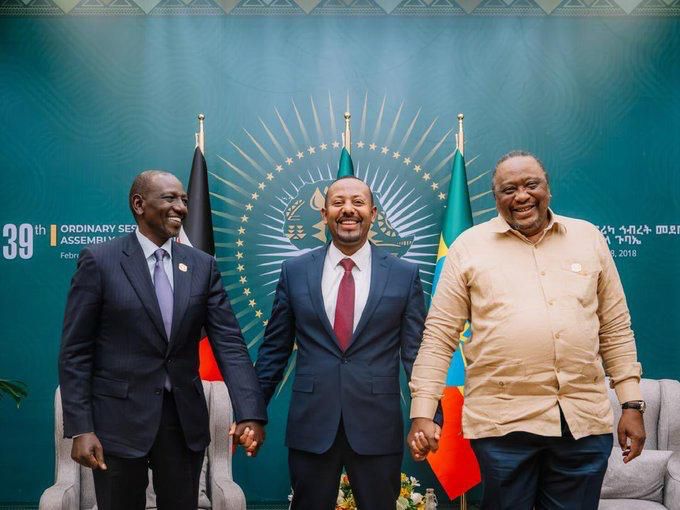
Kenya’s most explosive political feud tore through the gilded corridors of the African Union in Addis Ababa last Sunday in a dramatic confrontation that has rattled regional diplomats and sent shockwaves through the continent’s fragile peace architecture.
President William Ruto and his predecessor Uhuru Kenyatta locked horns in a tense, behind-closed-doors meeting hosted by Ethiopian Prime Minister Abiy Ahmed on the sidelines of the 39th AU Summit, with multiple aides and participants telling the media that the session degenerated into an electric exchange of accusations and counter-accusations that left the room stunned.
The fiery encounter was no accident of scheduling.
It was a carefully engineered intervention, sanctioned by Great Lakes presidents, specifically designed to force the two men into the same room and thaw their deep freeze of a relationship that, sources say, has directly sabotaged Kenya’s coveted role as mediator in the Democratic Republic of Congo’s catastrophic eastern conflict.
And it failed spectacularly.
The drama began, deceptively enough, with a photograph.
A group image showing PM Abiy Ahmed sandwiched between the two Kenyan leaders went viral almost the moment it was posted online, dissected frame by frame by an eager Kenyan public hungry for any signal of reconciliation between the country’s fourth and fifth presidents.
The image was shared by Uhuru’s camp after all parties had agreed to await Ahmed’s nod. But Ruto’s official handles never shared the photo at all. That single, glaring omission spoke louder than any statement either side would later issue.
Inside the room, it was anything but cordial.
“Aides recount a room electric with grievance,” a source close to the talks told the media. Ruto, who has long simmered over what his camp views as deliberate political sabotage by his predecessor, came to Addis prepared.
He confronted Uhuru with what he described as evidence of subversion against his Kenya Kwanza administration, presenting a case that his government’s difficulties, from the Gen Z revolts of 2024 to the resurgence of the opposition Azimio coalition, bore the fingerprints of his predecessor’s scheming.
Uhuru, characteristically composed but reportedly sharp in his rebuttal, denied it all.
He told the gathering he had not been undermining the Kenya Kwanza administration. But he did not pull his punches either, firing back that the government had failed to accord him the dignity and protocol owed to a former head of state.
Party leadership, he reportedly argued, cannot be equated to treason. Democratic participation cannot be dressed up as subversion.
THE DRC CRISIS NOBODY IS TALKING ABOUT
Beneath the personal drama lay a far more alarming reality: Kenya’s internal feud had, in the blunt assessment of an AU secretariat investigation, been actively strangling peace efforts in the eastern DRC.
Uhuru serves as a linchpin on the AU-EAC-SADC facilitation panel tasked with mediating in the restive provinces of Ituri, North Kivu, and South Kivu, regions where M23 rebels and their backers have unleashed a humanitarian catastrophe on millions of Congolese civilians.
His role demands seamless communication with President Ruto’s government, passing on progress reports and flagging obstacles to AU headquarters.
Instead, the two camps have given each other cold shoulders so frosty that the diplomatic pipeline has effectively seized up.
AU presidents, alarmed at the glacial pace of progress in the DRC talks, commissioned an internal investigation.
Its conclusion was damning: the personal animosity between Kenya’s fourth and fifth presidents was the single biggest structural impediment to regional peace.
That finding is what dragged both men into a room with Abiy Ahmed, a leader who has cultivated personal rapport with both through years of shared Horn of Africa diplomacy and bilateral ties.
His pitch, sources say, was blunt: reconcile or watch DRC’s chaos swallow Kenya’s carefully built mediator reputation along with it.
The pitch did not land as planned.
THE BETRAYAL THAT REFUSES TO DIE
To understand why the room crackled with such barely suppressed rage, you have to understand a decade’s worth of broken promises.
Ruto served as Uhuru’s deputy for a full ten years, from 2013 to 2022, under the TNA-URP alliance and later the Jubilee Party banner.
Their partnership was sealed with what insiders describe as a solemn political covenant: Uhuru would serve two terms, then hand the baton to Ruto.
The now-infamous pledge, delivered in Kikuyu by Uhuru, was: “Mimi nitafanya zangu kumi, kisha kumi za William.” I will do my ten years, then hand over to William to do his ten.
Instead, Uhuru shook hands with Raila Odinga, threw the full weight of state machinery behind the opposition, and watched Ruto’s allies face raids, prosecutions, and frozen funding. Ruto won anyway in 2022, but the wounds have festered ever since.
Uhuru, far from retreating into the quiet golf courses of retirement, has weaponised his post-presidency. He has openly endorsed Wiper boss Kalonzo Musyoka and former Interior CS Fred Matiangi, both seen as serious presidential contenders for 2027. His Jubilee Party has been revived and restructured. Kalonzo has been installed as Azimio coalition party leader. Ruto’s camp views all of it as a coordinated political insurgency designed to end his presidency after one term.
The Addis meeting erupted just three weeks after Ruto hosted Uhuru’s younger brother Muhoho Kenyatta at State House in Nairobi, in what was seen as another backchannel reconciliation attempt. Muhoho, who publicly attended in his capacity as the International Council representative of the Duke of Edinburgh Award, is widely regarded as the family’s quiet power broker. The attempt, clearly, did not produce the desired effect.
Ruto told Ahmed in the meeting that he had done everything within his power to accommodate his predecessor in retirement. He cited his now-famous December 2024 visit to Ichaweri, Uhuru’s rural home in Gatundu South, where he arrived bearing 12 goats, a deeply symbolic gesture among the Kikuyu people. The visit was hailed as the most potent signal yet that the two men had buried the hatchet. Within weeks, Uhuru was at a Jubilee Party meeting openly attacking Ruto’s government, accusing it of erasing the gains of his own decade in power.
“Today, many of the past’s gains have been eroded,” Uhuru told the gathering that installed Matiangi as Jubilee’s new kingpin.
Twelve goats, it turned out, were not enough.
Neither side was willing to confirm the explosive details of what transpired in Addis, though neither could fully deny that the meeting happened.
State House spokesman Munyori Buku was carefully evasive, telling reporters: “I am not aware there was a mediation meeting. I know President Ruto and former President Uhuru Kenyatta met together with PM Abiy. I have no details of what transpired because it was a closed meeting.”
Uhuru’s spokesperson Kanze Dena was more colourful in her dismissal. “Aiii surely!! Wasisalimiane? Inakuwa analysis!! Acheni hizo,” she fired off, suggesting the entire controversy was a case of reading too much into two men saying hello.
Politicians from Uhuru’s orbit were less diplomatic.
Embakasi North MP James Gakuya, speaking to Kameme TV on Wednesday, said plainly that the retired president is not going anywhere near the government’s corner. “Uhuru has indicated that he is in the opposition, and this is a way of Ruto’s divide-and-rule tactic,” Gakuya said, adding that no amount of wooing would pull Uhuru out of the united opposition camp ahead of 2027.
The stakes of this feud extend far beyond the bruised egos of two men who once ruled Kenya together.
The DRC’s eastern provinces remain a theatre of catastrophe, with the M23 rebellion, backed by external actors, having seized territory and displaced millions. Kenya’s role as a neutral mediator, which Nairobi has carefully cultivated since the 1990s, is the product of decades of diplomatic investment.
The EAC regional force that Kenya led into eastern DRC last year, and the Nairobi Process which Uhuru champions on the AU panel, are the twin pillars of that investment. Without coordination between the two Kenyan poles, that edifice is cracking.
The CSIS, in a detailed September 2025 report on Kenya-DRC relations, noted that domestic political dynamics in Kenya, specifically the conflict between Ruto and Uhuru, had directly impacted the DRC peace process from the very beginning, with the two camps not talking to each other even as Kenyan troops served in the region.
For Ruto, the personal calculus is no less urgent.
He heads into 2027 battered by the Gen Z uprisings of 2024, a stubborn economic crisis, a rebellion from former deputy Rigathi Gachagua in the Mt Kenya heartland, and now a resurgent opposition coalition that his predecessor appears to be personally bankrolling.
A unified opposition in 2027 could prove devastating for a sitting president who squeaked to victory in 2022 with 50.49 percent of the vote.
For Uhuru, the calculus is simpler: stay relevant, wield influence, and deny Ruto the coronation he believes was stolen from their pact.
PM Abiy Ahmed, who facilitated what was meant to be a quiet rapprochement, leaves Addis with a failed mediation on his hands and two Kenyan leaders whose cold war now risks becoming a continental liability.
One senior diplomat, briefed on the encounter and speaking strictly on condition of anonymity, put it most bleakly: “Africa cannot afford to have its most experienced mediating nation paralysed by a personal feud. The DRC is bleeding. Kenya is squabbling.”
As things stand, the squabble shows no sign of ending.
Kenya Insights allows guest blogging, if you want to be published on Kenya’s most authoritative and accurate blog, have an expose, news TIPS, story angles, human interest stories, drop us an email on [email protected] or via Telegram











Bolt Denies Viral Exit Claims, Says Kenya Operations Remain Fully Active

Secret Trident Meetings, Claims of Millions Exchanged: Fresh Questions Raised Over PCF Boss Mohammed Sahal’s Role in Insurance Battle

The Kamukunji Cash Pit: Ghost School, Phantom Audit Trails and NG-CDF Manager Who Refuses to Leave

Lawyer in Sh65 Million Fake Gold Scandal Dragged to Court as Investigators Uncover Web of Suspicious Deals

THE GREAT HOLLOWING: How James Mworia Extracted KES 750 Million While 33,000 Centum Shareholders Lost Everything

Port Tycoon Samuel Kairu Dragged Into Sh500 Million Mombasa Port Tax Scam

Couple Charged With Sh13.8 Million Forex Fraud

UK Wins Court Case Over Collapsed Rwanda Asylum Deal

Gachagua Attacks Ruto for Holding Madaraka Day Celebrations at Newly Built Wajir Stadium, Says Residents Have More Pressing Unmet Needs

Bought Popularity? Malindi NG-CDF Officer Nelson Alfayo Faces Fresh Claims of Poll Manipulation Amid Mounting Corruption Allegations

Why Ruto’s Favourite Candidate Adan Mohammed Could Be Locked Out of the KRA Top Job

Este Medical Kenya Fights American’s Explosive Complaints

Safaricom’s Sh1.4 Billion Reckoning: How Kenya’s Most Profitable Company Stole a Man’s Idea and Got Caught

LifeCare on the Brink: SHA Fraud, Stolen Wages, and the Rotten Empire Jayesh Saini Built

The Rot Inside Absa: How Bank Insiders Are Looting Nairobi’s Customers

The $24 Million Heist at the End of the World

Denial Under Duress: The Untold Collapse Threatening David Lagat’s DL Group’s Empire

THE INSURER THAT TOOK YOUR PREMIUM AND FORGOT YOUR NAME: How ICEA Lion Left a Client Begging for Sh7.8 Million Across Four Months

Court Confirms Safaricom Customers Data Was Sold To Betting Companies In Seven-Year Cover-Up

Eight Students Arrested In Kenya After Suspected Deadly School Arson Attack
-
 News1 week ago
Este Medical Kenya Fights American’s Explosive Complaints
-
 Investigations7 days ago
LifeCare on the Brink: SHA Fraud, Stolen Wages, and the Rotten Empire Jayesh Saini Built
-
 News4 days ago
Eight Students Arrested In Kenya After Suspected Deadly School Arson Attack
-
 Americas1 week ago
Inside FAFSA Fraud: How Kenyan Cybercriminals Siphoned Millions from America’s Sh12 Billion Student Loan System
-

 Business2 weeks ago
Blocked: How Mombasa Tycoon Ashok Doshi Has Stopped Imperial Bank Depositors From Getting Their Money
-
 Investigations1 week ago
LSK On The Spot For Renewing Rogue Lawyer Dennis Onyango’s Licence Despite Mounting Evidence He Held Foreign Investors’ Millions Hostage
-

 Investigations1 week ago
Your Medical Records Were Wide Open: How Three Digital Lenders Hacked the Heart of Kenya’s Health System and the DHA Chief Who Looked Away
-

 Investigations6 days ago
The Invisible Hand: Al Jazeera Further Exposes How Safaricom Became The Regime’s Most Powerful Spy